Coolest random tidbit from a random book of the week

From Arika Okrent’s In the Land of Invented Languages: of the 500 invented languages that Okrent profiles, the two most commonly spoken today are Esperanto and Klingon.

This is probably one of those things that everyone [in nerd land] already knew but me, but still. Wow, Trekkies. I was always a Star Wars girl, but color me impressed. (Also, this makes me wonder how the number of Klingon speakers compares to the number of people who would declare Jedi as their religion.)

We don’t sparkle…

…but we do hunger immortally. And if we could stalk books and watch them sleep, we probably would. Below, find some of our most yearned-after books, over which sighs have been heaved and wallets have been fingered.

Emera’s delicious unattainables

  • Neil Gaiman’s Neverwhere. Signed, limited, $200 (HarperCollins, 2009) – The first Neil Gaiman novel I read, and still one of my most beloved. “Deluxe Limited Numbered Edition, signed by Neil Gaiman, with a full cloth jacket in a fabric-bound slipcase. Includes two-color text and endpapers, and two full-color illustrated spreads. Limited to one of 1000. ” According to the man himself, it is also “several thousand words longer than the current US edition” and “has a bunch of odd, previously stuff in the back — my original outline for the BBC series and such.” Aiiiieee.
  • Ray Bradbury’s The Martian Chronicles: The Complete Edition.  Signed, limited & lettered editions currently on preorder, $300/$900 (Subterranean Press, 2009). Over 50 stories, essays, introductions, two full-length screenplays, full-color plates, “deluxe binding” on the lettered edition… excuse me while I expire in this corner. Subterranean Press: elevating book-shopping to a whole new level of debauchery.
  • Peter S. Beagle’s The Last Unicorn: The Lost Version. Signed, limited, out of print (Subterranean Press, 2007) – Beagle’s original, abandoned draft of his classic novel, featuring a modern setting and a completely different cast, apart from the unicorn herself. I always knew I would regret not buying this the instant it came out, which was at about the same time that I became aware of small press. This was also before I had multiple jobs and thus disposable income. Curses! It’s been unavailable on every book site that I watch, oh, pretty much ever since then, but I have put out watches for it on both Amazon and AbeBooks (which has a book-watching tool far superior to Amazon’s – Amazon’s commits you to buying the item if it ever becomes available, without your being able to review the condition and price first). It will be mine, someday.

On the other hand… stuff that’s significantly more attainable and will in fact be coming home at one point or another:

  • Kage Baker’s The Women of Nell Gwynne’s, a steampunk mystery novella about exclusive prostitutes who also happen to be the intelligencers of a secret organization. One reviewer described it as “James Bond in the 19th century.”  Could this sound any more AWESOME? Also, Kage Baker has a really cool name.
  • Caitlin Kiernan’s Alabaster, a dark fantasy short story & novella collection about an adolescent, albino, monster-killing girl named Dancy.  Again, sounds awesome, I love the cover art, and Caitlin Kiernan is one of those authors whom people keep telling me I’d like.
  • Peter S. Beagle’s Mirror Kingdoms. A “best of” short story collection. I preordered this in large part because I was smarting at not being able to find TLU: The Lost Version, and because I was resolved not to repeat the incident. Also, preordering of either the trade or limited editions is currently discounted – I got the normally $60 limited for $48, and Subterranean preorders give you free shipping. Win-win.
  • Finally, fellow bibliophile/blogger Vega, of The Athenaeum, was kind enough to obtain a signed copy of The Unicorn Sonata from Peter S. Beagle himself at San Diego Comic-Con for me. A thousand thanks!!

——–

Kakaner’s Objects of Desire

  • Ender’s Game, by Orson Scott Card. First edition. $1000. ‘Nuff Said.
  • The Time Traveler’s Wife, by Audrey Niffeneger. First edition, signed, $225. I’m a bit torn about this possible purchase… the only copy I can find is a bit worn and stained. However, to still my grabby hands, I have pre-ordered this. I can’t wait for October 1st!
  • Starship Troopers, by Robert A. Heinlein.  First Edition ~$5000. These books are the reason why I feel it is important to make money… have an income in general. Of course, with a name like Heinlein, one should totally expect to spend at least this much money. At least there’s hope! There seem to be a couple copies floating around, although I would totally hold out for a signed edition.
  • Jonathan Strange and Mr. Norrell, by Susanna Clarke. 1st edition, 8th printing, signed. This will probably be pretty high on my list, despite the fact that I already own four… other… editions…

What I Currently Have…

  • The Scar, by China Mieville. Limited 1st Edition, signed, #407/1000. Gold-edging, ribbon marker, overall droolness.
  • Ender in Exile, by Orson Scott Card. Signed 1st Edition. I’d always wanted to see Card’s signature in real life… it’s powerful! Huge round, loopy OSC. What a treasure =)
  • The City & The City, by China Mieville. 1st Edition (well, technically I think), signed, and personalized at a China Mieville author event I attended! Incredibly treasured, and sits proudly next to The Scar.

Moving onto less well-known authors, but equally treasured in my library:

  • Kings and Assassins, by Lane Robins. 1st Edition signed! Personally shipped by the author– everyone should read Maledicte. I own two copies of Kings and Assassins and one copy of Maledicte.
  • Warm Bodies, by Isaac Marion.  1st Edition, self-published, one of 100+ copies, signed. I am of the strong opinion that Isaac Marion is going to experience great writing fame in the future. Although Warm Bodies isn’t necessarily my top choice when it comes to his works, his short stories (all available on his website) are delectable and must-reads.

——–

Anyone else out there hankering for oh-so-tantalizing books? Those teases.

“The most frightening American poet ever”

My knowledge of poets tends to be acquired in a desultory fashion, so I’d never heard of Frederick Seidel until I read “The Edge of Night,” an entertaining and well-written review of Seidel’s collected poems by  David Orr of the New York Times. Seidel is an anomaly as a professional poet, in that he’s rich and disconnected from the literary-academic world; apparently he’s also “one of poetry’s few truly scary characters.” This may seem nonsensical to you unless you’ve ever read a poem that made you wince, or cringe, or hunch your shoulders and shiver and try to forget you ever read it (and I don’t mean in a that-was-so-bad-I-wish-it-never-existed way, which of course happens too, and more frequently); then you should know how viscerally emotional and disturbing poems can be.

The excerpts of Seidel’s work featured in the review seem menacing, meaty (in both sense of the word), and evilly funny. I’ve read some pretty horrifying poems – I’m thinking of some of C. K. Williams’ early, angry poems here, one of which I would quote but am embarrassed to – and many cringe-inducing poems (mmm, Sharon Olds*), but I’m not sure I’d be consitutionally capable of reading a whole collection of Seidel’s work. The full poem featured in the review made me feel as though someone with too-cold hands had run their fingers through my hair the wrong way. Brrr. Orr also provides some useful, interesting commentary on Seidel’s place in modern American poetry, particularly his early relationship with Robert Lowell’s work and his later parallels with Sylvia Plath. Orr also comments on Seidel’s none-too-infrequent exclusion from anthologies – a fact that would also explain my lack of knowledge of him.

Also, I love articles that send me off on multiple fascinating tangents generally culminating in a trip to Wikipedia – in this case, Orr’s reference in the review to the perhaps apocryphal funeral tradition of sin-eating. Too cool.

*Sharon Olds is disarmingly adorable in person. If she ever reads near you, go. I didn’t like her poetry until I got to see her read it.

The City & The City, by China Mieville (2009) K

Date read: 6.03.09

Book from: Personal Collection

Reviewer: Kakaner

Summary

The City & The City is dark, brooding, and meticulous. It is the story of Inspector Tyador Borlu who investigates a mysterious and highly delicate murder case. “Highly delicate” for Borlu soon discovers that he must invoke Breach, a mysterious judicial force that governs disputes in the rare case that they involve a crossing of the cities, Ul Qoma and Beszel. However, help is not so easily found and Borlu must undertake this investigation himself. Using not-exactly-by-the-book methods, Borlu uncovers mysteries of the murdered girl, the very archaelogy of these two odd cities, and Breach.

Review

Mieville pulls the reader in with promises of the same great and dark fantastical adventures of his previous novels– we concoct a terrible conspiracy in our minds when first confronted with the murder, we imagine the city divide must have come about as a result of a great otherworldly battle, we provide ancient magical powers for each mention of a mysterious artifact… and although these theories are shattered one by one as the novel progresses, we still imagine the epic Big Reveal will, in fact, prove all our thoughts to be correct. Instead, The City & The City is cold and harsh, and there is never a magical solution. There is definitely a depressing, suffocating atmosphere that comes from knowing that every death, every misunderstanding, every unnecessarily gruesome fact of life is caused for humans, by humans.

I have to say I harbored this niggling disappointment each time a plot turn indicated that there was in fact no magic. I was naive– I should have paid closer attention to the genre titles “noir fiction” and “weird fiction”, but Mieville has always had a way with enchanting the story no matter what genre. I found the mentions of Myspace and Chuck Palanhiuk highly jarring, but undoubtedly genius. These references really made the reader think and realize he was reading about a country off somewhere in the Middle East that existed in the same world at the same time, that if he travelled far enough he would perchance bump into the city of Beszel. This effect was definitely unnerving and brought the story closer to home.

In many ways, I found Beszel and Ul Qoma to be the darkest of any of Mieville’s cities to date. Beszel and Ul Qoma encapsulate the grimness of today’s most rundown urban centers, without the usual gems of beauty that one can find in Mieville’s other works. While New Crobuzon was covered with filth, death, and corruption, the reader was still made to understand the powerful potential of inner beauty– Lin’s amazing (although admittedly grotesque) artwork, the majestic surrealism of The Weaver, the slowly nurtured romance between Bellis and Silas– and in the end, the Baslag books were just as much about the good as they were about the bad.  And of course, the London underground setting of King Rat also contained an edgy artistically musical appeal. I didn’t see any of this hope or light in these cities– whenever I uncovered more about a good person or a seemingly magical concept, there was simply only… dirt and muck underneath. Basically, I didn’t come away seeing promise dangling on the ends of story threads in the same way I did for other Mieville works. This, perhaps more than the downward spiral to nowhere, frightened me the most and in many ways, made the story as a whole less appealing.

This is not to say that The City & The City isn’t another great work of art created by China Mieville. I was so accustomed to floating along in the waves of Mieville’s greatly fantastical settings and characters, only to find myself rudely shoved into a hard and entirely unforgiving setting. I am under the opinion that this novel is extremely mislabeled as a fantasy work…there is an explanation and a science behind everything plot turn, and ultimately, my point is do NOT walk into The City & The City expecting fantasy. Although I have not read much detective noir fiction, I can confidently say The City & The City must be among the cream of the crop– as usual with Mieville, you can see the literary quality dripping off the edges of each page and feel the weight of a great imagination.

Go to:

China Mieville
The Graveyard Book, by Neil Gaiman (2008) K

Date read: 11.8.08

Book from: Personal Collection

Reviewer: Kakaner

Summary

Nobody Owens (Bod) lives in a graveyard, has ghosts for friends and family, and a mysterious neither-living-nor-dead guardian. As he grows up, he has to learn both the ways and secrets of the large graveyard as well as deal with the outside world. This foreign world is extremely dangerous place for Bod because the assassin of his family is still on the prowl. Throughout the journey of his childhood Bod basically learns about growing up– girls, beings which are neither living nor, and slowly, how to function in the outside world.

Review

Way to go Neil Gaiman! All those months of meticulously following the progress of The Graveyard Book on his blog certainly paid off– the day it was released, I headed over to my local bookstore, plucked one brand spanking new copy off the display, and settled into an armchair to read for the next couple hours. I read it all in one sitting, and in about a week, after procuring enough monetary funds, I immediately bought the book.

I have to say The Graveyard Book was spot on in so many respects– character development, pacing, storytelling… to name a few. Sure Bod lives in a graveyard, but his childhood frustrations and adventures  are so relatable. He has his own quarrels with his guardians, fighting against the constraints of the graveyard much like children do their own homes. The imagery is simply splendid, especially Bod’s adventures beneath the graveyard and all the different fantastical creatures. And, who doesn’t like ghosts, vampires, and other such creatures? I definitely felt transported into another world through that imaginary magic portal every child wants to travel through. Above all, I was definitely caught up in the snowball effect of the novel– you’re reading and the suspense and developments keep piling on until suddenly, you realize you haven’t been breathing for several pages. That is the feeling I’d been longing to experience again, that same thrill of reading Patricia Wrede or Brian Jacques or J.K. Rowling as a child with breathy light-headedness.

The Graveyard Book has replaced Coraline as my favorite Gaiman YA fiction. It is fantastical, yet down to earth at the same time, and strikes a wonderful balance between barreling trains of action and meandering scenes chock full of character development. Quite honestly, one of my recurring gripes with Gaiman’s works is they typically feel a bit cold, despite being terrifically written and crafted. I usually enjoy every minute of a Gaiman novel or comic, but come away feeling a bit dissatisfied, as if it didn’t successfully speak to me on a deeper level. The Graveyard Book, however, was warm and honest, and definitely a great read for any child or even adult.

Go to:

Neil Gaiman

Let the Right One In, by John Ajvide Lindqvist (2004) E

Date Read: 6.13.09

Book From: Personal collection

Reviewer: Emera

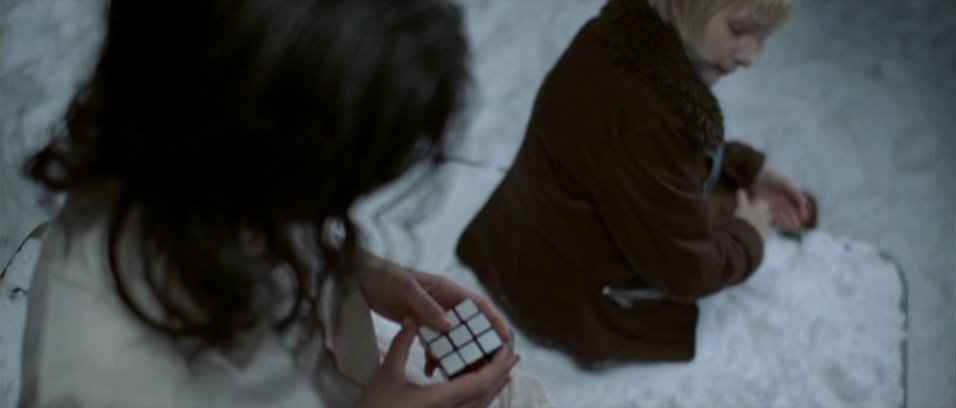
Oskar is an alienated twelve-year-old living in a decaying Swedish suburb in the 1980’s. He is brutally bullied at school, and fantasizes often about striking back at his tormentors, keeping a scrapbook of newspaper articles about murders as his inspiration. Two new neighbors move into Oskar’s apartment complex: one an older man, and one, apparently his daughter, an androgynous girl named Eli who smells terrible, walks barefoot in the snow, and only comes out at night, but is nonetheless befriended by Oskar.

If you know anything about vampires, you can imagine where this is going. Let the Right One In (Låt den rätte komma in, translated by Ebba Segerberg) was a bestseller in Sweden when it was published in 2004, and gained further international attention when the 2008 Swedish-language film adaptation (IMDB) won a number of awards and became a surprise hit. I’m not sure now if I heard about the movie or the book first, but unusually for me, I ended up watching the movie first, and read the book shortly after. I enjoyed both immensely, but for slightly different reasons in each case. Given that, I thought I’d do a combined film and book review. Please note that mild spoilers follow.

Continue reading Let the Right One In, by John Ajvide Lindqvist (2004) E

Vampire Deluxe!, by Lawrence Gullo & David Ryder Prangley (2009) E

Date Read: 6.19.09
Book From: Personal collection
Reviewer: Emera

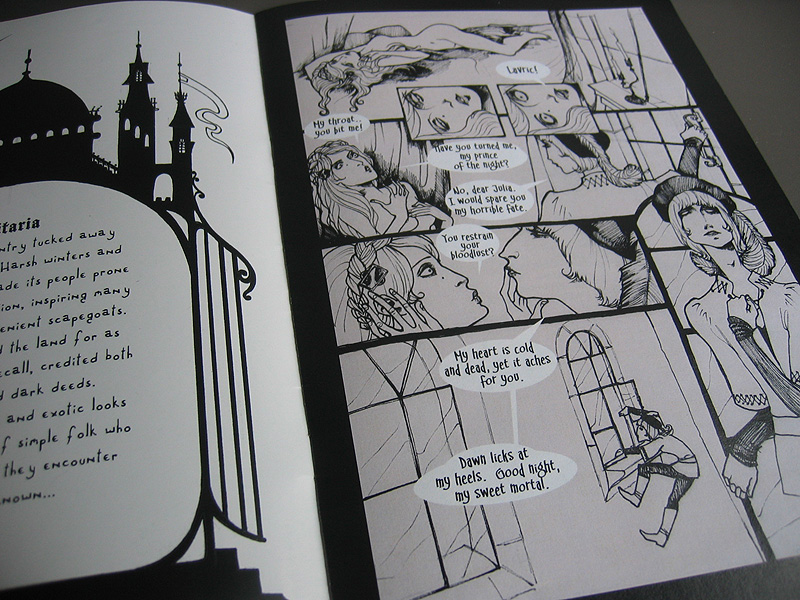
Vampire Deluxe!, by Lawrence Gullo and David Ryder Prangley,  is a profoundly silly vampire comic featuring two medieval lads who masquerade as princes of the night in order to sex (and rob) the ladies. Pretty good plan, huh?

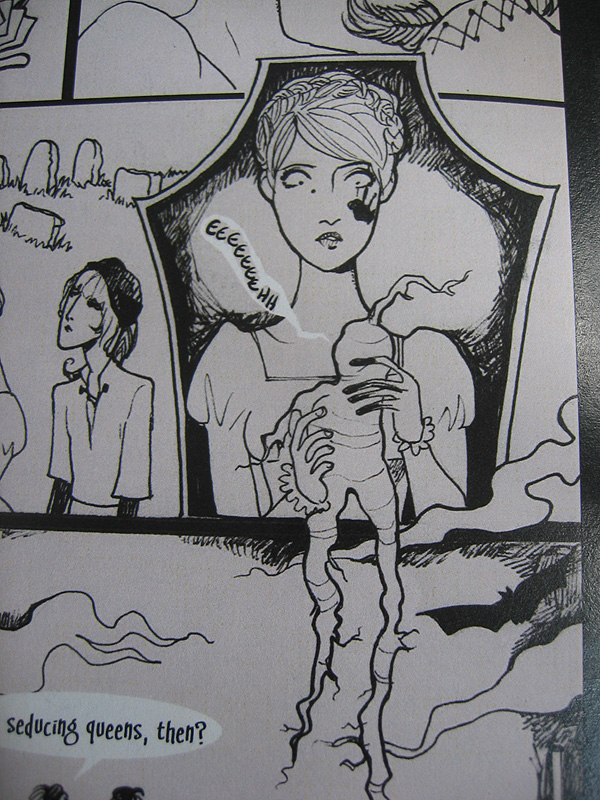
The concept is good enough to deserve a longer treatment, at least in my opinion, but here it sets up a pleasurably nonsensical plot involving midnight mandrake-digging expeditions, voluptuous ladies in white gowns, and dialogue like “Take that, harlot.”

Gullo’s characters are distinctively gaunt and elegant, and while his stylized anatomy can make for stiff posing, his characters’ hilarious facial expressions often sell the punchlines of the sardonic jokes – something I also find to be the case with My Life in Blue, his first webcomic. (Vampire Deluxe! also happens to be set in Gullo’s mythical Eastern European homeland, Baritaria, the subject of his second webcomic, Baritarian Boy.)

Eeeeeeeeehhhhhh

All in all, I had me some good times with Vampire Deluxe! – it’s a quick and marvellously fun read for any fan of Gothic goofiness. (If you like Young Frankenstein, try…)

Go to:
Lawrence Gullo: bio and author page
My Life in Blue
Baritarian Boy

The Scandal of the Season, by Sophie Gee (2007) E

Date Read: 12.17.08

Book From: Personal collection

Reviewer: Emera

English poet Alexander Pope achieved his fame and success when in 1712 he published his mock-epic poem, “The Rape of the Lock,” satirizing the public disgrace of the renowned beauty Arabella Fermor. This novel follows Pope’s rise to fame, as he departs his country home to travel to the city for a season. As Pope struggles to find material for a new poem, and to cope with the hypocrisy and cruelty of London’s high society, the haughty but meagerly dowered Arabella encounters the equally attractive and clever Lord Petre. Amid the stirrings of a new Jacobite rebellion (the conspiracy to return the Catholic James VII to the throne), Arabella soon undertakes a clandestine affair with Lord Petre – an affair that will become the talk of London, and Pope’s making, by the end of the season.

I was actually able to see Sophie Gee speak about this book and the research that went into its making, and found her a very intelligent, engaging speaker, so I had this quite high on my reading priority list. Plus, 18th-century bedroom/social intrigues have been a pet subject of mine ever since I fell in love with Choderlos de Laclos’ Les Liaisons Dangereuses. Unfortunately, Gee appears to be a pretty terrible novelist. Most of her book is graceless and entirely deficit in subtlety and real character development – the only area in which she demonstrates any deftness is the sometimes witty, cutting dialogue. Erotic scenes occasionally offer a break from the plodding narration, but are executed with a mix of irritating coyness and heavy-handed, charmlessly vulgar metaphors. (Imagine the most obvious sexual innuendo possible involving swords, hilts, and sheaths. Got it? Good. You have now succeeded in equalling every sex scene in the book.)

The saving grace of The Scandal of the Season is that it’s based on real people and real events, and ones in which Gee is clearly an expert, such that the weight of their true personal histories and characters give substance to an otherwise poorly-constructed novel. As such, the only reasons I kept reading this were that 1. I bought it (damn), and 2. I really wanted to see what would happen to the characters. The end is very bittersweet and truly fascinating historically, but Gee effectively robs it of most of its emotional heft. Boo.

Go to:

Sophie Gee

The Midwife’s Apprentice, by Karen Cushman (1995) E

Date Read: 6.11.09 (reread)

Book From: Personal collection

Reviewer: Emera

I must have picked this up at a used book sale a little while ago and forgotten that I had done so, because I found it on my shelf with no distinct memory of having acquired it – something that has been occurring with increasing frequency lately. Whoops.

The Midwife’s Apprentice is a medieval coming-of-age story, the story of a nameless girl picked up out of a dungheap by a sharp-tempered, greedy midwife. Christened Beetle by the midwife, she begins by sweeping floors and running menial errands, but begins to realize that she has more wits than the rest of the world gives her credit for.

I first read this in about fifth grade, but never liked this as much as Catherine, Called Birdy, Karen Cushman‘s other medieval historical fiction, although Midwife won the Newbery Medal. (Catherine “only” won the Honor.) Even at that age, I found the Moral at the End of the Story a little offensively obvious; Cushman also fell prey to the lesson-in-your-face YA tactic in Catherine, but that book’s greater narrative heft makes it more forgiveable.

However, The Midwife’s Apprentice is still an extremely enjoyable read. It’s very effective in creating a sense of space and slowly passing time despite its slim size, and there are quite a lot of wryly funny parts that I forgot. And Cushman’s attention to the details of medieval life is always extremely rewarding and fun – she creates a uniquely lively, earthy, and warm atmosphere, painting colorful pictures of village life, market fairs, and the breathtakingly detailed esoterica of the midwife’s trade, which employs ingredients from crushed emeralds to murderer’s wash-water. Her characters similarly have great warmth, and she effectively plays a broad emotional range over the course of the story. Overall, a very fun and feel-good read.

Go to:

Karen Cushman

The Adventures of Dr. McNinja, Book Two, by Chris Hastings & Kent Archer (2008) E

Date Read: 6.12.09

Book From: Borrowed from Kakaner

Reviewer: Emera

The Adventures of Dr. McNinja is an ongoing webcomic about a doctor who is also a ninja; duh. Chris Hastings writes and draws, and Kent Archer inks. They used to be roommates, and you can kind of tell.

In the second volume of the Doctor’s adventures, Dutch action star and sworn ninja nemesis Frans Rayner has captured the Doctor’s loyal teen sidekick, Gordito, and will stop at nothing to destroy the Doctor and claim Gordito’s magnificent and authoritative mustache as his own. Meanwhile, a mysterious drug has hit the streets, endowing common hoodlums with ninja powers. Can Dr. McNinja D.A.R.E. to resist ninja drugs and violence? Will he be able to protect Ben Franklin’s clone from harm in a high-speed motorcycle chase? Will his gorilla assistant Betty ever be able to eat her hot dogs in peace?

It’s a tricky affair to read this on a train, or anywhere else public. First there’s the business of trying to hide the pages of neckbeards and ninja showdowns from seatmates and the people across the row from you; then you have to try not to keep hooting maniacally and out loud. Granted, you do have to have a pretty random and absurd sense of humor to enjoy Dr. McNinja, which relies on non sequiturs, preposterous plot twists, occasional nerd references, and a universe of characters who take themselves way too seriously – if you couldn’t tell from the summary.

Luckily, I am well-endowed in the random-sense-of-humor department, and get a huge kick out of every volume, although I also tend to feel slightly stupider afterwards. (By contrast, my brother read a few panels and preemptively declared, “This sounded awesome, but it’s stupid.” His loss.) The fact that Chris Hastings’ art tends to be kind of shaky – it reminds me of the illustrations that you’d see in a high school newspaper – actually adds to the comic’s humor. Disproportionate facial features, rather lumpen anatomy, and physically implausible poses just seem right.

I would recommend Dr. McNinja as being great for de-stressing. My own roommate and I read the first volume during some of our darkest academic hours this past school year, and still get way too much of a kick out of shouting, “FROZEN SHAMROCKS KEEP HITTING MY FACE.”

Dr. McNinja can be read for free online, or purchased in printed volumes – which replicate the original comics’ alt texts – via Raptor Bandit Industries.

Go to:
Chris Hastings