Galápagos, by Kurt Vonnegut (1985) E

Date read: 4.29.08
Read from: Personal collection
Reviewer: Emera

As the world economy crashes and the majority of the human race begins to plunge to its end, half a dozen oblivious individuals  make their way aboard a luxury cruise liner. The ship will indeed reach its ultimate destination – the Galápagos Islands – but rather than enjoying the “Nature Cruise of the Century,” its passengers will instead become the progenitors of a new humanity.

I felt a little foolish reading Galápagos since it’s heavily interwoven with references to other works in Vonnegut’s canon, in particular referencing Slaughterhouse-5 stylistically, when the only other Vonnegut novel I’ve read to date is Cat’s Cradle. Nonetheless, I thoroughly enjoyed the novel, which, in typical Vonnegut style, is a loopy, frightening, and brilliant satire that manages to be utterly compelling sci-fi without necessarily hewing all that closely to little things like scientific reality.

The narrative is executed with almost dizzying meta-playfulness (the meta aspect actually being explained by events later in the book), jumping from character to character while variously concealing, foreshadowing, and fragmenting the events of the plot. And though I sometimes find it hard to actually care about the characters in satires, I found the brittle, desperate cast of Galápagos strangely lovable. Much of this is thanks to Vonnegut’s tone, which is sad, funny, bitter, and loving in a way that makes you suspect he half-regrets loving anyone in the first place, but he can’t help himself, either.

Both novels of Vonnegut’s that I’ve read have a unique perspective on the absurdity of human life – both times, I’ve gotten a sense of actions that are simultaneously tiny and monumental, meaningless and all-important, cascading across a vastly bleak landscape. Here, Vonnegut asks the question of whether humanity will survive once we’ve done our best (unintentionally or otherwise) to destroy it – and if so, in what shape. And would the planet be losing anything anyway, if humanity as we see it now were to disappear? Vonnegut doesn’t quite say yes or no, which is one of the aspects of Galápagos that most make it worth reading.

Go to:
Kurt Vonnegut
Introducing Paige M. Gutenborg

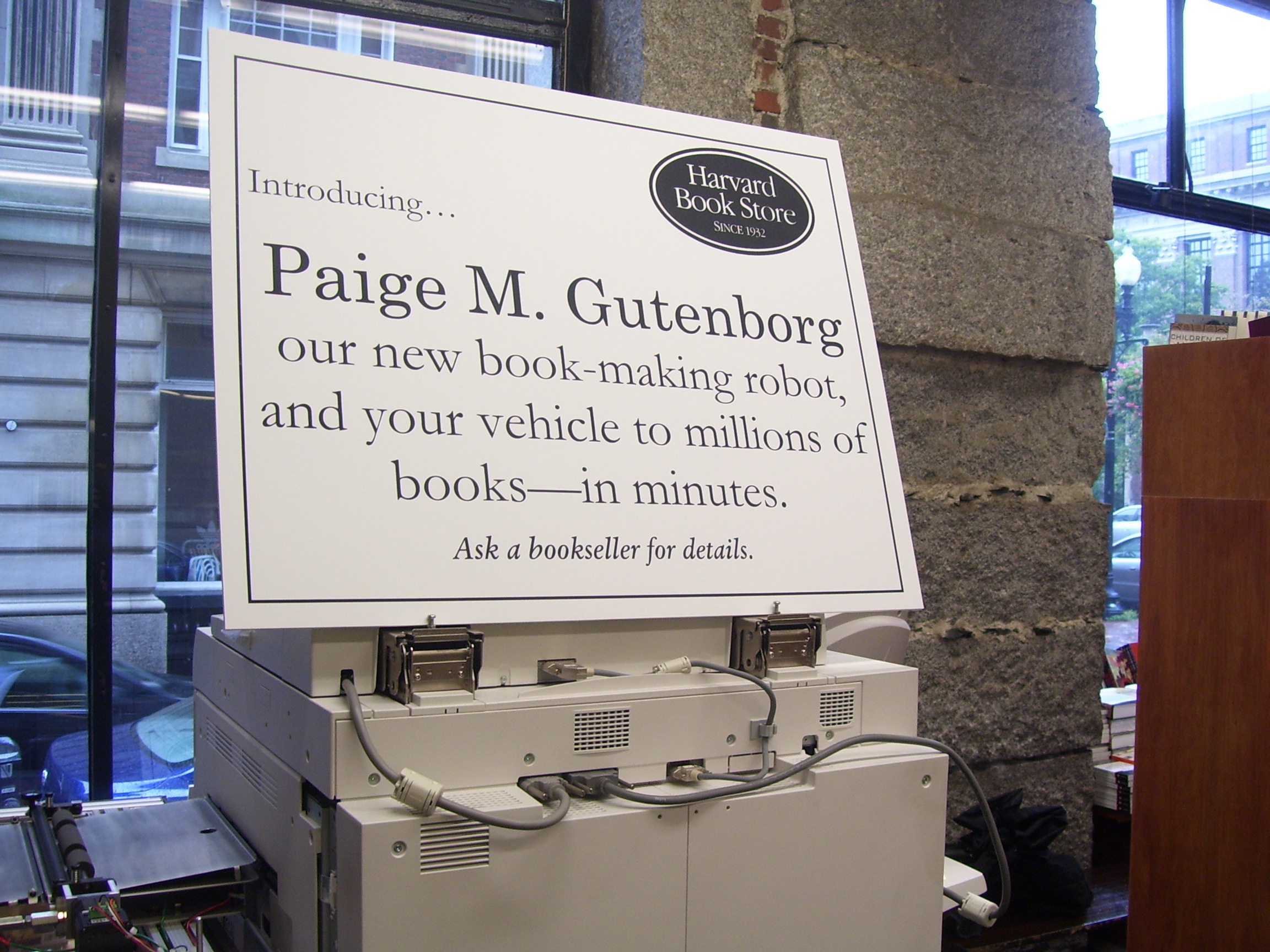
Recently, the Harvard Book Store unveiled a machine that has been many years in the making… Paige M. Gutenborg!

paige_m_gutenborg_introduction_about_poster

For those of you unfamiliar with this, Paige M. Gutenborg is a book-making machine. Although I wasn’t present at the unveiling, I made sure to pack my camera when I stopped by a few days later. Here are some details from the webpage:

  • Prints books from a growing catalog of 3.6 million books, including titles from Google digital files and public domain databases—along with previously inaccessible works.
  • Creates a library-quality, perfect bound, acid-free 300-page paperback book in roughly four minutes. These books are indistinguishable from paperbacks produced by major publishing houses.
  • Represents a revolution in the book world, allowing readers to get their books in a manner that is fast, local, green, and affordable.
  • Can print your book and we can deliver it locally—same- or next day! We also deliver domestically and internationally.
  • Provides authors with affordable, flexible printing options. There are no minimums, and you retain full rights and complete control of your work.
  • Looks forward to printing your novel, personal cookbook, family genealogy, memoir, dissertation, personalized gift, and more.

Continue reading Introducing Paige M. Gutenborg

The Historian, by Elizabeth Kostova (2005) E

Date read: 12.30.07
Read from: Personal collection
Reviewer: Emera

In The Historian, the titular scholar reminisces about the quest that she, her father, and her father’s mentor pursued several decades ago. All three became determined to discover the origins, deeds, and whereabouts of the true Dracula, the now-immortal Romanian warlord Vlad Tepes.

It should probably be evident to anyone following this blog for a certain length of time that I have a huge vampire problem, which very often leads me to read things that, well, aren’t really worth the time. This includes The Historian. I discovered only after the fact of attempting to read it that it has been sarcastically and very appropriately dubbed “The Dracula Code.” (Although to Kostova’s credit [?], she began writing it 10 years before Dan Brown began work on his ticket to fame.) The formula is indeed the same: flimsy historical detective work pursued among various scenic European locations, wedded to page after page of cheap cliffhangers achieved by conveniently dicing the narrative into chunks digestible enough for the attention-span-impaired.

Likewise, the “startling” or “creative” revelations she makes about the Dracula myth are only startling or creative if you don’t know all of them already, which I inevitably did. However, I do have to assume that people who pursue more useful hobbies than endlessly reading vampire mythology might still find the book an amusingly presented tour through various bits of folklore and theory. Overall, though, Kostova’s writing is pretty limp and insubstantial, if not quite on the level of a Dan Brown novel. I ended up ploughing through a total of 70ish pages out of a sense of obligation (having unfortunately purchased the novel), glanced at the ~600 left, and said “screw it.” Add Kostova to the list of presumably smart people (she’s a Yale graduate) who can’t actually write novels.

Go to:
Elizabeth Kostova

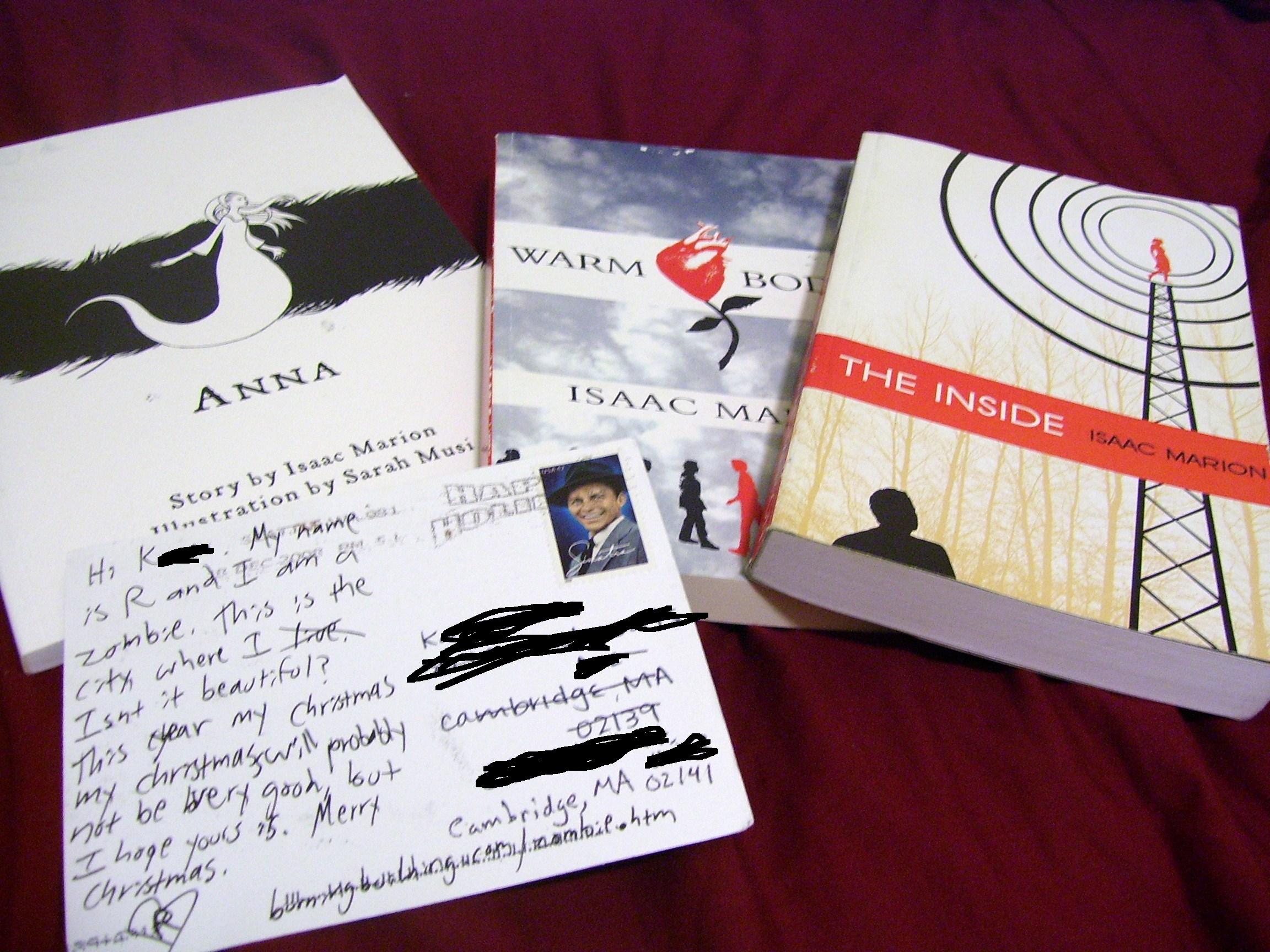
Isaac Marion Stash and a Story

isaac_marion_anna_warm_bodies_inside_postcard

By now, I’m sure you’ve seen Emera’s and my numerous reviews of Isaac Marion‘s works, namely The Inside, Warm Bodies, and Anna. These works are pretty much all highly recommended, and are self-published by Marion (links provided at the bottom of this post). Marion is noted for his strange genre niche that is, for the most part, a mix of horror, weird fiction, and romanticism.

Continue reading Isaac Marion Stash and a Story

The Music of Razors, by Cameron Rogers (2007) E

Date read: 10.29.08
Read from: Personal collection
Reviewer: Emera

In 19th-century Boston, a brilliant medical student falls in with a group of young spiritualists, only to see his hopes and plans go terribly awry as a result of their experimentations. A century and a half later, he walks the earth weary and immortal, wielding instruments made from the bones of a murdered angel, and seeking to discharge the task that he took upon himself at the height of his despair. Finally seeing a candidate worthy of becoming his successor, he enters the dreams of a boy named Walter. The young and frightened Walter learns that all he needs to do to banish his bad dreams is tell the monster in his closet to go away – only to learn too late that it was the monster who stood between him and a force banished from the universe at the beginning of time.

If the above summary sounds complicated, it doesn’t even begin to represent the full breadth of the mythology of The Music of Razors. This is a universe big enough for fallen angels, closet monsters, and a clockwork ballerina to coexist over several centuries and in the same 300 pages. The novel’s pace and complexity are undeniably demanding, especially in the beginning chapters, but the reward is that every time the page is turned, you uncover a new secret of this strange mythology, and your mind constantly stretches to keep up with the narrative’s wicked twists and hinted truths. All of these elements are convincingly and for the most part satisfyingly intertwined, and the ending of the novel delivers a volley of heavy emotional punches before leaving the reader with that perfect combination of feeling fulfilled, yet still wanting more.

I do think that the pacing could have used some stretching and breathing space to improve coherence, allow the reader more time with the characters’ emotions, and reduce the ending’s frenzied, overexplosive feel. However, from what I understand of the novel’s publishing history, there were constraints placed on its length. The first, Australian publication, released in 2001, was even shorter. Significantly more material was added to the American release, but from the sounds of it, Rogers would have liked even more.

Rogers’ writing is briskly dark, his brief sentences filled with a subtle, glancing menace, capable of both brutality and a wistful, fairy-tale loveliness. He seems to write with a grim kind of exhilaration, as aware of the emotional and spiritual weight of the story and its characters as he is of the breathtaking leaps of imagination employed in fully animating it.

This is a novel that offers immediate, visceral pleasure and sorrow, as well as food for later thought – in particular, Rogers has fascinating things to say about the role of our fears in shaping our selves. The panoply of fantastical elements also means that there is something here for all tastes, from historical fantasy to horror. All in all, I highly recommend The Music of Razors. Even if flawed, this is one of the most memorable fantasy novels I have read in recent years, and I know that many of its denizens will be staying with me for the rest of my life. Fans of Neil Gaiman and Caitlín R. Kiernan will likely enjoy this book.

Go to:
Cameron Rogers
Cameron Rogers interview with Tabula Rasa

“Where Laughter Came From”

As this is still in copyright, I am figuratively glancing about surreptitiously and wondering if I’m allowed to post this – but I can’t resist.

Where Laughter Came From

Laughter was the shape the darkness took around the first appearance of the light. That was its name then: The Shape The Darkness Took Around The First Appearance Of The Light.
The light still keeps trying to touch its lips. The lips of darkness.
The light’s hand rises but the darkness is not there. Only laughter.

– W. S. Merwin

From his 2007 collection of prose poems, The Book of Fables.

I like it when poems are resistant to easy interpretation in a playful, secretive, mythological way, rather than being abstruse or strenuously allusive. (Although the latter kind are fun in their own way, especially when generously footnoted for the uninitiated.) I’m having a lot of fun putting my brain into origami pleats trying to grasp all of this one at once.