.jpg) Check out the Kansas City Public Library’s 25-foot-tall “Community Bookshelf,” which is apparently just one side of their parking garage. Wow.
Check out the Kansas City Public Library’s 25-foot-tall “Community Bookshelf,” which is apparently just one side of their parking garage. Wow.
There’s a full list of the bookshelf’s contents here, along with a couple more photos.
– E
Check out the Kansas City Public Library’s 25-foot-tall “Community Bookshelf,” which is apparently just one side of their parking garage. Wow.
There’s a full list of the bookshelf’s contents here, along with a couple more photos.
– E
PSA – just in case it wasn’t already sort of obvious, Bad Book Cover Fridays are on hiatus while I plumb new depths of procrastination finish my theses (holycrap).
In the meantime, please enjoy the ever-encyclopedic David Forbes’ mind-blowing essay, “Sovereign Bleak” (via Coilhouse) on sci-fi landmarks and the philosophical trends that shaped them.
– E
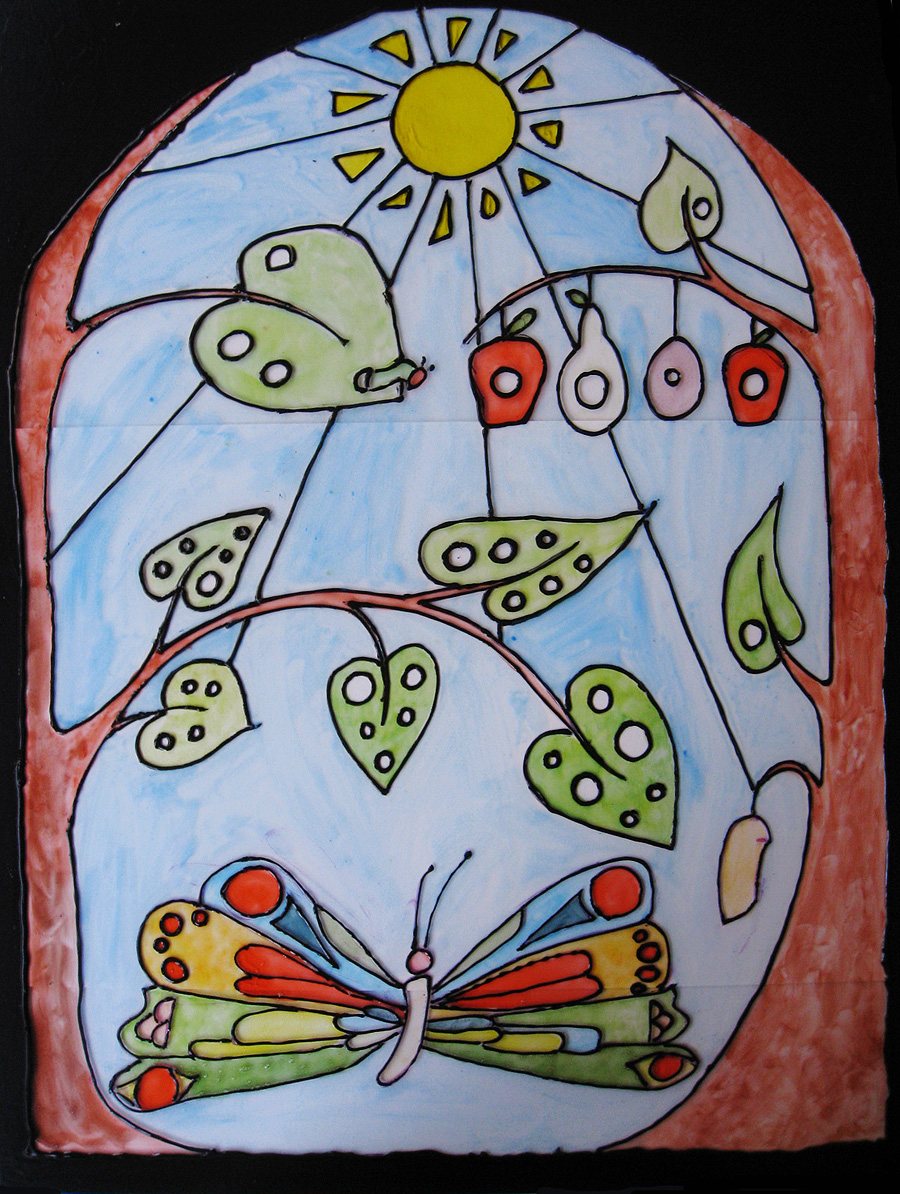
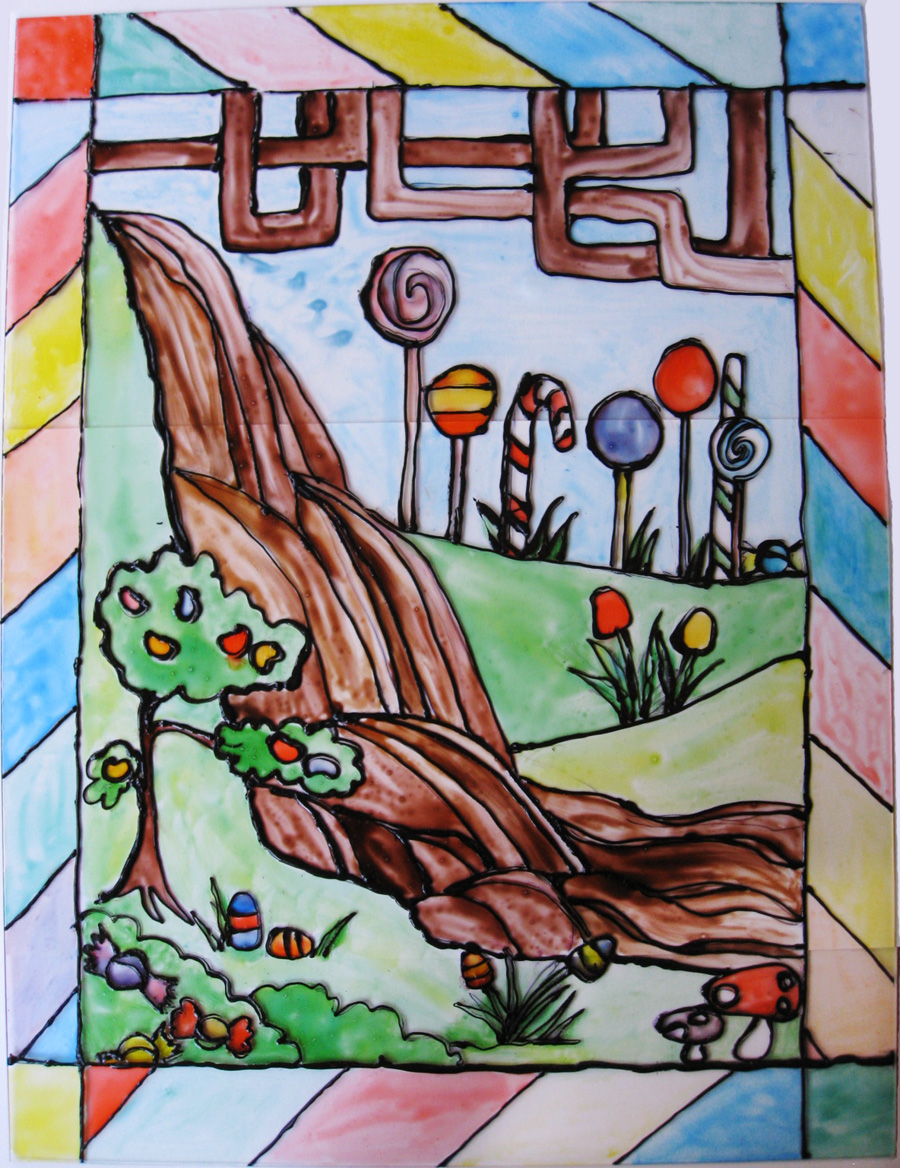
One of my roommates and I work part-time for a children’s library, and one of the activities this past fall was teaching kids how to interpret stained-glass windows – so in between midterm cramming, we ended up painting eight huge faux-stained-glass windows of popular children’s (and a couple YA) books for the kids to guess. Anyone else like to have a go?
1.
2.
Translated 2009 by Deborah Boliver Boehm.
Date Read: 4.11.10
Book From: Personal Collection, from Vertical, Inc.
Reviewer: Kakaner
Summary
The Cat in the Coffin is a romance/suspense (rather than a romance/mystery as the back cover claims) novel set in Japan that revolves around three lives: Masayo, an aspiring painter who is simultaneously a casual student of Goro, one in a family of famously lucrative artists, and a live-in tutor for Goro’s reserved and precocious daughter, Momoko. As Masayo eagerly begins her duties in the househould, she beings to naively fall for Goro, until the entrance of an old flame sets catastrophic events into motion.
Review
Unfortunately, I have much more gripe than praise for this book, despite giving ample room for consideration given that I was not reading it in the original language. Overall, it is a superficial, cheesy, predictable, simple story, heightened by the fact that it is very apparent Koike was trying to weave a masterful complex tale. First, I would use this book for the classic lesson of “Show. Not tell.” Most of the suspense in the novel would have been halfway effective had Koike not prefaced every twist with flashing red warning signals. Momoko goes out into the snow at night, and Masayo is “filled with a sense of foreboding” and “knows something bad is about to happen.” As she rushes out in the snow after Momoko, she images a sinister scene unfolding (which, I might add, had been set up from the first chapters anyway), which lo and behold, just happens to be the same as the events that actually do take place. In this way, several crucial scenes are effectively ruined throughout the book. It’s actually pretty surprising how Koike manages to wrangle so many elements of Suspense 101 yet is still described as a celebrated mystery and romance writer in Japan.
Continue reading The Cat in the Coffin, by Mariko Koike (2009) K
A snippet of a larger (but still very short) prose piece, “Nothing Began as It Is,” from Merwin’s The Book of Fables:
The story of the hinge is that it is learning to fly. “No hinge has ever flown,” the locks tell it again and again. “That is why were are learning,” it answers, “and then we will teach the doors.”
– E
Go to:
“Where Laughter Came From”
Date read: 4.4.08
Read from: Fantasy Magazine
Reviewer: Emera
… The Mumbaki came, as did the elder warriors, and they sang of Bugan the sky goddess who descended to earth to marry the warrior Kinggawan. They sang of how the lovers lost each other and how Kinggawan seeks his Bugan to this day. When the Mumbaki poured the wine over your head you did not cry.
It was a good sign, the village people said. But no one could explain why. It just was so.
After this, there was more dancing and feasting, but your mother took you away to the quiet of her hut where she stared into your face and tried to read your future while you suckled at her breast.
“Hi Bugan ya Hi Kinggawan” is inspired by the mythology of the mountainous Ifugao region of the Philippines, where the author was raised. It’s both thematically and aesthetically satisfying, playing on personal and cultural anxieties through parallel narrative threads: the emotional and sexual coming-of-age of a young woman named Bugan, after the Ifugao sky goddess, and the upheaval in her small village as contact is made with Western colonizers.
Loenen-Ruiz’s language is vibrant and wonderfully rhythmical (I’d love to hear the story read aloud), and she skillfully conveys the turbulence of the forces working on the protagonist and her culture. Against the themes of loss and disruption, Loenen-Ruiz sets the heady sensuality of the story’s resolution. Renewal of tradition is coupled with the building of new unities; an act of sexual transgression becomes an act of cultural resistance.
Also, the love interest is hot. Just sayin’.
Go to:
Rochita Loenen-Ruiz
Fantasy Magazine Author Spotlight with Rochita Loenen-Ruiz
Date read: 1.4.10
Read from: Mary Robinette Kowal’s website
Reviewer: Emera
“Evil Robot Monkey,” which was nominated for last year’s Hugos, got an “mmm… eh” from me. It’s a vignette framing the emotional experience of an intelligence-augmented chimpanzee who just wants to be left alone to make pottery. Though his warring destructive and creative impulses are viscerally conveyed, the story as a whole relies too much on clichés to do its thematic work – calling something a “hellish limbo” doesn’t do much towards convincing the reader that it actually is. As a character sketch, it’s okay; as speculative fiction, it’s predictable and lacks nuance.
Go to:
Mary Robinette Kowal
Date read: 4.8.10
Book from: Personal collection
Reviewer: Emera
Blast from the past! Between the ages of about ten and thirteen, I made my way through most of Anne McCaffrey’s major series*, starting with (of course) the Dragonriders of Pern books. The Crystal Singer trilogy was always my favorite guilty pleasure, though, at least in part because re-reads entailed a lot less effort than a trek back through the monumental Pern series would have. Emphasis on the guilty part of the pleasure, also, because it’s one of her more brainless series – it’s world-building detail porn, with McCaffrey’s characteristic focus on the workings of an imagined elite profession.
In the first book, we follow the conveniently meteoric rise to fortune of Killashandra Ree, a headstrong, ambitious type who ditches her home planet and 10 years of rigorous operatic training after being told that her voice isn’t suitable for solo work. After learning that the only explicit entry requirement is perfect pitch, Killa becomes bent on becoming a member of the mysterious, fabulously wealthy Heptite Guild of the planet of Ballybran, whose silicate crystals provide the galaxy with unmatcheable communications and transportation technology.
The later books take Killa off-planet for more adventures, but the first book is basically an extended training montage set almost entirely on Ballybran. Crystal cutters, Killa learns, are those who have made a full transition to a symbiotic bacterium endemic to the planet. In consequence, they gain vastly augmented lifespans and sensory abilities, but also suffer from gradual onset of dementia and paranoia caused by addiction to the intensely sensual process of “singing” the planet’s resonating crystal ranges. On top of that, Ballybran’s three moons create intense storm systems that have claimed numerous victims. Nonetheless, Killa accepts the risks, and quickly rises to become a full-fledged crystal singer.
2010 Hugo nominations are out! Whoo!
…and yet again, remind me of the extent to which I don’t have time to keep up with current reading. Boo.
Between the two of us, I think Kakaner and I have read 5 things on the ballot (Boneshaker, The City & The City, Palimpsest, “Spar,” and Batman: Whatever Happened to the Caped Crusader), which I suppose isn’t thaaat unrespectable… but still. I’d love to make it my goal to read everything on the short story ballot, at the least.
Go to:
Hugos a go-go
Awards season
Date read: 3.20.10
Book from: Personal collection
Reviewer: Emera
In the chimney the autumn wind sings the song of the elements, and the old firs before my study window wave excitedly with their arms and sing so loudly in chorus that I can hear their sighing melody through the double panes. Suddenly from above, a dozen black, streamlined projectiles shoot across the piece of clouded sky for which my window forms a frame. Heavily as stones they fall, fall to the tops of the firs where they suddenly sprout wings, become birds and then light feather rags that the storm seizes and whirls out of my line of vision, more rapidly than they were borne into it.
[…]
And look what they do with the wind! At first sight, you, poor human being, think that the storm is playing with the birds, like a cat with a mouse, but soon you see, with astonishment, that it is the fury of the elements that here plays the role of the mouse and that the jackdaws are treating the storm exactly as the cat its unfortunate victim. Nearly, but only nearly, do they give the storm its head, let it throw them high, high into the heavens, till they seem to fall upwards, then, with a casual flap of a wing, they turn themselves over, open their pinions for a fraction of a second from below against the wind, and dive – with an acceleration far greater than that of a falling stone – into the depths below. Another tiny jerk of the wing and they return to their normal position and, on close-reefed sails, shoot away with breathless speed into the teeth of the gale, hundreds of yards to the west: this all playfully and without effort, just to spite the stupid wind that tries to drive them towards the east. The sightless monster itself must perform the work of propelling the birds through the air at a rate of well over 80 miles an hour; the jackdaws do nothing to help beyond a few lazy adjustments of their black wings.
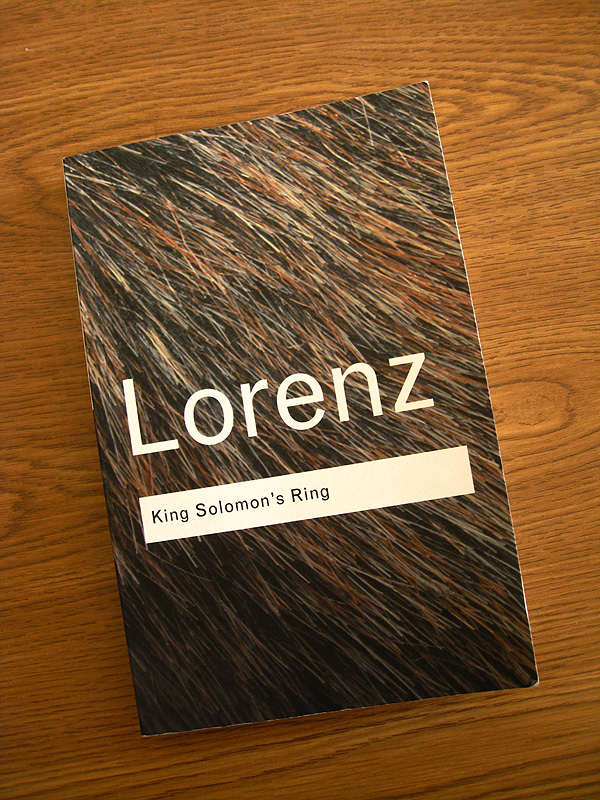
Konrad Lorenz (1903-1989) was a Nobel-prize-winning Austrian ethologist (animal behaviorist) particularly famous for his work on imprinting, and is one of the loves of my life. He’s wonderful to read – wise, methodical, wondering, and wryly humorous. Being guided through his observations is like an act of meditation, and every chapter in King Solomon’s Ring (whose title refers to the mythical ring that allowed Solomon to speak with animals) bears multiple, slow re-reads.
Continue reading King Solomon’s Ring, by Konrad Lorenz (1949) E