August 2010

You are currently browsing the monthly archive for August 2010.

A worthy successor to the [Profession/Status/etc.]’s [Female Relation] trend? Just spotted from Librarything’s* “Popular this month” list:

  • The Thousand Autumns of Jacob de Zoet, David Mitchell
  • The Short Second Life of Bree Tanner, Stephanie Meyer
  • The Immortal Life of Henrietta Lacks, Rebecca Skloot

Pretty good sampling of genres there, too – one literary/historical fiction, one… whatever you want to call Stephanie Meyer, one nonfiction. Any others I’m missing? I feel like I must be, if three out of a list of just ten bestsellers are hits for the trend.

* Mindlessly soothing hobby of the month, while I avoid my numerous laboriously overwritten and therefore still unposted reviews – tweaking and entering dozens of books into my Librarything. Anyone else out there have an account and like to be library-buddies?

- E

Date Read: 8.13.10 (reread)
Book From: Personal Collection
Reviewer: Kakaner

Review

I recently made the perilous trek through Alan Moore’s The League of Extraordinary Gentleman: The Black Dossier, which was a constant reminder that I should reread some Jules Verne. There have also just been a smattering of references here and there so I thought I’d pick up my middle school favorite, 20,000 Leagues Under the Sea.

My experience reading it the second time around was so appallingly different from my middle school read that I couldn’t believe it was the same book. Right before I cracked the cover, I excitedly recalled the dashing, dark, mysterious, yet loveable Captain Nemo, a brave man-gang shaking their fists (harpoons and electric wands too) at giant sea squid, the hulking science-defying metal warmachine of the Nautilus,  a whirlwind of action, climax and resolution under the sea, and what I found were… dry characters and lots and lots of taxonomy. So much that I’m pretty sure there was more science in that one itsy book than in my high school biology textbook. On the one hand, I greatly appreciated the, um, education, but on the other, it was frustrating to move along in the story only to screech to a halt and have to plod through terribly strained dialogue for setting up long monologues of classification. I felt like my brain was being taxed to its limit having to conjure up all these detailed mental images of fish.

This is not to say that I think 20,000 Leagues Under the Sea lacks imagination. I still fully understand why I loved it so much, proceeded to read all of Verne’s books I could find, and cited him as a favorite author whenever prompted. The concept, story, and scarily accurate scientific predictions were still impressive the second time around, but it would have taken a miracle for the book to have held up to the expectations I built for it.

But no, Monsieur Arronax was not quite the adventurous and fresh man of science I had always envisioned him to be, Conseil was basically a non-character, and Ned was indeed a rather infuriating spoil sport. I’m afraid I must admit that I defeatedly returned my little used copy back to its place on the shelf and called Jules Verne up to end our little affair. However, The Mysterious Island remains on my reread list because I still vividly remember it being a league above the rest of the books and I owe it to Captain Nemo to give him a second chance.

Go To:

Jules Verne

Aronnax

Tags:

Here they are!

As usual, I’ve read a depressingly minute fraction of the list, but it does include a good chunk of Black Letters favorites – notably, Caitlín Kiernan’s The Red Tree (my review here), one of our favorite reads of 2009.

Congratulations to all the nominees!

- E

Tags:

Date read: 8.13.10
Book from: Personal collection, via Conlan Press
Reviewer: Emera

This here’s the manticore. Man’s head, lion’s body, tail of a scorpion. Captured at midnight, eating werewolves to sweeten its breath…

The Last Unicorn comic adaptation #2 (review for #1) arrived at my door last week, and despite being exhausted I had to squeeze it in before falling asleep that night, in part because this is the issue that I can’t help but think of as “Meet Schmendrick;” and what self-respecting fan could resist the tawdry horrors of Mommy Fortuna’s carnival? In this issue, the unicorn wakes to find herself imprisoned in a two-bit witch’s menagerie of illusory monsters, and her best chances for escape lie with a well-meaning but inept magician named Schmendrick.

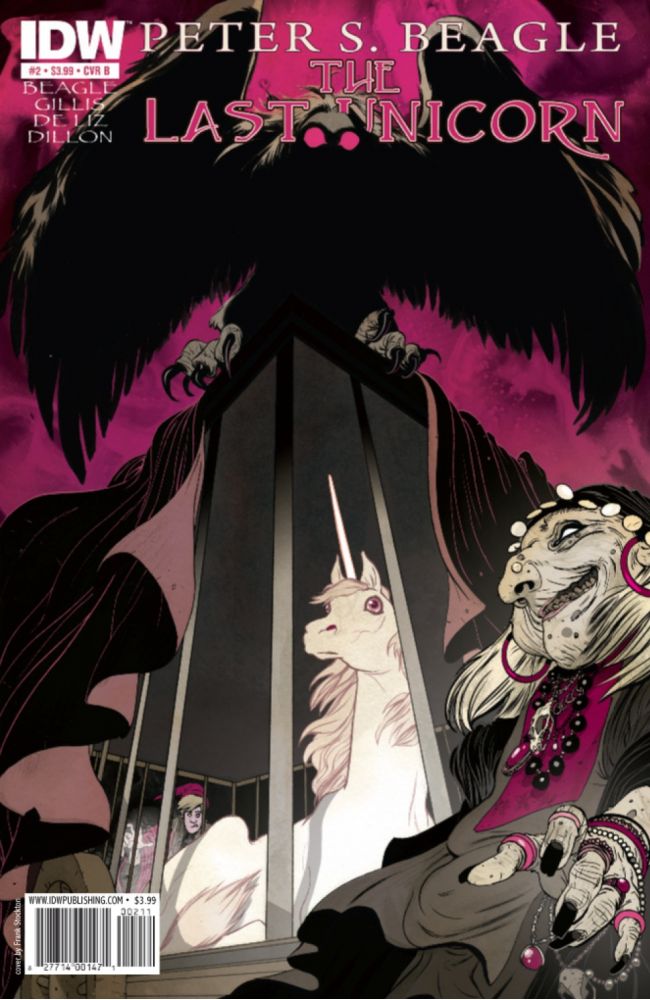
This time, I got Frank Stockton’s alternate cover art:

The Last Unicorn #2While I love his graphic approach, and particularly liked his cover variant for the first issue, it irks me that his unicorn tends to look kind of witless, and on principle I have trouble condoning the idea of a unicorn having “the hair of a Hollywood starlet.” Also, I really, really loved the de Liz/Dillon cover design for this issue. But life goes on, and Mommy Fortuna’s hand looks awesome here.

Basically, everything that I liked about the first issue I liked just as much, if not more, here: atmospheric color choices, expressive human characters, effective panel layouts, and pretty much pitch-perfect adaptation of the text. Very occasionally I was still bothered by coloring choices, but I found the use of textures much less obtrusive in this issue than in the first, and particularly effective in conveying the murk and grime of Mommy Fortuna’s carnival. There were also a couple of mostly-wordless compressions of action and narration that made me go YESSS, that could not have been done in any medium other than comics.

Read the rest of this entry »

Tags: ,

Date read: 8.2.10
Book from: Borrowed from a friend
Reviewer: Emera

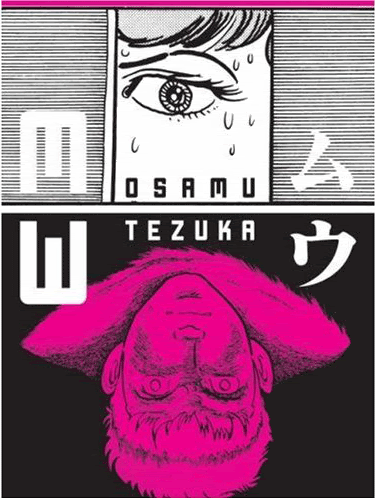
MW - Tezuka Osamu

Apparently not a single unpixellated version of this image wants to let me find it.

Whyyyy did I read this all in (pretty much) one sitting. Whatever the opposite of feel-good is, MW falls into that category. The whole time I was reading, I got the impression of Tezuka Osamu crowing, “Suffer in an agony of dread while I, the creator of such lovable, family-friendly classics of Japanese animation and comics as Astro Boy and Kimba the White Lion, manipulate your feelings with this unrelentingly dark thriller about a serial killer and the priest bound to him by guilt and love! Bwa ha ha ha!” Thanks, Tezuka. By the time I hit the last 20 pages, I was so overwrought with fatalistic dread that I had to put the book down for a few hours, before returning to the equally depressing final scenes.

For an illuminating bit of background, Wikipedia provided me with the following context: “This manga series is notable because it can be seen as Tezuka’s response to the gekiga (”dramatic pictures”) artists who emerged in the 1960s and 70s and an attempt to beat them at their own game. The gekiga artists of this period created gritty, adult-oriented works that sharply contrasted the softer, Disney-influenced style that Tezuka was associated with, a style that was seen as being out-of-step with the times.” So I think I’m not entirely wrong in detecting a certain amount of authorial glee in the proceedings.

MW is also a response to the use of chemical weaponry during the Vietnam War. MW’s resident sociopath, Yuki Michio, the charming, long-lashed scion of a renowned family of kabuki actors, is a sociopath because he was exposed as a child to a neurotoxic weapon – MW – leaked from an island containment facility owned by Nation X (i.e. America). Father Garai, Yuki’s confidante and extremely guilty lover, feels bound to protect Yuki’s identity from the authorities because he, as an erstwhile hoodlum, was holding a nine-year-old Yuki captive at the time. He and Yuki were the only survivors; Garai joined the Church some time thereafter in an attempt to escape both his horror at having witnessed the disaster, and his guilt at his relationship with Yuki. (Yes, do the math there. Tezuka reaches for pretty much every variety of shock value, and even by the standards of anime/manga,  most of it is awful.)

Read the rest of this entry »

Tags: , , ,

Re-reading Neil Gaiman’s Sandman in its entirety is one of those things that I’ve wanted to do for a while, but that looks increasingly unlikely to happen soon as the summer winds to a close. (nooooo….)

Luckily, Matthew Cheney (of The Mumpsimus) provides an alternative, in his Sandman Meditations over at heady comic-book blog Gestalt Mash. In each installment, Cheney provides commentary on one issue as he reads through the series for the first time; two installments are out so far. (A similar read-through essay series is also being offered for George R. R. Martin’s A Song of Fire and Ice series, with the added twist of commentary being provided by one new and one re-reader.) Graphic novels are not his expertise, but his background in film studies is obvious, as he pays close attention to details of shape, composition, color, and the flow of panels.

These won’t do much for anyone who hasn’t already read the series, or isn’t in the process of doing so, but they’re a fascinating, if largely technical way to revisit it.

- E

Go to:

Neil Gaiman: bio and works reviewed
Sandman, 10 (and maybe 5) years later

Tags: , ,

Date read: 7.26.10
Book from: Personal collection
Reviewer: Emera

This will be possibly one of the world’s least impartial reviews, in that my love affair with The Last Unicorn started when I was about six, when I first saw the animated movie adaptation, then proceeded to sort-of forget about it in such a way that it became a native feature of my mental landscape. For a really, really long time, I thought it was actually a really amazing, really sad dream that I had once had. For all that it’s typically praised as “whimsical” and “charming,” it’s also a story that’s profoundly concerned with mortality, sacrifice, and loss of wonder and innocence, all of which was both troubling and stirring to me as a child. Attached to my dream/memory of it was both a great yearning for the film’s melancholy, twilight-shaded beauty, and a certain sense of haunted anxiety.

Like many other fans, I didn’t rediscover the movie till years later, after which I proceeded to re-watch it an egregious number of times, attempt (unsuccessfully) to foist it on friends, and finally, very belatedly discover that it was based on Peter S. Beagle’s 1968 novel. Said novel, read at twelve or thirteen, went on to become part of what I think of as my core canon; I’m often hard-pressed to find the words to explain how much it means to me.

Given all this, I was a bit leery but mostly excited to see the news this spring that IDW would be releasing a six-part comic adaptation of the novel, under Beagle’s supervision, adapted by comics writer Peter B. Gillis,with art by wife-and-husband team Renae De Liz (pencils) and Ray Dillon (ink and color). Being the sucker I am, I immediately sprung for the signed preorders (hey, signed and inscribed copies ship for free, so it’s like I saved money… right?) available via Conlan Press, Beagle’s affiliated publisher. Recently I got around to sitting down with the first installment. A blow-by-blow review follows, with quotes here and there from the original novel – which, for those who have not encountered it in one form or another, is the story of a unicorn who learns one day that she is the last of her kind in the world, and leaves her wood in order to seek out her imprisoned kin.
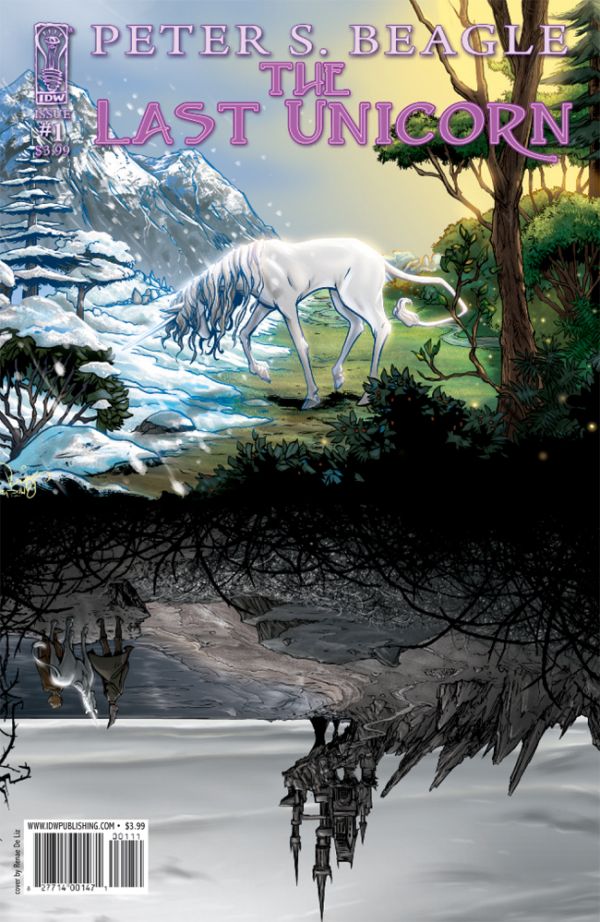
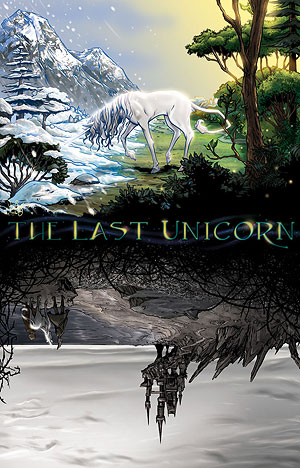
The Last Unicorn: Issue #1First reaction: augh @ awkward author/title placement for a composition that was obviously supposed to have a vertically centered title. Also a little disappointed that De Liz’s unicorn looks pretty distinctly horsey, when Beagle is very strong in his insistence that unicorns look not-much like horses:

She did not look anything like a horned horse, as unicorns are often pictured, being smaller and cloven-hoofed, and possessing that oldest, wildest grace that horses have never had, that deer have only in a shy, thin imitation and goats in a dancing mockery. Her neck was long and slender, making her head seem smaller than it was, and the mane that fell almost to the middle of her back was as soft as dandelion fluff and as fine as cirrus. She had pointed ears and thin legs, with feathers of white hair at the ankles; and the long horn above her eyes shone and shivered with its own seashell light even in the deepest midnight.

That aside, it is a pretty gorgeous cover, and one I’d rather like to see as a poster.

My personal preference artwise would have been for a more old-fashioned illustrative style (think Charles Vess, Michael Zulli, Michael Kaluta), but maybe that’s too obvious and literal, anyway. And any time I start feeling too picky, I flip back to the first page:

Read the rest of this entry »

Tags: ,