“Descending,” by Thomas M. Disch (1964) E

Date read: 2.17.10
Read from: The now-defunct scifi.com, or listen online at MindWebs
Reviewer: Emera

I originally found “Descending” through Ellen Datlow’s wonderful online selection of classic sci-fi short fiction, and was aggrieved to discover that with the passing of the original scifi.com, it’s now only available online with the help of the Wayback Machine. But to get on with the real thing –

I’ve always been vaguely leery of escalators (where are those steps really going, when they sink into one another at the bottom? – I had a childhood fear that my feet would get sucked in with them if I didn’t step off quickly enough); Thomas M. Disch’s “Descending” has ensured that I’ll never trust one again. “Descent” begins with an unrepentant debtor’s delinquent spree in a department store, and ends in a state of perfect horror. It’s pleasingly precise and surprisingly rich in its details both of setting and character, packing a huge amount of atmosphere and subtlety into just about 4000 words, and the humor is wicked and ominous. Great stuff – I’ll have to look up more of Disch’s work.

John Schoffstall provides a wonderful reading and historical contextualization of the story here – also brief and rich – and Matthew Cheney at The Mumpsimus follows up with a quick consideration of how the story works as a piece of short fiction here.

Go to:
Thomas M. Disch
Remarkable Creatures, by Tracy Chevalier (2009) K

Date Read: 1.29.10
Book From: Personal Collection
Reviewer: Kakaner

Summary

When Elizabeth Philpot and her sisters move to Lyme Regis, resigned to a life of spinstershood tucked away in a modest English seaside village, she finds herself befriending a queer fossil hunter, Mary Anning. Through Elizabeth’s education and readings, and Mary’s instinctive knowledge of the shore, they grow together in their mutual love for paleantology and fossil hunting. But the lives of the Philpots, Annings, and the very town are turned upsidedown when Mary discovers a prehistoric extinct fossil, causing an uproar in the scientific community and the entrance of many distinguished gentlemen in the field. Behind the scenes, Elizabeth and Mary explore a friendship that is strained by their respective failures to find a suitor, and interwoven with the fervor and drama of scientific discovery in a male dominated intellectual society is the sorrow and resignation that comes with spinsterhood.

Review

For me, Tracy Chevalier has never quite accomplished the same breathtaking, luminous achievement that was The Girl with a Pearl Earring  with her other books, but Remarkable Creatures is a complete turnaround. I ran away to BNN one day, picked it up for two hours, and simply could not put it down so I paid the $26.95 + tax to have the privilege of finishing it that very night in my bed. Overall, Remarkable Creatures is the historical novel I’ve been craving for a long while, whisking me off to 19th-century seaside England and embroiling me in the scandal, loneliness, and scientific discovery of the time.

Remarkable Creatures made me fear for my own life, made me examine my aspirations and accomplishments, and specifically the incredible brevity of a lifespan. Elizabeth and Mary have such purpose and drive, and are both gripped by an urgency to uncover more and more truths, working furiously to overcome social and cultural barriers. I, on the other hand, sit in my cubicle writing mundane scripts and am safe from the discrimination and prejudice of a century ago. And once Elizabeth and Mary reached a certain age in their lives, the despair seeped in, and both resigned themselves to many stagnant, loveless remaining years.

Continue reading Remarkable Creatures, by Tracy Chevalier (2009) K

BBCF: The Alphabet Mysteries

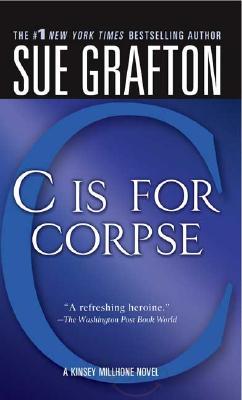
For this week’s Bad Book Cover Friday, we have the covers of Sue Grafton’s alphabet mystery series, a.k.a. the Kinsey Millhone novels. Kakaner referred me to these for the purposes of BBCF, and ever since then I can’t stop seeing them in used book sale piles everywhere.

Sue Grafton - C is for Corpse

Deeply mediocre, in a “we had no budget so we gave our cover designs to a 6th grader with Word Art pretensions” kind of way. Simplicity has its advantages in terms of recognizability, of course – as evidenced by my inability to not see these everywhere now – but. well. You could try to make it look a little less like you spent 5 minutes in Photoshop per cover doing these.

Also, on first look, the juxtaposition of the title and the cover blurb on the above cover made me think that “refreshing heroine” referred to the titular corpse. Did this happen to anyone else?

A couple more under the cut…

Continue reading BBCF: The Alphabet Mysteries

Locke and Key Volume 1, by Joe Hill and Gabriel Rodriguez (2009) E

Date read: 1.26.10
Book from: Borrowed from Kakaner
Reviewer: Emera

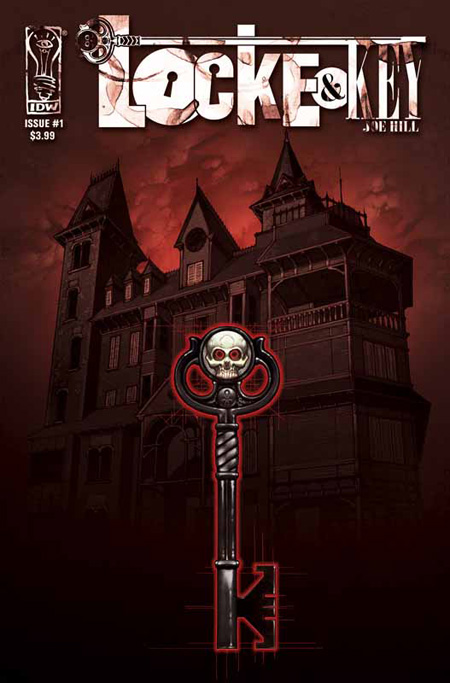
Joe Hill and Gabriel Rodriguez - Locke and Key Volume 1

(Locke and Key Volume 1: Welcome to Lovecraft collects Locke and Key #1-6.)

After their father is murdered by a disturbed former student, the three Locke children travel with their mother to start a new life in an unlikely haven: the Keyhouse, an ancient mansion on an island named Lovecraft, off the Massachusetts coast. Keyhouse, with its sprawling, dilapidated grounds and many doors, is where their father grew up, and where he insisted – with unaccountable prescience – that his family stay should anything ever happen to him.

Here, oldest son Tyler immerses himself in guilt over his tumultuous relationship with his father and his possible culpability in his death, while middle sister Kinsey struggles with her overwhelming fears and loss of sense of self in the wake of the violent attack. Meanwhile, 6-year-old Bode explores the house unattended, and soon discovers something of the curious properties of Keyhouse’s doors, and the keys that can be used to unlock them. Unfortunately, Bode’s explorations bring him within the reach of an unsavory force dwelling on the mansion’s grounds, with a particular interest in keys and what they can achieve.

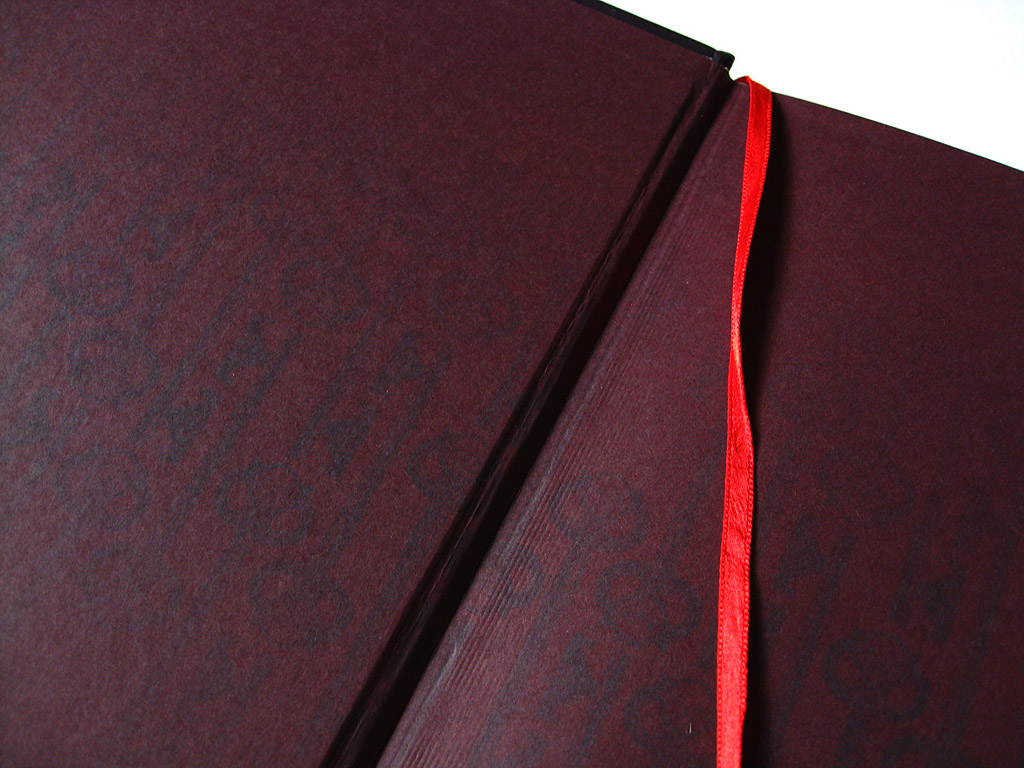
First of all, books with ribbon bookmarks and nicely designed endpapers = win:

Joe Hill and Gabriel Rodriguez - Locke and Key Volume 1

(might be a bit hard to see, but the papers have a pattern of black keys.)

For those who might not already know, Joe Hill is Stephen King’s middle son, but has eminently succeeded in making a name for himself outside of his father’s reputation. I’ve been meaning to read his first novel (Heart-Shaped Box) and short story collection (20th Century Ghosts) for a languishing Forever, but Locke and Key Volume 1 ended up being my first foray into his work, after I grabbed it off of Kakaner’s shelf last summer. I went in with high expectations, and came out jonesing for moooore.

Continue reading Locke and Key Volume 1, by Joe Hill and Gabriel Rodriguez (2009) E

BBCF: Diamond Star

For this week’s Bad Book Cover Friday, I present the cover of Catherine Asaro’s Diamond Star:

Catherine Asaro - Diamond Star

Yet again. Yes, the book is actually about rock stars in space (rather, a rock star in space). And it actually sounds like a very entertaining, cleverly conceived book, too. Unfortunately, when the cover artist was told “futuristic,” s/he seems to have settled on “the 80’s” as the nearest approximation. And so we are granted the bargain-bin equivalent of the love child of David Bowie and the vampire Lestat as our cover boy.

Let’s just hope that proximity to cosmic! star! light! won’t reduce his sperm count as much as those pants will, because then where would we be? Deprived of a new generation of starlets with mullets, that’s where.

– E

Go to:
Bad Book Covers Friday Archive
BBCF: The God Engines
BBCF: The Mammoth Book of Best New Horror 16
BBCF: The Gathering Storm

Sebastian O, by Grant Morrison, art by Steve Yeowell (1993) E

Date read: 6.11.08
Book from: Personal collection
Reviewer: Emera

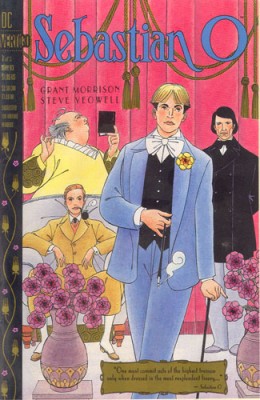
Grant Morrison and Steve Yeowell - Sebastian O

“One must commit acts of the highest treason only when dressed in the most resplendent finery…”

After over four years of squalid captivity, the infamous dandy Sebastian O escapes from Bedlam Asylum, determined to seek revenge for the treacherous destruction of his Club de Paradis Artificiel, an association of “free-thinkers.” Battling officers of the Queen and crazed assassins alike, Sebastian makes his way through several wardrobe changes and the sewers and railways of an alternate Victorian England, where a strange conspiracy is beginning to make itself known.

Sebastian O is one of the earliest contemporary steampunk creations, as well as being an obvious tribute to Oscar Wilde. Not surprisingly, it’s also one of my absolute favorite comic series – I love sneaking re-reads of it whenever I’m feeling down and in need of some amoral, witticism-wielding libertines in my life. Unfortunately, it’s quite short – only 3 issues – and though Grant Morrison does excel at packing a lot of content and tight plotting into his mini-series, you’re left wanting much, much more of the characters and settings, all of which are colorful and vividly imagined. On top of that, it’s out of print, though used copies run cheap.

Artwise, I’m lukewarm on Tatjana Wood’s pastel palette, but it does work with Yeowell’s delicately lined, Beardsley-inspired art – one gets, appropriately, the sense of a brittle confection of spun-sugar. I also enjoy how Yeowell renders facial expressions, particularly Sebastian’s perpetual air of weary self-possession and amusement just a little too slight to be called mockery.

All told, Sebastian O is a perfectly paced, literarily aware romp through decadence and dandisme, full of gadgets, duels, one-liners, and speculative-fiction braincandy. I would love to see a full-length return to Sebastian’s London, but unfortunately, it looks unlikely to happen.

Go to:
Grant Morrison

Dodgy business at Amazon, part three hundred and two

And this would be why Amazon tends to make me uncomfortable:

Amazon removes all Macmillan books from its store listings, in retaliation for pricing disputes. (via the New York Times)

Cory Doctorow provides useful perspective on the matter here, with a general consideration of the problems of market concentration and Amazon’s DRM policy.

(You may remember the awkward brouhaha dubbed “Amazonfail” last year, during which over 50,000 books having anything to do with sexuality were pulled from Amazon’s sales charts – most controversially, books, including classics, with LGBT themes, which caused much slinging about of heated claims of censorship. Amazon, after a great deal of public miscommunication and apparent internal confusion, eventually issued a statement attributing the problem to “a glitch.” I wish I could find an article with better coverage of the thing than CNN’s, but right now I’m not up to further newsdigging.)

– E

Booklish #2: Jonathan Strange and Mr Norrell Black Forest Raven Cake

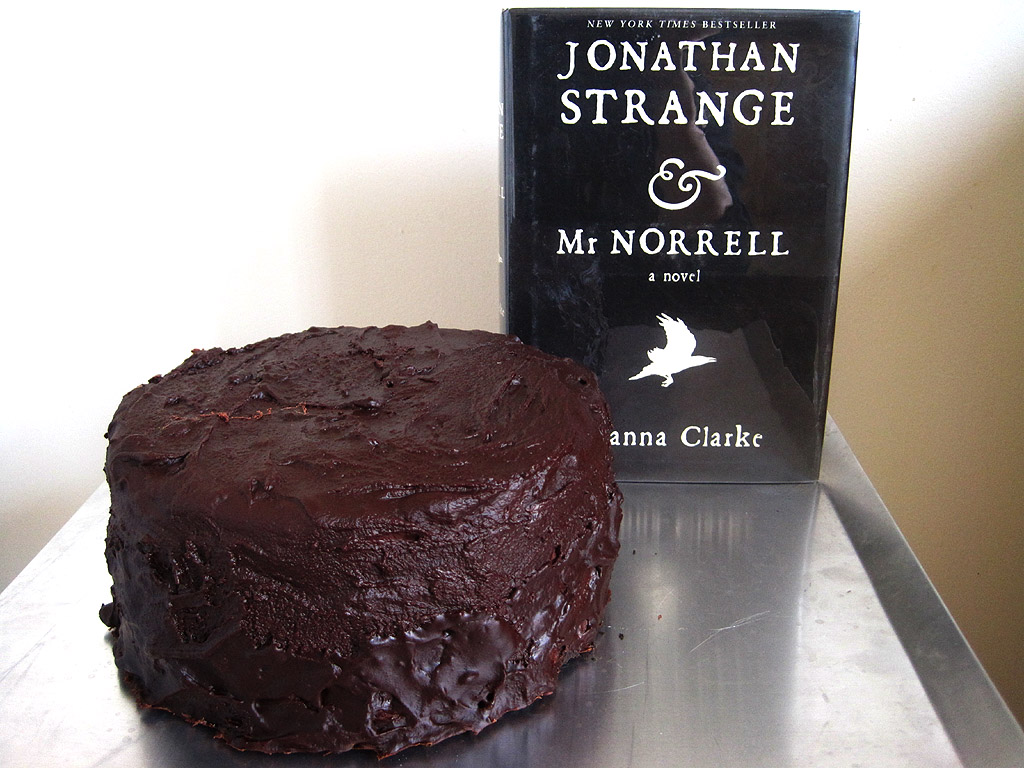
booklish-jonathan-strange-and-mr-norrell-susanna-clarke-whole-cake

View Recipe: Jonathan Strange and Mr. Norrell Black Forest Raven Cake

Today we celebrate Susanna Clarke’s Jonathan Strange and Mr. Norrell (2004), a fantastical alternate history of gentlemen and magic, and an utmost obsession of Kakaner and Emera. We decided to honor this richly wrought tale of fairies, otherworlds, and scholarly magic with an appropriately dense and complex confection filled with all sorts of surprises.

Continue reading Booklish #2: Jonathan Strange and Mr Norrell Black Forest Raven Cake

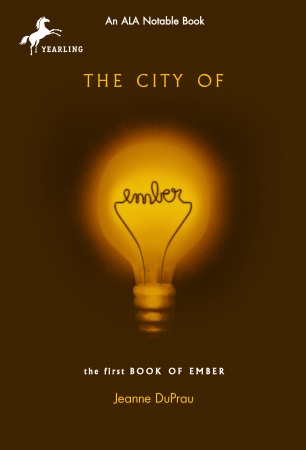
The City of Ember, by Jeanne DuPrau (2003) E

Date read: 1.26.10
Book from: Borrowed from Kakaner
Reviewer: Emera

Jeanne DuPrau - The City of Ember

“The city of Ember was made for us long ago by the Builders. It is the only light in the dark world. Beyond Ember, the darkness goes on forever in all directions.”

At the age of twelve, every child in Ember is assigned a job. Curious, bright-spirited Lina Mayfleet longs to be a messenger, but is instead assigned to dreary, dirty work in the underground Pipeworks. Doon Harrow, her classmate, is convinced that the sporadic blackouts of the great lamps of Ember – the only lights in a world of immeasurable darkness – forebode worse troubles for the city. He longs to investigate the enormous generator in the Pipeworks that provides the city with all of its power, so when he receives the job of messenger, he and Lina eagerly swap their assignments. As the blackouts increase in frequency and fear spreads among Ember’s citizens, Lina soon comes to share Doon’s suspicions that Ember is a dying city. Together the two embark on a search to uncover Ember’s origins, and to find a way to lead their people to the bright city that Lina is sure exists somewhere in the Unknown Regions beyond Ember.

I didn’t enjoy The City of Ember nearly as much as I thought I would, for all that it’s a rather endearing book. The characters and setting are warmly evoked, with detailed and frequently beautiful descriptions, and of course the concept is fantastic to begin with – Ember is one of those fictional realms you wish you could visit, and more often than not end up carrying around with you in your head after reading. (I imagined it looking like a less anarchic version of the city in the film La Cité des Enfants Perdus/The City of Lost Children, and would pay a large amount of imaginary money to run along its streets and peer into its shops.)

Continue reading The City of Ember, by Jeanne DuPrau (2003) E

BBCF: The God Engines

By request of Kakaner, the star of this week’s Bad Book Covers Friday (an hour and a bit late by my timezone; whoops) is the unreleased* version of the cover of John Scalzi‘s The God Engines, released by Subterranean Press:

John Scalzi - The God Engines
Missing the baby-fresh complexion, the rosy glow that once graced your youth? Just try stripping down to a loincloth, wrapping yourself in chains, and screaming as block letters loom over your forehead and you, too, can feel fresh and perky once more. Your pores won’t just open – they’ll scream for mercy. Side effects may include washboard abs, inhuman rage, and neckbeard.

From what I’ve gathered of the plot, this cover is actually a fairly accurate representation of what occurs in the book (I won’t go so far as to say “what the book is about”). So yes, one part of me rejoices in those cover artists who actually produce something remotely relevant to the contents of the books they illustrate. The rest of me is wishing that this one didn’t make something that looks like the dreams of a ninth-grade boy who just overdosed on Dragon Ball Z and Pepto-Bismol.

The best/only good part of this cover disaster is that Subterranean Press later released a very, very delicately worded admission that the cover was Not What They Were Expecting, and shortly thereafter presented a different cover illustration for the actual printing:

“Our previous cover to John Scalzi’s dark fantasy novella, The God Engines, didn’t quite convey the spirit of the tale, so we’ve had it redone by SubPress favorite Vincent Chong.”

“Didn’t quite convey the spirit of the tale,” you say… Ah well, blessings upon independent presses that a. have the taste and b. actually take the time to effect quality control. That is dedication.

Also, is it just me or has the running theme for all the BBCF’s so far been “stuff that’s screaming and/or thrusting fists in the air”?

* corrected from “first-edition;” thank you to the scarily fast John Scalzi for pointing this out.

Go to:
Bad Book Covers Friday Archive