A story in twelve pictures; tributes to Miéville

Fans of Australian author-illustrator Shaun Tan, please to enjoy his very short illustrated story “Eric (presented by the Guardian), about a peculiar foreign exchange student. (Fans of Chris Van Allsburg will likely be keen on Tan’s work as well, given the resonance between their quiet, eerie, carefully rendered illustrations.) The last image made me gasp, and my skin prickle.

—–

Dispatches from a Troubled City (via Super Punch) is a satisfyingly varied collection of art inspired by the work of China Miéville, featuring work by nearly 20 different artists. The collection encompasses sculpture, artifacts, poster/cover design, and illustration, all almost entirely based on the Bas-Lag books, but with a couple of tributes to Un Lun Dun (my review; Kakaner’s) as well.

Favorites: Steve Thomas’ pro-avanc propaganda, Jason Chalker’s awkward-creepy-cute magus fin, and Jared Axelrod’s box of battered memorabilia from the pages of Perdido Street Station.

Go to:

China Miéville: bio and works reviewed

“Houses Under the Sea,” by Caitlín R. Kiernan (2003) E

Reviewer: Emera
Date read: 1.12.14

“When I close my eyes, I see Jacova Angevine.

I close my eyes, and there she is, standing alone at the end of the breakwater, standing with the foghorn as the choppy sea shatters itself to foam against a jumble of gray boulders. The October wind is making something wild of her hair, and her back’s turned to me. The boats are coming in.”

Caitlín Kiernan’s novelette “Houses Under the Sea” (2003) introduces the Lovecraftian deep-sea mythology that later figures largely in the 2012 novel The Drowning Girl. My favorite section of the story is actually the very first, where Kiernan sets glinting shards of memory tumbling in the liquid medium of her protagonist’s memory. It’s painful, frightening, smoky, sensuous (just take the fact that the victim-villainess’ name is as outrageously rich as Jacova Angevine), with a noirish swagger later amplified by the narrator’s hard-drinking pathos, and, rather playfully, by included excerpts from the works of Angevine’s mystery-novelist father.

Technically, the story is beautifully crafted, with Kiernan’s trademark circular movement (which echoes the final image that ends up haunting the narrator – “She has drawn a circle around me”) of thought and memory carrying the reader to successive climaxes of dread. An empty warehouse with a recently painted-over floor. Undersea things – coldly, sinuously, invasively sensuous, both muscular and rotten-soft.

The role that the Monterey Bay Aquarium’s deep-sea exploration plays in the story is especial fun for me given the fact that I spent several years in elementary school obsessively drawing viperfish and anglerfish, and that my dream job for a much longer time was to work at said aquarium… (It did just occur to me that a thread of my anglerfish affinity persists, in that I now study the family of bacteria that includes Photobacterium, those responsible for the luminescence of anglerfishes’ and flashlight fishes’ light organs. Shine on, you creepy diamonds.)

Go to:

Caitlín R. Kiernan: bio and works reviewed

Landscapes lorn and lonely

I did not know this: Tove Jansson (moomin-creator) did illustrations for the 1962 Swedish edition of The Hobbit (courtesy Babel Hobbits, a repository for international Hobbit illustrations). They range from Quentin Blake-ishly sketched storm giants, to what is now my favorite rendering of the depths of Mirkwood. I don’t understand how Jansson always manages to combine qualities of both warmth and chill in her art.

Also, her Gollum is something else – towering over Bilbo, he looks unexpectedly like a wodwo or a Green Man, though I can’t think what his wreath might be made of. (Dried bats?)

——-

Via the ever-loyal but outrageously busy Kakaner: carved book landscapes by Guy Laramee. Mute, contemplative, eerily lit. I’ve seen my fair share of altered-book art, but as Kakaner put it, “This gives me the shivers in a good and bad way. More bad though.” (But bad in a good way, I would add!)

– E

Louisa the Poisoner, by Tanith Lee (1995) E

Reviewer: Emera
Date read: 11.2.2013
Book from: Personal collection

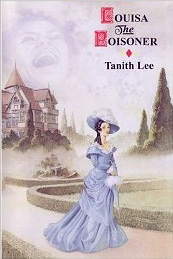
Louisa the Poisoner: cover

‘There are three things that grow in March Mire,’ said the aunt, in a silly sing-song voice, her eyes half closed, ‘and that grow nowhere else together, and seldom anywhere. Find them in one spot, take them and make them up. From them comes this dew. Oh Louisa. Listen carefully. This stuff grants the gift of death.’
Louisa widened her eyes but she was not actually impressed. Death was everywhere in the mire and especially often in her aunt’s nasty bottles.
‘Listen,’ said the aunt again, ‘the poison in this bottle leaves no trace as it kills. In the world beyond the mire this can mean much. I’ve told you, there are towns along the moors, and great houses piled up with money and jewels. If every cobweb on that ceiling was changed to bank notes it would be nothing to them … We’ll seek for just such a rich place. Then I’ll know how to go on. You shall pretend to be a lost lady, as I’ve trained you. You’ll do as I say, and our fortunes will be made.’
‘But how, Aunt?’
‘They’ll fall in love, and make over their goods through wills, which I’ve told you of. And then I’ll see them off …’

This standalone Tanith Lee novella from Wildside Press is quite as wicked and frivolous as it sounds. There’re vile aristocrats, bloody deaths, and incidental madmen and ghost horses; there’s brooding architecture (a manor called Maskullance!) and one of Lee’s trademark canny and uncanny heroines – those women who enter into society at an angle, slice their way in quietly. Also, George Barr provides some beautifully pulpy illustrations; his Louisa has a great Vivian Leigh-ish thing going on:

Unfortunately, the prose isn’t quite as effortless as it so often is in Lee’s work – the little twists of syntax often feel worked over, rather than sinuous and startling, and the dialogue frequently falls short of wittiness. And I think the story would have worked better at shorter length, given that a reading a detailed accounting of the sequential deaths of a bunch of boorish aristocrats entails spending a depressing amount of time with those aristocrats.

Still, the last few pages work up to a tremor of dreadful sublimity, and feature one of the best descriptions of hell I’ve ever read. If not one of Lee’s strongest works, this is nonetheless a fun treat for a cloudy autumn afternoon.

Louisa the Poisoner - Illustration by George Barr

Go to:
Tanith Lee: bio and works reviewed


Fancy; battered

Sighted in September by Boing Boing, for particularly avid Bradbury fans: a very rare asbestos-bound 1953 special edition of Fahrenheit 451, somewhat worse for the wear, but, one hopes, still somewhat safer from incendiaries, conflagrations, merry bonfires, unmerry bonfires, and other forms of fiery doom.

—–

On display by the Uppsala University Library: a 14th-century German book that was mended with silk thread. Looking at this gives me interestingly weird feelings: up close, the stitches are so homey in appearance (good ol’ blanket stitch!), but – especially where they were used to mend holes – simultaneously resemble biological structures or growths. Plant cross-sections, vacuoles, paramecia. I can see this being used as a springboard for an art exhibit about how we think about categories of craft/art/literature, about objectness, etc. For some reason I also just want to see an art installation of a roomful of colorful books suspended from floor to ceiling in white crocheted webbing. “Shelob Reads to Excess”?

– E

The Water Mirror, by Kai Meyer (2005) E

Reviewer: Emera
Date read: 8.13.2013
Book from: Personal collection

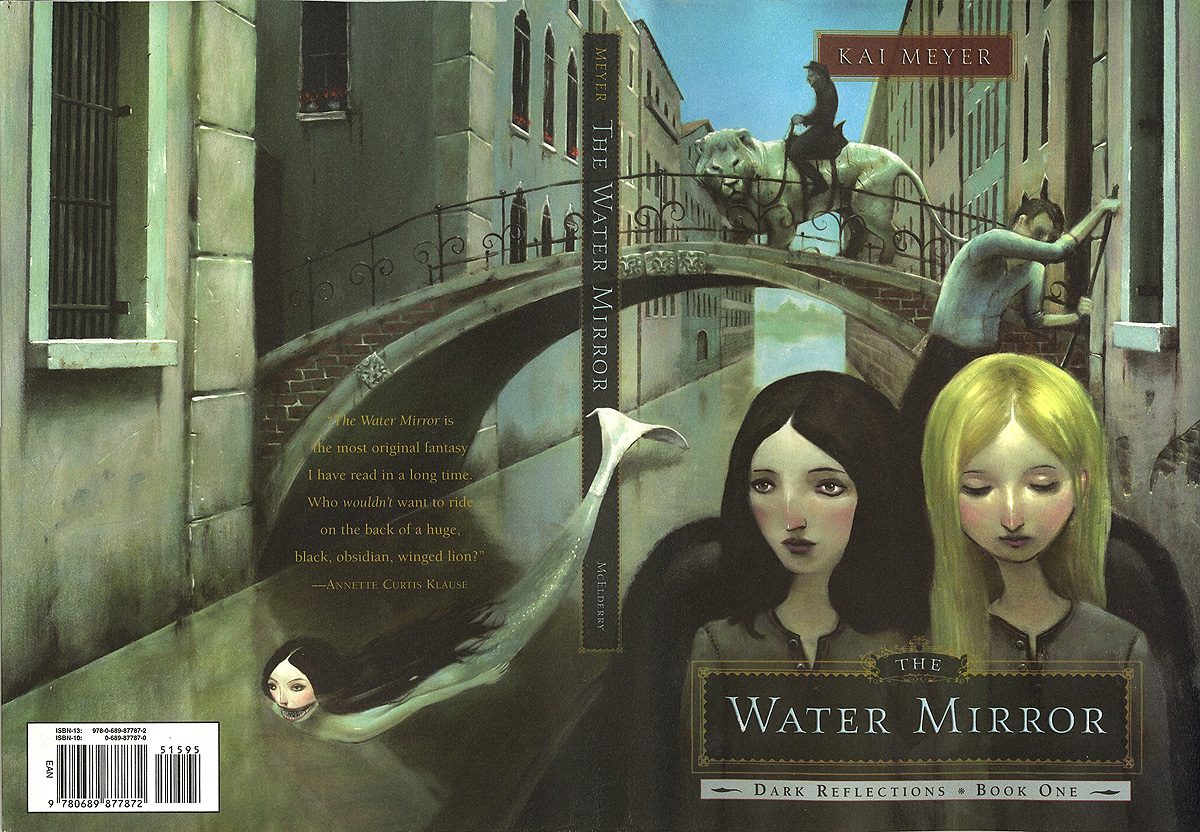
The Water Mirror, by Kai Meyer: two pale-faced girls, one blonde and one brunette, are poled in a gondola down a grey-green Venetian canal

“In Venice, magic is not unusual. Merle is apprenticed to a magic mirror maker, and Serafin – a boy who was once a master thief – works for a weaver of magic cloth. Merle and Serafin are used to the mermaids who live in the canals of the city — beautiful creatures with hideous mouths that split their faces from ear to ear.

But Venice is under siege by the Egyptian Empire; its terrifying mummy warriors and flying sunbarks are waiting to strike. All that protects the Venetians is the Flowing Queen. Nobody knows who or what she is – only that her power flows through the canals and keeps the Egyptians at bay. When Merle and Serafin overhear a plot to capture the Flowing Queen, they are catapulted into desperate danger. They must do everything they can to rescue the Queen and save the city – even if it means getting help from the Ancient Traitor himself.”

Disappointing. I glommed onto this while bookshopping with Kakaner when I saw the cover art (by Jonathan Weiner), and couldn’t put it back on the shelf. This could have been a very nice dark-fantasy YA morsel – fast-paced, with a motley cast and an alternate Venice satisfyingly redolent of wartime paranoia and esoteric secrets whispered in clammy alleyways.

Unfortunately, the setting proved to be more interesting and memorable than the perfunctorily developed characters, and the prose is often awkwardly juvenile, e.g.,

“Merle appeared to be spellbound by the disgusting appearance of the fiery figure.”

Note that this is written from Merle’s perspective, so it makes no sense that she should “appear” to be spellbound. Of course it’s hard to say whether choices like these are original to the (German) text, or due to the translator, but there are also occasional outbreaks of ridiculousness that are more easily attributed to the translator, as when a mermaid’s skeleton is described as resembling a “supergigantic fish bone.” SUPERGIGANTIC. Boo, translator. This makes me curious about the editorial process for works in translation.

In any case, good brain candy if you’re one for intriguing world-building, but I didn’t find too much else of substance to enjoy. I’m still thinking about framing the cover art, though! That mermaid, boy o boy.

Go to:

Kai Meyer: bio and works reviewed

The dark creeps in on little tentacled feet

It took me a while to realize that both of these things were happening, so I hope other dark-fiction aficionados will find this helpful as well: there are two new online professional magazines for horror and dark fantasy either launched or launching this year.

One is Nightmare Magazine, founded this spring as a sister publication to Lightspeed/Fantasy, and likewise edited by John Joseph Adams.

The other is The Dark (that link has yet to go live, so here’s their Facebook page as well), currently set to debut in early October of this year, and with an editorial staff including Clarkesworld‘s Sean Wallace. Excited to see both of these venues grow.

– E

Sakuran: Blossoms Wild, by Moyoco Anno (2002) E

Reviewer: Emera
Date read: 5.19.13
Book from: Personal collection

 

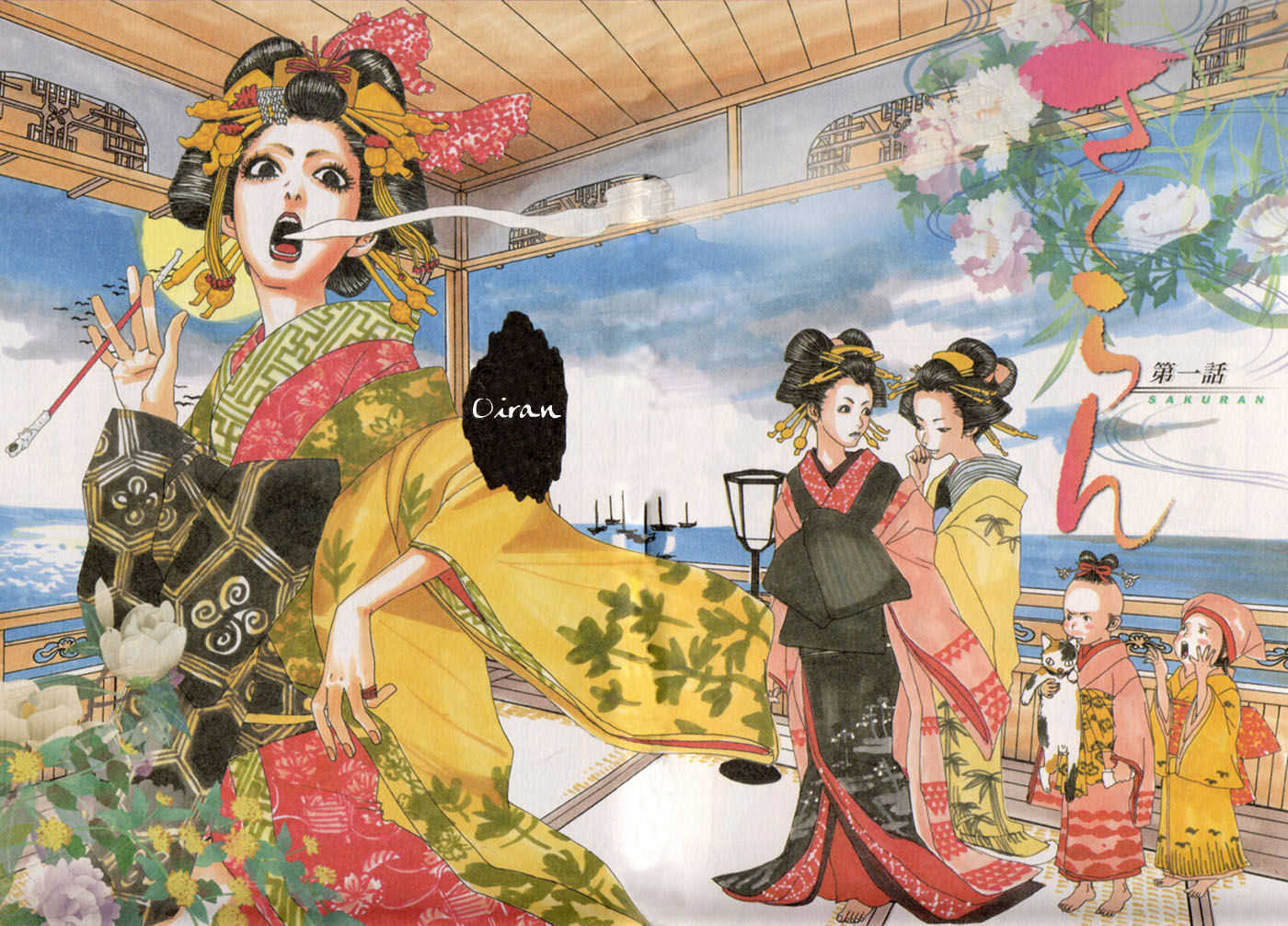
Sakuran cover

I expected Sakuran to be fun – racy, rambunctious, ornate. Brothel life in Edo-era Japan, oh yeah. And it is fun, sort of – bubbling over with scheming, ambition, spectacle, and biting exchanges of emotional violence.
Sakuran opening spread

But it’s also deeply, and more lastingly, sad. Kiyoha is fifty times the usual feisty protagonist: she’s crass, arbitrarily malicious, and often outright violent. While this can all be amusing, even admirable, it’s also a disturbing, straightforward statement about the molding influence of a system founded on mistrust, competition, and the basic cruelty of buying and trading young women. Sure, Kiyoha might just be a queen of cats by inclination, but we also bear witness to the events that progressively eat away at her humanity, at her willingness to trust and share and be kind.

The courtesans’ lives are haunted by a desperate craving for love, and by its impossibility. If I recall correctly, only one of the girls eventually marries her favorite patron; the rest are fated to disappointment, or even death, at the hands of patrons, or their own desperation. The manga culminates in a quiet emotional ruin: in a few pages, we see Kiyoha – at the ripe age of twenty-something – eaten completely hollow by love’s casual betrayal. Sakuran is an anti-romance, in other words.

While I have nothing but praise for Sakuran‘s emotional daring and honesty, there are several practical stumbling blocks to enjoying the manga. Moyoco Anno draws only a veeeery narrow range of facial features, so it’s nearly impossible to distinguish the oiran (and many of their patrons, too) except by their wardrobes. Flipping frantically between pages to double-check which girl with what dialogue bubble had the kimono with the crane pattern and not the peony pattern and these hair ornaments not those hair ornaments, was about as fun as it sounds – and then you get to do it all over again as soon as the scene changes and everyone’s wearing different clothes! Which happens often, since the manga drifts from vignette to vignette, with little connective tissue. This works to create a sense of drifting and dislocation, of the oiran existing in an unmoored twilight realm whose essential drudgery is punctuated by episodes of bizarrely heightened emotion. But my god, it wouldn’t have hurt for everyone to look a little bit more different, would it?

Productionwise, there’s a lot to love about Vertical Inc.’s sophisticated visual design, as usual (ohhhh that glamorously garish metallic cover), but I wasn’t entirely satisfied with the translation. While a certain degree of informality seems apropos to the manga’s earthiness and irreverence, many of the anachronisms (“spacing out,” “twerp”) just seemed silly and misplaced. And, too, most of the lyrical reflections don’t quite reach the height of fluency and elegance that they need to work as emotional transitions between scenes; they contort into fortune-cookie-esque awkwardness, e.g. “Castle-topplers whisper idle nothings to trap their guests.”

Still, the underlying substance of the manga is so very excellent that it more than made up for all the practical distractions; I look forward to the added fluency of comprehension that a reread will bring. If you didn’t like Memoirs of a Geisha (I didn’t), or maybe if you did, too, but are ready for a more hard-bitten take on the courtesan-memoir, I strongly suggest you give Sakuran a try.

Go to:
Moyoco Anno: bio and works reviewed
The Moon and the Face, by Patricia A. McKillip (1985) E

Reviewer: Emera
Date read: 8.8.2013
Book from: Personal collection

To the best of my knowledge, Patricia McKillip has only written three novels of science fiction, all back in the mid-1980’s – the duology beginning with Moon-Flash (1984) and ending with The Moon and the Face, and 1987’s Fool’s Run. All three are out of print, and hence some of the only McKillip works I hadn’t/haven’t yet read, my teenaged obsession with her work having settled to a fond simmer by the time that I was in a position to go OOP-hunting. But the McKillip fangirl of yore emerged from hibernation when a dear friend (with whom my friendship was cemented largely on the basis of our taste in reading – geek pre-teens ahoy!) offered to ship me much of her McKillip collection, including The Moon and the Face, in the course of downsizing her belongings.

Having forgotten that The Moon was the second in the duology, I dove right in. Reading series out of order was standard practice for me when I was younger, since I’d just read whatever volume my dad brought home from the library for me, without regard for chronology. If I liked it, I’d beg him to navigate the mysteries of Interlibrary Loan for me and find its series-companions. Stepping into the midst of an already fraught narrative appealed to my relationship with uncertainty: I like the feeling of being an eager novitiate, working to unravel all that came before with hungry ears and eyes, and lingering equally pleasurably over those mysteries I couldn’t penetrate. (All told, I probably read more series out of order than in, back then.)

Since McKillip often works to appeal to this mode of reading anyway (I think here especially of the densely mystifying opening of the Riddle-Master trilogy), it took me some time to realize that The Moon and the Face was a sequel; it could have worked perfectly well as a stand-alone.

The novel is an elegant fable about homecoming, heritage, and the meeting of cultures. McKillip is very good at writing lovers in separation (thinking again of Morgon and Raederle in the Riddle-Master trilogy), each working intently towards divergent ends. Here, we meet Terje and Kyreol, who previously journeyed out together from a sequestered aboriginal culture, have become integrated into the futuristic world of Domecity, and are now pursuing very different vocations as cultural explorers: Terje has returned to their native Riverworld as an anthropological observer, barred from being seen or otherwise making contact, while Kyreol is trepidatiously preparing for her first offworld expedition. Both meet with unexpected dangers and sorrows, but the narrative moves with implacable gentleness towards reunification on both the personal and cultural levels.

McKillip works here in a significantly pared-back style compared to the trademark baroque or tanglewoodsy dream-impressions of her fantasy work. Freed of many of her more kitschy stylistic tics, like constant worshipful references to characters’ eye colors, what emerges is a style of light, dreaming lucency; it goes down like clear water. I was reminded of some of Ursula LeGuin’s science fiction, particularly “A Fisherman of the Inland Sea,” with which it shares strong emotional and thematic overlap. Certain elements still threaten preciousnesss – principally, McKillip’s complete unwillingness to threaten her main characters with serious physical harm means that long stretches of narrative are devoid of plausible tension, other than the sense of mystery that she excels in cultivating. Still, I felt happily rewarded simply by the elegance of the language and narrative movement, and the gentle humor of the characters’ relationships. Terje and Kyreol’s concluding exchange in particular is memorably sweet and wry, and left me smiling for a long time.

Now, to go back in time and seek out Moon-Flash

Go to:
Patricia A. McKillip: bio and works reviewed
The Bell at Sealey Head, by Patricia A. McKillip (2008): review by Emera