Darkly Dreaming Dexter, by Jeff Lindsay (2004) K

Date Read: 11.26.08
Book From: Personal Collection
Reviewer: Kakaner

Summary

Short version: Dexter S1.
Long version: Dexter, a serial killer of serial killers, works in the Miami Metro Police as a blood spatter analyst alongside with his foster sister Deb. We learn that Dexter was taken from a violent crime scene and raised by a cop. Upon learning that Dexter was prone to murderous intentions, his dad taught him the art of killing. Suddenly, a new wave of killings crop up and are accredited to the “Ice Truck Killer” and Dexter recognizes that these killings are somehow a message to himself. Using his skills as a killer and resources at the police department, Dexter helps track down the killer while trying to keep those that matter to him safe.

Review

Unfortunately, I have to say this is exactly what I expected. I watched two seasons of Dexter before picking up one of the novels (much to my shame), partly due to the horrible things I had heard about the books. Unsurprisingly, the writing was entirely mediocre, unsophisticated, and wholly disappointing.
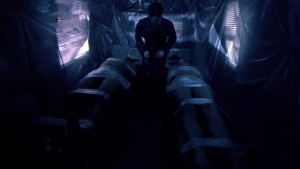
dexter-s1-dexter-killing

Naturally, I couldn’t help but compare Darkly Dreaming Dexter to the TV series. The novel is told from Dexter’s point of view, and really does try hard to achieve the same dark, cynical, wry atmosphere that the TV adaptation manages to accomplish so well… but just falls short. The pacing of the book was alright, as in there was always some action each chapter to propel the story forward. I feel like I’m really at a loss for what else to say about the novel. It was just unremarkable (again, comparison to the TV series). There are some minor plot differences between the novel and show, except for the ending; however, I don’t really care because I’m not reading anymore books.

dexter-in-blood-lab

At the least, reading Darkly Dreaming Dexter has made me appreciate the TV adaptation immensely. You really begin to gain an understanding of the skill involved in developing Dexter’s character for the screen, piecing together the soundtrack and film style for that perfect cynical criminal atmosphere, and the screenplay is just impeccable. The TV show has really come a long way from the novel and certainly shaped a masterpiece from raw materials.

Go To:
Jeff Lindsay

Affinity, by Sarah Waters (1999) K

Date Read: 12.26.07
Book From: Personal Collection
Reviewer: Kakaner

Summary

Margaret Prior becomes a “Lady Visitor” at the Millbank prison. There, she takes in the prison experience, from the food to the garb to the treatment of the prisoners and takes steps to befriend and be a source of comfort for many of the inmates. As her visits progress, she finds herself drawn to one girl in particular, a spirit medium Selina Dawes, convicted of spiritualistic fraud and assault. Soon, between her own declining health and the nature of her friendship with Selina, Margaret finds herself hopelessly committed to the Millbank prison and tangled up with mysterious spirits.

Review

Well, I don’t really know how to approach this review. I could either review it superficially and not give away the story, or try to convey everything I want to and ruin everything by implication. I’ll… just… charge ahead as best I can and see where it takes me.

Overall Affinity was a much easier read than either Tipping the Velvet or Fingersmith because it was so linear and set in one place– the prison and Margaret’s house were the only settings and the prison was the only plot. As a result, the circumstances definitely called for a slow, steadily snowballing story.

Continue reading Affinity, by Sarah Waters (1999) K

Shadow Puppets, by Orson Scott Card (2002) E

Date read: 8.22.09 (re-read; originally read in about 2004 or 2005)
Read from: Borrowed from Kakaner
Reviewer: Emera

N.B. This review is probably not very accessible to anyone who hasn’t read any of the Shadow Saga sequels to Ender’s Game, as this comes nearly at the tail end of the series. If you haven’t read any of the series, you may also wish to not read this review for fear of spoilers.

Some poor decision-making on the part of Peter Wiggin, adolescent Hegemon extraordinaire, leaves the fledgling Hegemony and its resources in the hands of Achilles. Though nominally disgraced in the eyes of the world after the revelation of his international-scale treachery, Achilles is as dangerous as ever. His new power puts him in position to re-enter the game of political manipulation, and sends Bean and Petra – his most hated enemies – into hiding. Meanwhile, the other members of Ender’s Jeesh continue to jockey for the precedence of their respective countries, while themselves often ignored or manipulated by their own governments. In short, the world is paying the price for having nursed a generation of young Napoleons, and Bean and Petra find themselves at the center of events, just when they have come to realize that what they value most is simply each other’s happiness.

My main impression of this was: bridge novel. It’s so obviously written as the sort of mid-series book that has to begin at one place, and get to another, such that while I was fairly engaged when reading, I kept on losing interest in following it as a whole. Overall I’ve become slightly disenchanted with Orson Scott Card, both on the basis that I find many of his political and personal opinions repugnant and on the basis that… frankly, I don’t think he’s a genius as much as I used to anymore. I’ve been re-reading the Shadow series because the final book hadn’t yet been published when I first ran through the series, so I’ve had to catch up again. A lot has changed in how I read in these past few years, so while Ender’s Game is still next to sacred in my canon and thus I don’t let myself nitpick it, it’s easier now to see the flaws in the rest of his books.

Continue reading Shadow Puppets, by Orson Scott Card (2002) E

The Inside, by Isaac Marion (2008) E

Date read: 2.6.09
Read from: Originally borrowed from Kakaner; now in personal collection, via Burning Building
Reviewer: Emera

At twelve, David falls asleep on a schoolbus, and meets, literally, the girl of his dreams. In real life, he grows up, marries a woman he thinks he loves, and proceeds to destroy both of their lives. He is unable to shed the belief that somewhere beyond the world he sees every day, there’s another one that’s more vital, more beautiful – and most importantly, is home to the girl whom he still glimpses in maddeningly brief and unpredictable snatches. Soon, even his waking life is invaded by the inexplicable: radio towers appear and disappear; cryptic cassette tapes appear on his welcome mat; he wakes up in his car in places that he doesn’t remember driving to. David is terrified, infuriated, and eventually obsessed by these “messages,” desperate to take control and escape a life that seems to hold no meaning except for the conviction that love lies elsewhere.

The Inside is a strange book. Though I hate to pin it down with genre terms (I know, then why am I doing it?), it’s most easily described as part psychological horror/suspense, part romance, part weird. After Kakaner lent me her copy (I bought my own later), I was haunted by it every moment that I wasn’t actually reading it, quite as obsessed as David, and a little frightened. Ultimately, I didn’t even care so much about the eventual reveals as I did about the process of getting to them, which is absolutely absorbing, often moving, and beautiful in a crazed, pained kind of way. I do think the novel falters towards the end, which I found somewhat rushed and a little incoherent, and there are certain other moments when Marion tries too hard to maintain the book’s tone, and slips into wryer-than-thou territory. Overall, though, Marion is an extremely assured writer, with a distinctive, effective voice and good control of pacing and plot.

Continue reading The Inside, by Isaac Marion (2008) E

Let the Right One In, by John Ajvide Lindqvist (2004) E

Date Read: 6.13.09

Book From: Personal collection

Reviewer: Emera

Oskar is an alienated twelve-year-old living in a decaying Swedish suburb in the 1980’s. He is brutally bullied at school, and fantasizes often about striking back at his tormentors, keeping a scrapbook of newspaper articles about murders as his inspiration. Two new neighbors move into Oskar’s apartment complex: one an older man, and one, apparently his daughter, an androgynous girl named Eli who smells terrible, walks barefoot in the snow, and only comes out at night, but is nonetheless befriended by Oskar.

If you know anything about vampires, you can imagine where this is going. Let the Right One In (Låt den rätte komma in, translated by Ebba Segerberg) was a bestseller in Sweden when it was published in 2004, and gained further international attention when the 2008 Swedish-language film adaptation (IMDB) won a number of awards and became a surprise hit. I’m not sure now if I heard about the movie or the book first, but unusually for me, I ended up watching the movie first, and read the book shortly after. I enjoyed both immensely, but for slightly different reasons in each case. Given that, I thought I’d do a combined film and book review. Please note that mild spoilers follow.

Continue reading Let the Right One In, by John Ajvide Lindqvist (2004) E

Looking for Jake, by China Mieville (2005) K

Date Read: 2.17.06

Book From: Personal collection

Reviewer: Kakaner

Summary

Looking for Jake is Mieville’s first published short story collection, containing tidbits of every lustworthy genre– weird and urban fantasy, sci-fi, noird, horror, and of course, baslag. The collection is an extremely welcome contrast to Mieville’s previous works– one, his first novel, and the other three a sprawling epic trilogy. Mieville definitely clings (and I suspect will always cling) to the urban setting, which in my opinion, is the best type of backdrop to broil all types of conspiracies, folklore, and war. In the case of suspense and horror literature, I feel the urban setting also lends itself very well to relatability, and while you as the reader might find yourself soaring to distant lands and imaginations with high fantasy, urban fantasy brings the weird and excitement directly to you. My reactions to the stories in this collection range from indifferent to eyes-glued-to-the-page drooling– here I have some thoughts and mini-summaries of each story:

Continue reading Looking for Jake, by China Mieville (2005) K