Bookstores of Wellington, New Zealand: Arty Bees Books

Hello! It’s been quite the year-long hiatus… well I’m finally returning after having most recently traveled some countries, including bunkering down in several bookstores in NZ during my stay. Honestly, I planned only two bookstore visits in Wellington according to some recommendations, and was so impressed by the selection and presentation that I proceeded to bookstore hop for an entire day. So even more bookstore reports to come!

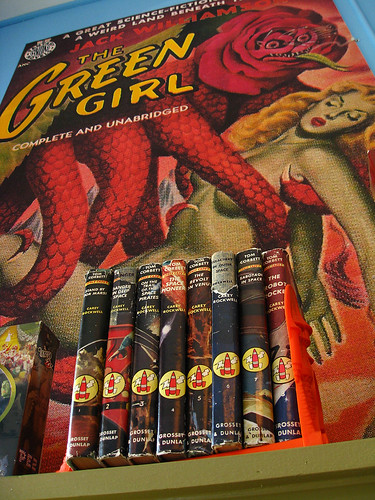
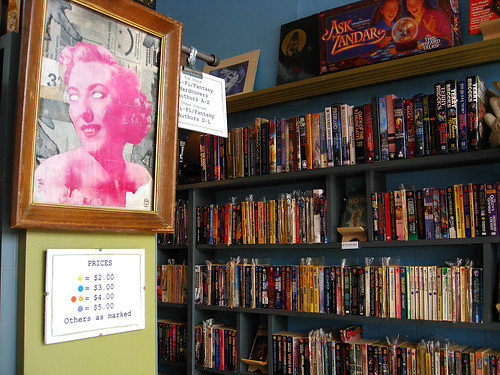
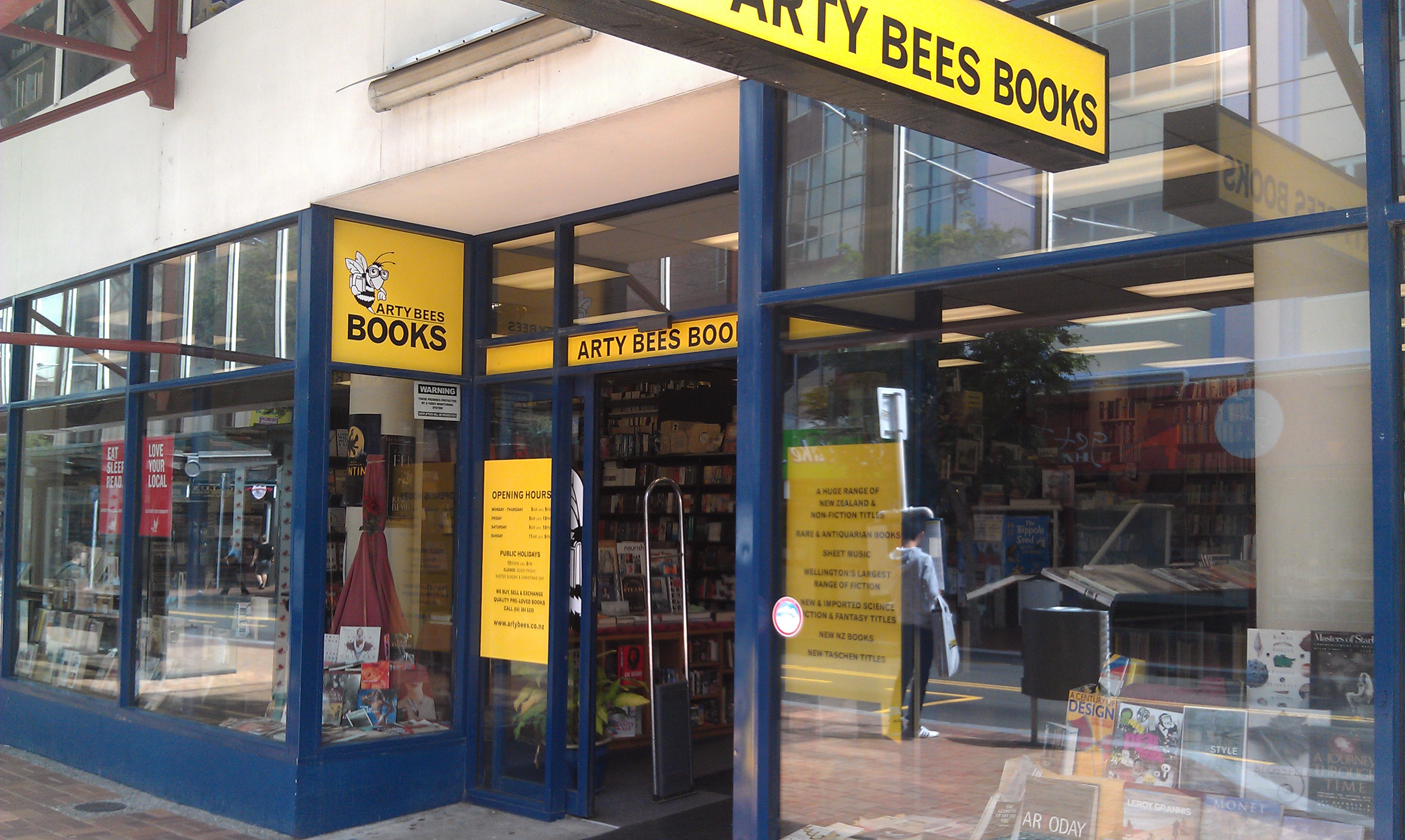
Arty Bees Books is located right off Cuba Street in the heart of Wellington, and offers sprawling selections of just about anything– fiction, references, instructional pamphlets, children’s literature, music, histories, rare/old tomes, and most importantly, bizarre bibliophilia curiosities. The best (and strangest) part was that I kept laughing while browsing Arty Bees whether from interesting shelving formations, weird collections displayed proudly, or the endless number of interesting genre placards. That does not happen at chain bookstores!

arty bees front
Sheet music AND imported SFF

Continue reading Bookstores of Wellington, New Zealand: Arty Bees Books

Anya’s Ghost, by Vera Brosgol (2011) E

Reviewer: Emera
Date read: 11.24.11
Book from: Personal collection

“Of all the things Anya expected to find at the bottom of an old well, a new friend was not one of them. Especially not a new friend who’s been dead for a century. Falling down a well is bad enough, but Anya’s normal life might actually be worse. She’s embarrassed by her immigrant family, self-conscious about her body, and she’s pretty much given up on fitting in at school.

Anya really could use a friend – even a ghost. But her new BFF isn’t kidding about the “Forever” part . . .”

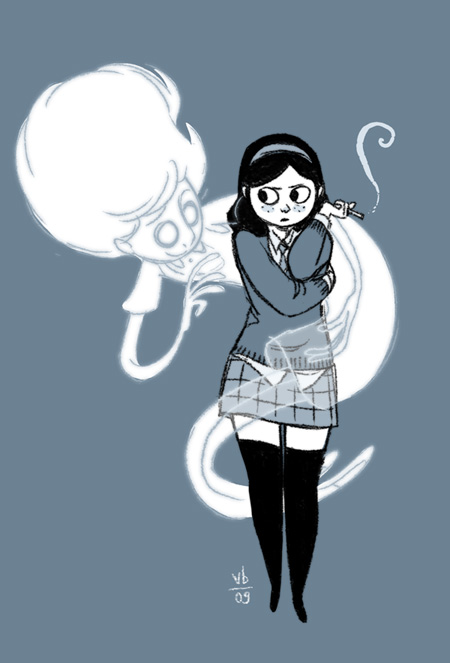
Great characters, great dialogue, fabulous art. Brosgol’s style is elastic and rounded, equally ideal for conveying weightless movement and solid figures; the same could be said of her writing.

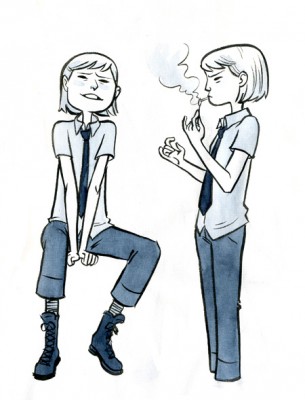
The resolutions to Anya’s emotional and social conflicts head towards conventional teen-movie territory, but Brosgol has such a light touch (her sharply contemporary dialogue often comes in handy) that none of the “wholesome realization! reconciliation and mutual understanding!” moments feel too heavy or forced. The climax, in particular, surprises by deliberately backing off of a too-easy, emotionally violent “conclusion.” I love how honest Anya comes to be about her own shortcomings. I’m also rather in love with her acerbic, squinty, spiky-skinny best friend Siobhan:

Siobhan
Siobhan, Exhibit A.

I found the comic a clear-eyed exploration of how so much of what makes teen girls unhappy – social pressure, body image, embarrassing family, lack of perspective – can come close to making some into little monsters of selfishness, and how they/we (been there, not so long ago) can come to back away from that brink. All in all: Anya’s Ghost is funny, scary, sad, and beautifully drawn.

(I first found Brosgol’s work, by the way, through the Draw This Dress Tumblr she shares with Emily Carroll, where the two post their lively illustrations of historical and sometimes not-so-historical fashion. Anya actually models a Victorian bathing suit in one post!)

Go to:
Vera Brosgol: bio and works reviewed

White Cat, by Holly Black (2010) E

Reviewer: Emera
Date read: 2011.10.16
Book from: Personal collection

Cassel Sharpe is the only non-magical member of a family of curse workers, in a world where magic is illegal and hence “worker” families constitute the magical equivalent of the mafia. Despite his disappointing failure to inherit curse-working powers, Cassel somehow managed to murder his childhood friend and love, Lila – though why he can’t remember. Add in life-threatening bouts of nightmares and sleepwalking, a dysfunctional crime family, and the beginnings of an elaborate conspiracy, and Cassel’s attempts at passing himself off as a normal kid seem like they might be over for good.

I read White Cat in one sitting after accidentally meeting Holly Black at a book festival and picking up a copy from her. This is addictive stuff: magical con artists and Russian mobsters; family melodrama; a hard-driving, twisty-turny plot; a mouthy, self-deprecating protagonist with likably grounded sidekicks. I must give a particular hurrah for there being a male Asian-American character: Sam Yu, Cassel’s roommate, a theater geek whose vehicle of choice is a converted hearse.

Black’s prose is a lot sharper and cleaner than I remember it being in her Modern Faerie trilogy, which I sorta-loved for its heroines, but mostly remember as a swill of angst. Cassel angsts plenty, too (I admit to skimming some of the whinier passages), but there are moments – particularly the ending – where his emotional experience deepens into real, wrenching anguish. That, and plenty of sharp detail – the world-building, Cassel’s slickly laid out cons, characters who convince you of their reality – kept me invested. I can’t wait to see where the series goes from here. Let this stand as a reminder to myself to pick up Red Glove whenever I find the chance.

Go to:
Holly Black: bio and works reviewed

The news gauntlet

Two bits of Caitlín Kiernan excitement:

  • The growing gallery of Kyle Cassidy’s photographic work based on Kiernan’s next novel, The Drowning Girl, forthcoming in March. The documentary clarity of Cassidy’s photos is unsettling in combination with the uncanniness of many of the scenes, particularly when angular, predatory Eva (as portrayed by model Sara Murphy) is involved. Other shots are intimate, introspective, rich and dusky in lighting. Prints from the collection are available for purchase, and one in particular is on sale.
  • An appetite-whetting interview over at Bloody Disgusting on Alabaster: Wolves, the forthcoming Dark Horse comic featuring Kiernan’s lonely, teenaged monster hunter Dancy Flammarion. Dancy first appeared in Threshold, and later in short stories collected in Alabaster (review).

Through all her earlier misadventures, Dancy has always been guided by an angel, this seraph, unless the seraph is only an expression of insanity, or some unconscious aspect of her that, inexplicably, leads her to these creatures. In the first issue, she breaks with her guardian angel, so to speak, and is on her own for the first time. She is reborn. Her will and her wiles become her only guiding force. I don’t want to drop too many spoilers, but Alabaster: Wolves is largely about Dancy finding her own way, and it’s a much darker road than she’s ever walked. Maybe this is a book about Dancy going sane. As to other themes, I’m really trying to address the grey areas between what we call good and evil. Dancy has always struggled with the idea that maybe she’s just another sort of monsters, and possibly some of the beings aren’t necessarily evil. You’ll see a lot of that.”

The strength (/blindness) of the earlier Dancy’s convictions made her both admirable and something of a psychological cypher, since she ultimately responded to any uncertainty or self-doubt by destroying external threats, and thereby, supposedly, restoring some measure of metaphysical order. I very much look forward to the new direction that the older and “rebooted” Dancy will take.

—–

The Sindiecate is an artist collective (six members so far) who post tributes to independent comics, featuring a different series each week. I’ve enjoyed browsing their archives both to see art of familiar favorites (Mouse Guard, Umbrella Academy, Oglaf [link is to my favorite piece of the bunch, which is, predictably if you know Oglaf, very much NSFW]…), and to glean recommendations for future comic reads.

—–

Check out The Open Road for a critical symposium spotlighting Hubert Selby, Jr., author of Last Exit to Brooklyn and Requiem for a Dream (review). I haven’t had a chance to read all of the essays yet, but so far I’ve particularly appreciated M. G. Stephens’ reflections on the development of Selby’s voice – one of his most remarkable assets, alongside his urgently expressed compassion for suffering – and the creative milieu he occupied in bohemian New York.

– E

Go to:
The Umbrella Academy, Vol. 1, by Gerard Way & Gabriel Ba (2008), review by Emera
Mouse Guard: Fall 1152, by David Petersen, review by Emera
Mouse Guard: Winter 1152, by David Petersen, review by Emera
Legends of the Mouse Guard, by David Petersen and others, review by Emera

Wislawa Szymborska, 1923-2012

Polish poet and Nobel laureate Wislawa Szymborska passed away last week, on Monday, February 1, at the age of 88. The Poetry Foundation has a brief obituary and one of her poems here. Rest in peace.

I spent several months last year reading a few of her poems in multiple translations (many of which I found through this aggregation assembled by the University of Buffalo), particularly “Brueghel’s Two Monkeys.” Her poems are carefully observed, ironic, sometimes cuttingly so, yet without the least trace of cruelty or bitterness: it is clear that she always wrote from a place of sorrow and love.

– E

??

Undercover: Pretty Monsters

Here’s a photo-feature that I’ve been wanting to start for a while: a series featuring the subtle design quirks that I occasionally find under the dust jackets of hardcover books. First up on the plate is Kelly Link’s Pretty Monsters, whose full cover design you can see here. Will Staehle’s enigmatic, Victorian-funereal (with horned women) design easily ranks in my top, oh, twentyish? favorite book designs of all time. That thar is a very rough assessment, but hopefully my point is clear: there are a lot of book covers that I like, but I really, really, really like this one.

The little monster-mark underneath just seals the book’s place in my affections:

Undercover: Pretty Monsters, by Kelly Link

Rawr!

– E

Vampire Stories by Women: “Turkish Delight,” “Prince of Flowers”

Reviewer: Emera
Dates read: The very end of December 2011
Read from: Vampire Stories by Women, ed. by Stephen Jones (2001). (I’ll be putting together an index post for this collection once I’m done reviewing the stories I found the most interesting.)

Roberta Lannes says in the introduction to her short story, “Turkish Delight” (2001),that the most interesting element of the vampiric repertoire to her is the seduction. The vampiric “granddad” in this story seduces by shaping himself to fill a lack; his eventual victim is Andrew, a gentle-hearted boy who lives in claustrophobically close quarters with his aunt and controlling, abusive mother, and dreams of finding his absent father’s family. (Enter the vampire…) Lannes does an excellent job of drawing the web of tensions and hidden desires at work in Andrew’s household, with its additional layer of vampiric subtext in how Andrew’s mother uses him as fuel for her pettish rages. Unfortunately, the end of the story loses emotional focus, once a slew of more conventionally “genre” elements are introduced (luxurious mansion full of vampire victims, etc.), and the narration seems to drift out of contact with Andrew’s experience. (It’s hard to imagine a 10-year-old boy thinking that “everything the old man said was full of vagaries and obfuscation.”) Still, Lannes’ story is often moving in its examination of deception and manipulation.

Stupid admission: I often confuse Elizabeth Hand with Elizabeth Bear. Same with Gene Wolfe and Gary Wolfe. That said – Elizabeth HAND’s “Prince of Flowers” (1988) starts with some absolutely gorgeous evocations of the vasty, esoteric innards of Washington D.C.’s Natural History Museum:

“Her favorite was Paleontology, an annex where the air smelled damp and clean, as though beneath the marble floors tricked hidden water, undiscovered caves, mammoth bones to match those stored above…

The Anthropology Department was in the most remote corner of the museum; its proximity to the boiler room made it warmer than the Natural Sciences wing, the air redolent of spice woods and exotic unguents used to polish arrowheads and axe-shafts. The ceiling reared so high overhead that the rickety lamps swayed slightly in drafts that Helen longed to feel. The constant subtle motion of the lamps sent flickering waves of light across the floor. Raised arms of Balinese statues seemed to undulate, and points of light winked behind the empty eyeholes of feathered masks.”

The prose continues to be gorgeous, but “Prince of Flowers” (the eponymous resident vampire is a beautiful Balinese puppet that Helen steals from the museum) unfortunately runs along monster-movie lines, and so lacks thematic or emotional resonance, outside of the unease conjured by the increasingly sinisterly lush descriptions.

Still, considering that this was Hand’s first published story, I’m definitely going to make a point of looking for more of her work. I’ve also read a couple of her reviews for F&SF, and found them a pleasure to read – thoughtful and wide-ranging.

Go to:
Stephen Jones: bio and works reviewed
Vampire Stories by Women: “Rampling Gate,” “Miss Massingberd”

Vampire Stories by Women: “Rampling Gate,” “Miss Massingberd”

Reviewer: Emera
Date read: 12.25.2011
Read from: Vampire Stories by Women, ed. by Stephen Jones (2001)

Inevitable disclaimer: I was obsessed with the first three books of Ann Rice’s Vampire Chronicles (and her two historical-fiction novels) in high school; haven’t read her since then. Also, this summary/review is spoilery.

“The Master of Rampling Gate” (1984), Rice’s only vampire short story, reads like an adolescent vampire’s dreams of an adolescent girl’s dreams of him (Twilight inverted?) – it’s a sentimental Gothic confection spun mostly of lissome sensuality and wish-fulfillment. Rice’s prose flows creamily (I use that word because I can’t help but remember Anthony Blanche’s indictment of Charles’ jungle paintings in Brideshead Revisited: “It was charm again, my dear, simple, creamy English charm, playing tigers…”), but there’s troublingly little depth to it. Maybe she was taking a break from the unrelenting moral horror that the VC protagonists wrangle with?

Young, idly wealthy Julie and Richard arrive in the country estate of Rampling Gate, having been commanded by their late father to tear it down “stone by stone,” but instead find themselves seduced by its quiet luxury and meditative, timeless solitude. A few gasps and midnight encounters later, Julie learns that the true master of Rampling is a mopy, beautiful vampire who dates to the Middle Ages and likes reading her fiction. (It must be true love!)

There’s a horrifying flashback to the plague years to explain why Rampling Gate, and the vampire, must remain – they serve as monument to the plague-devastated village that once stood there – but the story reverts so quickly to the couple’s delighted honeymoon-planning that the plague episode ends up reading as an ornament to the tragedy of the eternally lonely vampire, rather than a reflection on human misery and the awfulness of history.

The whole thing is especially creepy because Rice keeps on insisting that the chief attribute of both Julie and the vampire is their innocence, even when he’s lovingly showing her visions of them feasting together upon ladies in red-wallpapered bordellos – because she has to become his vampire mistress, natch. Hooray for eternally prolonged adolescence!

—–

Tina Rath’s “Miss Massingberd and the Vampire” (1986) is a crisply written, very Britishly humorous little story. As in the other story that I’ve read of Rath’s, “A Trick of the Dark” (review in this post), the vampire offers sensual escape from a buttoned-up life, here that of a schoolmistress whose evening encounter in a churchyard tweaks her life slightly out of the polite course of things. It’s a story that, like Miss Massingberd, seems to be smiling to itself.

Go to:
Stephen Jones: bio and works reviewed
Anne Rice: bio and works reviewed
Tina Rath: bio and works reviewed
Bookstores of Boston/Cambridge: Seek Books

Seek Books
1747 Centre Street, Boston, West Roxbury, MA, 02132

Seek Books storefront

Seek deserves to be called something really grandiose, like “a repository of pulp splendor.” Seriously, if you’re an sff fan (especially if you’re the kind who has slightly off tastes and whose favorite authors are generally out of print… not that I’d know anything about this) and ever in the Boston area, don’t miss it. Seek has character.

Old posters and figurines and ’90’s boardgames abound; it smells like the kind of paperbacks that have banana-yellow edges; many of the books are battered within an inch of their lives (and rightly so, since Seek specializes in pre-1970’s fiction). The owners are as much curators as booksellers: series are carefully sorted out of the morass and shelved together, books with particularly loved cover art are wrapped in plastic.

The smiley-face-sticker pricing system is fun (and yes, the prices are ridiculously good), though sometimes the stickers do end up pulling off bits of binding off the spine. (Kakaner & I were also a little alarmed that sorted series are sometimes rubber-banded together, which means that spines and covers inevitably get bent.)

That aside, I don’t know too many other places where I could come away with a stack of eighteen or so Tanith Lee novels (I exaggerate, but not significantly) in one trip. Kakaner and I have been here twice so far, and each time we always end up finding way more things that we’d like to buy than we thought we were actually looking for – odd editions of favorite children’s books, copies of classics with actually frightening cover art (that Zelazny novel… SHUDDER)…

Some more photos under the cut, including some unbelievable monuments of SFF publishing history/nerd conversation pieces:

Continue reading Bookstores of Boston/Cambridge: Seek Books

Wayward Girls and Wicked Women, ed. by Angela Carter (1986) E

Reviewer: Emera
Date read: 6.8.11
Book from: Personal collection

An ironic title: Carter’s take on “waywardness” and “wickedness” is far more subtle, of course. The women in this anthology – all written by women – are canny, worldly, self-directed. They are leery of others’ plans for them, and quietly attentive to their own desires – which is not to say that they are selfish, necessarily*, though they run the gamut when it comes to moral fiber. The mother in Elizabeth Jolley’s “The Last Crop” cheerfully cons a kindly doctor when she decides that she’d really rather keep and cultivate her inherited land after all. The women and girls in Jane Bowles’ “A Guatemalan Idyll” are capable of disturbingly calculated callousness – the youngest, Lilina, “[chooses] her toys according to the amount of power or responsibility she thought they would give her in the eyes of others.” The particular toy she considers in this story, a pet snake, ends up beheaded due to her (deliberate?) carelessness; Lilina’s only comment is, “Look how small her head is. She must have been a very small snake.”

(In a wonderfully horrible play with point of view, Bowles half-distracts us from the impending violence in this scene by shifting the perspective to another character just long enough for the snake’s death to occur in the interim. [The other character, a boy, is meanwhile observing that he dislikes Lilina “probably because he suspected intuitively that she was a person who could fall over and over again into the same pile of broken glass and scream just as loudly the last time as the first.”] The aggregation of such effects in this story left me strangely unsettled, and, like the visiting traveler who eventually “escapes” from the Guatemalan women, feeling like I’d awoken from a fever dream.)

I’ve gotten way off track – there’s so much to talk about in each story. Carter’s own point about the morality of these women, questionable or otherwise, is that the range represented is a normal one. The women here are well-characterized individuals, flawed and proud individuals of varying ages and desires and backgrounds, rather than one-note femmes fatales or whores or shrews. They frequently “act out” simply by resisting, by hunkering down and continuing to dig out their own paths. The protagonist of Ama Ata Aidoo’s “The Plums,” a Ghanaian student named Sissie who is touring in Europe, looks askance at the advances of a lonely German housewife, and in the end sloughs her off and keeps traveling. Throughout the story, she registers an ironic combination of pity and quiet contempt for the German woman and for whiteness in general, reflecting that “it must be a pretty dangerous matter, being white. It made you awfully exposed, rendered you terribly vulnerable. Like being born without your skin or something.” (The German woman’s son and husband are both named Adolf, it’s worth noting.) By contrast, Sissie goes through the story shielded, observing and untouched, sometimes even cruel, behind her armor of self-respect.

Continue reading Wayward Girls and Wicked Women, ed. by Angela Carter (1986) E