romance

You are currently browsing articles tagged romance.

Date read: 1.2.11
Book from: Public library
Reviewer: Emera

“The story I tell over and over and over and over is Beauty and the Beast.  It all comes from there.  There are variations on the theme–and it’s inside out or upside down sometimes–but the communication gap between one living being and another is pretty much the ground line.  And usually the gap-bridger is love.”

- from Robin McKinley’s blog (this post)

Mirasol, formerly a beekeeper, has become the Chalice of her demesne, charged with binding and unifying both its inhabitants and its restive magical energies. Unfortunately, her demesne is unsettled by the violent deaths of its last Master and Chalice. The arrival of the new Master only promises more strife. Previously banished by his brother, the last Master, to the priesthood of fire, he returns more than a little inhuman, terrifying to his own people and perhaps unable to command the land’s magic as he should.

The feeling that struck me as I was reading Chalice was that I was reading Sunshine again – which makes perfect sense, given McKinley’s above reflection. Chalice plays on that dynamic, and many more of her trademarks: fearful and inexperienced but pragmatic, good-hearted protagonists; magic that’s as often inconvenient and frightening as it is wondrous. (Mirasol, when receiving omens of her impending Chalicehood, spends most of her time cleaning up after the overflowing milk and honey that result.)

More than any of McKinley’s other books that I can recall (except maybe Rose Daughter), Chalice has an elusive, vignette-ish quality to it.  It feels as if we only spend a brief time with the characters and world before the curtain drops on the scene again. Mirasol’s world is rich with tradition and history – there are numerous mentions of a not-so-distant barbaric past, and Mirasol’s fellow Circle members have evocative, little-explained titles like “Talisman” and “Sunbrightener” – but we’re only privy to what detail Mirasol’s own experiences reveal. This guardedness lends the setting a pleasantly mysterious feel.

On the other hand, I was not so much a fan of the intense internality that controls most of the book. The vast majority of it happens inside of Mirasol’s head, with dialogue and action indirectly reported, and flashbacks and occasionally repetitive exposition occupying much of the first half of the novel. So while I was deeply intrigued by the setting and circumstances,  I felt a little stifled and not immediately involved. I was also put off by the flatness of the political conflict that eventually tests both Chalice and Master. I realize that for McKinley it’s always more about how her protagonists overcome difficulties, rather than what in particular they’re overcoming, but it can start to seem a little silly when all the villains are either greedy Overlords or mincing sycophants.

Overall, though, I was happy to sit back and enjoy the ride, just soaking up the odd, earthy details of Mirasol’s life, the rituals that she concocts and carries out, and the few characters with whom she interacts. Also, the love story is very sweet. Throughout, McKinley wields crisp, vivid language that particularly helps to crystallize Mirasol’s experiences of magic. Chalice is not a must-read if you’re not already a big McKinley fan, but it is beautiful and ultimately satisfying, if on the slower side.

Go to:
Robin McKinley: bio and works reviewed
Beauty (1976), review by Emera
Deerskin (1993), review by Emera
Deerskin (1993), review by Kakaner

Tags: , , ,

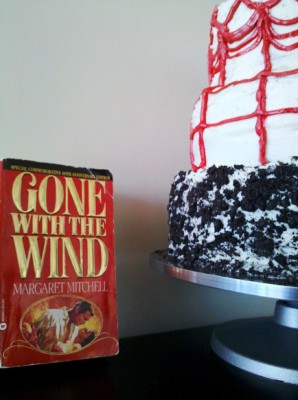
gone-with-the-wind-tara-cake-book-margaret-mitchell-partial

View Recipe: Gone With the Wind Tara Cake

I envisioned nothing less than a grand, massive tiered cake for Margaret Mitchell’s sweeping 1936 romantic epic, Gone With the Wind.  This famous and controversial novel has all the good bits– war, betrayal, unrequited love, mis-timed requited love– and a spoiled southern belle forced to experience the worst of humanity who then seizes her life back though hard work, womanly charms, and sheer force of will. This recipe is meant to capture the full range of history, time and emotion in the novel, as well as convey an atmosphere of grandness throughout.

Read the rest of this entry »

Tags: , , ,

Date read: 12.30.10
Book from: Public library
Reviewer: Emera

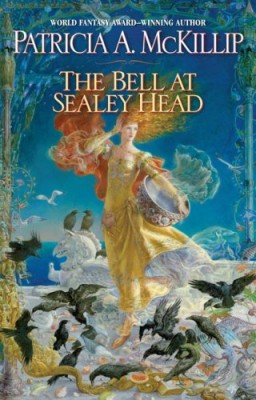
The Bell at Sealey Head

The Bell at Sealey Head contains the most outright sexual passage I can recall reading in any of Patricia McKillip’s work. Tellingly, it’s also a tongue-in-cheek commentary on bibliomania:

The odd thing about people who had many books was how they always wanted more. Judd knew that about himself: just the sight of Ridley Dow’s books unpacked and stacked in corners, on the desk and dresser, made him discontent and greedy. Here he was; there they were. Why were he and they not together somewhere private, they falling gently open under his fingers, he exploring their mysteries, they luring him, enthralling him, captivating him with every turn of phrase, every revealing page?”

A-hem.

McKillip was possibly my most protracted love affair during my high school reading. Though I’ve grown away from her work a bit since then (particularly since I wasn’t much taken with her last two novels), reading The Bell at Sealey Head was a pleasant return. It’s a bit like Georgette Heyer meets Ombria in Shadow. Much of the novel concerns itself with gentle comedy and small dramas of courtship, set in the titular seaside town “at the edge of the known world.” But the underlying mystery that drives the plot concerns a ghostly bell that rings at sundown, and a strange world of knights and ritual occasionally glimpsed through the doors of a decaying manor.

McKillip occasionally writes overwhelmingly large, hectic casts, but here the slow pace and loose plot give the characters room to breathe. I found most of them endearing, if not all terribly memorable as individuals. There’s a book-obsessed innkeeper’s son (Judd); a merchant’s daughter being courted by a cloddish squire, but who would much rather write novels; an itinerant scholar with a keen interest in the history of the phantom bell; a maid who has befriended the princess who lives in the manor’s past; and so on.

As in The Tower at Stony Wood, there’s a strong feminist thematic, with a particularly pointed attack being made on the conventions of the courtly romance: the princess is made to constantly fulfill fractured, meaningless rituals in service of the faceless knights who ride in and out of the castle, with the expectation of eventually being married off to one of them purely for the purposes of bearing another child to carry out the rituals. (Spoiler: We eventually learn that she has literally been imprisoned in images out of a storybook.) Several of the other female characters are quietly rebellious, and seek self-determination or otherwise subvert social expectations. One of the most interesting, though least-seen characters is a woman of wealth who is forced to conceal her intelligence and private desires by perfecting a mask of exquisite boredom and frivolity.

All in all, a sweet, thoughtful, and frequently witty read. Not as urgent or eerie as my favorites of McKillip’s works, but as usual, it’s full of memorable, otherworldly imagery, rich and occasionally glinting with menace. It also has some awesome lifestyle inspiration, in the form of an herbalist who runs around barefoot and lives in a book-filled, garden-surrounded house built in and around a hollow tree trunk. Excuse me while I radiate envy/aspiration…

P.S. Happy 2011, all!

Go to:
Patricia A. McKillip: bio and works reviewed

Tags: , , , ,

Date read: 12.19.10
Book from: Public library
Reviewer: Emera

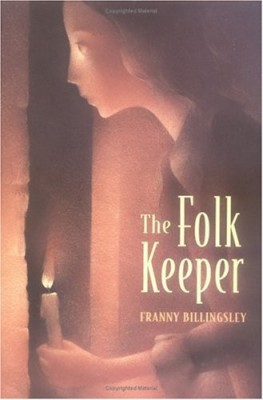
book folkkeeper

“Here in the cellar, I control the Folk. Here, I’m queen of the world.”

The Folk Keeper is much darker and stranger than I expected based on the title and cover art alone – which is awesome, since that’s the way I prefer it. Corinna Stonewall is a proud, vengeful orphan girl who by wit and trickery earned the position of Folk Keeper. In subterranean dark, she appeases the anger of the vicious, cave-dwelling Folk – described as “mostly wet mouth and teeth.” Summoned by a dying lord to be Folk Keeper of his island estate, where the Folk are particularly voracious and mysteries abound, Corinna sets about uncovering any secrets that might give her more power, whether over the Folk or the estate’s various inhabitants. At the same time, it comes clear that she must begin to come to terms with her own secrets: her unknown parentage, her odd powers and desires.

Billingsley’s angular, vivid prose is an absolute pleasure, full of sharp dialogue, intriguing detail, and unsettling, obliquely beautiful imagery; she’s one of the most successful stylists I’ve encountered in recent years. If you have any familiarity with Celtic folklore, the key to Corinna’s secrets is pretty obvious, but Billingsley puts a number of creative spins on this and other traditional elements within the novel. Some are more convincingly organic than others, but all are beautifully described. And Corinna’s friendship with Finian, the estate’s eccentric, ship-loving heir, is genuinely endearing, with his good heart and gentle quips countering and eventually thawing her chilly Machiavellian pragmatism. I would gladly welcome a sequel just to read more of their [ADORABLE] exchanges. (<— ill-concealed fangirling, exhibit A.)

The only point on which I was less happy: the last few pages seemed overburdened by their obvious instructive agenda and labored symbolism, which cost the narrative some of its earlier leanness and fluidity.

Nonetheless, The Folk Keeper is destined to become part of my permanent collection, and likely the subject of numerous re-reads. Fans of traditional fairy lore, Patricia McKillip, Holly Black, or Elizabeth Marie Pope’s The Perilous Gard, go forth and read! In the meantime, I’ll be eagerly anticipating Billingsley’s next YA novel, which is apparently slated for spring 2011…

Go to:
Franny Billingsley: bio and works reviewed
Author’s Note for The Folk Keeper

Tags: , , , , ,

Date read: 12.10.10
Read: Borders piracy
Reviewer: Emera

Quick skim after my interest was momentarily piqued by seeing the trailer for the upcoming movie adaptation. Alex Flinn’s take on Beauty and the Beast casts Kyle Kingsbury, a New York prep-school prince with daddy issues, as the Beast. After playing a cruel prank on a (token subcultural) classmate, Kyle is horrified to discover that said classmate is, in fact, a witch, who proceeds to perform the requisite curse. Kyle is exiled by his father to an apartment in Brooklyn, where he sulks, is encouraged to read classics by his blind tutor, cultivates an interest in rose-gardening, obsesses over how he’s going to find someone to love him, and engages in mildly amusing repartee with a chatroom full of other modern-day fairy-tale characters. After an altercation with a drug addict, Kyle ends up welcoming into his mini-domain the addict’s daughter: one of his former classmates, a token scholarship student/girl named Lindy, who happens to like books and roses. You know where it goes from there.

For a book that’s supposed to be about learning not to rely on good looks and privilege, Beastly is distinctly concerned with, well – good looks and privilege. When Kyle first meets the witch, she’s described as an overweight Goth girl with a hooked nose and green hair. Luckily, when she reveals herself to Kyle as a witch, we learn that oh, actually, she has long eyelashes and a nice nose and a “hot” body. This is how we know she’s cool and powerful! And apart from his personality makeover, pretty much everything that Kyle accomplishes in the book (constructing a greenhouse and growing roses, buying a library’s worth of books for Lindy) is contingent on his still having access to his daddy’s credit card. Also, have a wise Latina (in the film version, magical negro) maid while you’re at it!

So yeah, I was not so much a fan, although I did find parts of Kyle’s voice and mannerisms surprisingly convincing, particularly his mixture of half-formed self-awareness and “buuut I couldn’t be bothered to give a crap about it” attitude, and some of his painfully telling remarks about his childhood perception of his father. The result is a character who balances depressingly realistic self-absorption and callousness with a believable eagerness to learn and do good.

I did appreciate Flinn’s obvious desire for readers to further investigate fairy tales and literature – the book is littered with references to other adaptations and parallel works, e.g. The Phantom of the Opera and The Hunchback of Notre Dame, and the afterword includes extensive recommendations for other fairy-tale retellings. If I could rewind, I might have read only the afterword, really, since I enjoyed her reflections on how she decided to approach the tale, particularly her observation that Beauty and the Beast can be read as two abandoned children united by circumstance. Nonetheless, I’m going to be incredibly predictable and recommend instead either of Robin McKinley’s retellings (Beauty or Rose Daughter; review of Beauty here) or, if you’re interested in the Beast’s perspective, Donna Jo Napoli’s Beast, whose historical and descriptive detail I remember enjoying.

Go to:

Alex Flinn: bio and books reviewed
Beauty, by Robin McKinley (1976) E

Tags: , , , ,

Date read: 11.30.10
Read: Online, via Nerve
Reviewer: Emera

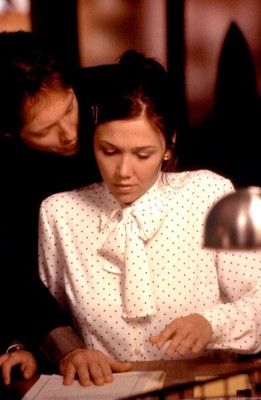
Secretary - James Spader and Maggie Gyllenhaal

The 2002 film Secretary stars the incomparable Maggie Gyllenhaal as an emotionally fragile young woman who enters into a sadomasochistic relationship with her lizard-eyed, hypercontrolled lawyer boss (James Spader): two very unhappy people who find that they are each other’s complements, emotionally and sexually. After seeing the movie twice, and both times loving its tenderness, quirky humor, rich visuals, and slinking soundtrack, I finally read the Mary Gaitskill short story (click to read) on which it was based.

Predictably, the movie and story are utterly different beasts, with the film departing from the story’s restless, sickly unhappiness. Gaitskill called the film adaptation the “Pretty Woman” version, which is apt, but doesn’t, I think, negate the film’s sensitivity and sweetness. In the film, the secretary (Lee) and lawyer (Mr. Grey) find a genuine connection, with Lee eventually emerging as the one with the strength to dictate the terms of their relationship.

In Gaitskill’s story it’s pretty clear that the (nameless, sleazily charismatic) lawyer is using the secretary (Debby in the story) for his own gratification because he knows she’ll let him get away with it. Yes, some part of her does enjoy it – after her last encounter with the lawyer, she remarks impassively, “I didn’t feel embarrassed. I wanted to get that dumb paralegal out of the office so I could come back to the bathroom and masturbate.” But the undertones of her identification with the humiliation that she experiences are much more troubling, and by the end of it, she returns home to be soundlessly reabsorbed into her dysfunctional family, who, given their “intuition for misery,” ask no questions.

Apart from the entirely divergent emotional experience, what struck me most on reading the story is how successful the film was in capturing Gaitskill’s written style. Debby’s narration is flattened, almost child-like, but interspersed with bursts of ungainly, oddly vivid imagery: “There were no other houses or stores around it, just a parking lot and some taut fir trees that looked like they’d been brushed.” “He clapped his short, hard-packed little hands together and made a loud noise.” And possibly my favorite – “A finger of nausea poked my stomach.” Gyllenhaal’s Lee, with her wise-child face, shabby graceless suburbanity, and propensity for awkward remarks and fits of snorting laughter, recreates the experience perfectly, particularly when juxtaposed with the plush, hushed interior of Mr. Grey’s office. I expect most audiences will prefer the transformative love story that follows in the film, but Gaitskill’s original is stylistically memorable, bitterly intelligent, and packs powerful character portraits into a few terse pages.

Go to:

Mary Gaitskill: bio and works reviewed

Tags: , , ,

Date read: 6.8.10
Book from: Borrowed from my brother
Reviewer: Emera

Since I’ve been wasting too much time trying to write summaries and not enough actually reviewing, I’m deploying a back-cover summary here:

Somewhere in South America, at the home of the country’s vice president, a lavish birthday party is being held in honor of the powerful businessman Mr. Hosokawa. Roxane Coss, opera’s most revered soprano, has mesmerized the international guests with her singing. It is a perfect evening – until a band of gun-wielding terrorists takes the entire party hostage. But what begins as a panicked, life-threatening scenario slowly evolves into something quite different, a moment of great beauty, as terrorists and hostages forge unexpected bonds and people from different continents become compatriots, intimate friends, and lovers.

So my main difficulty with Bel Canto laid in the fact that it’s halfway a rapturously romantic fable about the power of art – opera in particular – and love, and halfway a grim tragedy. Now, that’s basically the story’s selling point, that the author plays on the tension between romance and realism, but it left me feeling a little cold and mostly troubled throughout. The romance reaches such giddy heights, with character after character discovering hidden talents and unexpected love, that my suspension of disbelief (which is notoriously generous) just gave up and wandered away about halfway through, leaving me reluctant to be really convinced and moved by any of it. (I still teared up at the ending, though.)

This despite Patchett’s coolly, dreamily elegant and often funny prose, the artfulness of the entire set-up, and my wanting to really care for the characters, all of whom are very human and carefully drawn. There’s a French ambassador who just wants to go home to his wife, a vice president who throws himself with increasing satisfaction into his role as maid to captors and captives alike, a translator who’s forced to find words of his own for the first time in his life, a weary Red Cross negotiator who watches the breakdown of the hostage-terrorist divide with growing unease… I did think that their development suffered from the fact that the cast is so large, so that many don’t get much further than sketches, even if those sketches are evocative.

All in all, I found the book pleasing in style and admirable in craft, but as a whole it just didn’t click for me.

Go to:
Ann Patchett

Tags: ,

Date Read: 6.10.09 (fourth[?] reread)
Book From: Personal collection
Reviewer: Emera

Caribou is a dreamer of dreams, a solitary figure isolated from her tribe ever since the death of her father. One day her sister-in-law comes to her, bearing a strange golden child whom she begs Cari to conceal and raise. At first unwilling, Cari is nevertheless struck by the child’s beauty and takes him in, naming him Reindeer – for as she reluctantly comes to realize, he is a trangl, one who can take the form of both human and stag. Though she longs to keep him by her side, his blood will always call him to run with the wild deer that course the land. As the years pass, stirring spirits and strange upheavals in the mountains and hot springs send the tribespeople to Cari’s door for advice. From Reindeer, she learns that the world is being remade, and that if she is to save her people, she and Reindeer must guide them over the Burning Plains to the safety of the lands that lie beyond the Pole, where only the wild deer have run before.

Of all the authors I’ve read, I’ve most deeply identified with the work of Meredith Ann Pierce, for the longest period of time. I first read her books when I was eight or nine, and though there were many literary loves before then, and have been many, many more since, I always think of Pierce’s books – particularly her Darkangel Trilogy – as The Milestones. She’s most often written tales about strange, wise girls who become strange, wise women, fall in love with transfigured or supernatural lovers, and have adventures in worlds of beautifully realized mythology. Mythology, because her books often read to me like myths from alien planets: her images and language have a timeless, jewel-like purity to them, coupled with deliciously archaic diction and – this might be the part that most gets me – a deep, deep sense of yearning that encompasses both human and immortal desires.

This was the first time I’ve re-read one of her books in about eight years, and since a lot has changed in that time, this doesn’t have quite as immediate an emotional impact on me as it used to. I used to get a lot of vicarious rage and anguish on Cari’s behalf. The older me is both slightly more phlegmatic (though really not that much less romantic), and slightly savvier: this time around, I was a little squicked at Cari having a relationship with her foster child, despite Pierce’s care in emphasizing his inhuman nature and unfamilial relationship with Cari.

Regardless, I was still deeply affected by the wondrous and joyful imagery: gambling trollwives, rivers of silver caribou running, a sledge with belled harness and golden runners, firelords with lava-seamed palms… And while the younger me fumed (again on Cari’s behalf) when she read the inconclusive ending, the older me was pleasantly surprised to recognize its maturity and realism. This will continue to be a story, and a world, that I treasure, and that I suspect will still surprise me every time I re-enter it.

Meredith Ann Pierce’s works will very likely appeal to fans of Patricia McKillip and Robin McKinley; I’ve never entirely understood why she hasn’t become more well-known and widely read. Not that I’m biased or anything.

Go to:
Meredith Ann Pierce

Tags: , , ,

Translated 2009 by Deborah Boliver Boehm.

Date Read: 4.11.10
Book From: Personal Collection, from Vertical, Inc.
Reviewer: Kakaner

Summary

The Cat in the Coffin is a romance/suspense (rather than a romance/mystery as the back cover claims) novel set in Japan that revolves around three lives: Masayo, an aspiring painter who is simultaneously a casual student of Goro, one in a family of famously lucrative artists, and a live-in tutor for Goro’s reserved and precocious daughter, Momoko. As Masayo eagerly begins her duties in the househould, she beings to naively fall for Goro, until the entrance of an old flame sets catastrophic events into motion.

Review

Unfortunately, I have much more gripe than praise for this book, despite giving ample room for consideration given that I was not reading it in the original language. Overall, it is a superficial, cheesy, predictable, simple story, heightened by the fact that it is very apparent Koike was trying to weave a masterful complex tale. First, I would use this book for the classic lesson of “Show. Not tell.” Most of the suspense in the novel would have been halfway effective had Koike not prefaced every twist with flashing red warning signals. Momoko goes out into the snow at night, and Masayo is “filled with a sense of foreboding” and “knows something bad is about to happen.” As she rushes out in the snow after Momoko, she images a sinister scene unfolding (which, I might add, had been set up from the first chapters anyway), which lo and behold, just happens to be the same as the events that actually do take place. In this way, several crucial scenes are effectively ruined throughout the book. It’s actually pretty surprising how Koike manages to wrangle so many elements of Suspense 101 yet is still described as a celebrated mystery and romance writer in Japan.

Read the rest of this entry »

Tags: , ,

Date read: 4.4.08
Read from: Fantasy Magazine
Reviewer: Emera

… The Mumbaki came, as did the elder warriors, and they sang of Bugan the sky goddess who descended to earth to marry the warrior Kinggawan. They sang of how the lovers lost each other and how Kinggawan seeks his Bugan to this day. When the Mumbaki poured the wine over your head you did not cry.

It was a good sign, the village people said. But no one could explain why. It just was so.

After this, there was more dancing and feasting, but your mother took you away to the quiet of her hut where she stared into your face and tried to read your future while you suckled at her breast.

“Hi Bugan ya Hi Kinggawan” is inspired by the mythology of the mountainous Ifugao region of the Philippines, where the author was raised. It’s both thematically and aesthetically satisfying, playing on personal and cultural anxieties through parallel narrative threads: the emotional and sexual coming-of-age of a young woman named Bugan, after the Ifugao sky goddess, and the upheaval in her small village as contact is made with Western colonizers.

Loenen-Ruiz’s language is vibrant and wonderfully rhythmical (I’d love to hear the story read aloud), and she skillfully conveys the turbulence of the forces working on the protagonist and her culture. Against the themes of loss and disruption, Loenen-Ruiz sets the heady sensuality of the story’s resolution. Renewal of tradition is coupled with the building of new unities; an act of sexual transgression becomes an act of cultural resistance.

Also, the love interest is hot. Just sayin’.

Go to:
Rochita Loenen-Ruiz
Fantasy Magazine Author Spotlight with Rochita Loenen-Ruiz

Tags: , , , ,

« Older entries