feminism

You are currently browsing articles tagged feminism.

Reviewer: Emera
Date read: 6.8.11
Book from: Personal collection

An ironic title: Carter’s take on “waywardness” and “wickedness” is far more subtle, of course. The women in this anthology – all written by women – are canny, worldly, self-directed. They are leery of others’ plans for them, and quietly attentive to their own desires – which is not to say that they are selfish, necessarily*, though they run the gamut when it comes to moral fiber. The mother in Elizabeth Jolley’s “The Last Crop” cheerfully cons a kindly doctor when she decides that she’d really rather keep and cultivate her inherited land after all. The women and girls in Jane Bowles’ “A Guatemalan Idyll” are capable of disturbingly calculated callousness – the youngest, Lilina, “[chooses] her toys according to the amount of power or responsibility she thought they would give her in the eyes of others.” The particular toy she considers in this story, a pet snake, ends up beheaded due to her (deliberate?) carelessness; Lilina’s only comment is, “Look how small her head is. She must have been a very small snake.”

(In a wonderfully horrible play with point of view, Bowles half-distracts us from the impending violence in this scene by shifting the perspective to another character just long enough for the snake’s death to occur in the interim. [The other character, a boy, is meanwhile observing that he dislikes Lilina "probably because he suspected intuitively that she was a person who could fall over and over again into the same pile of broken glass and scream just as loudly the last time as the first."] The aggregation of such effects in this story left me strangely unsettled, and, like the visiting traveler who eventually “escapes” from the Guatemalan women, feeling like I’d awoken from a fever dream.)

I’ve gotten way off track – there’s so much to talk about in each story. Carter’s own point about the morality of these women, questionable or otherwise, is that the range represented is a normal one. The women here are well-characterized individuals, flawed and proud individuals of varying ages and desires and backgrounds, rather than one-note femmes fatales or whores or shrews. They frequently “act out” simply by resisting, by hunkering down and continuing to dig out their own paths. The protagonist of Ama Ata Aidoo’s “The Plums,” a Ghanaian student named Sissie who is touring in Europe, looks askance at the advances of a lonely German housewife, and in the end sloughs her off and keeps traveling. Throughout the story, she registers an ironic combination of pity and quiet contempt for the German woman and for whiteness in general, reflecting that “it must be a pretty dangerous matter, being white. It made you awfully exposed, rendered you terribly vulnerable. Like being born without your skin or something.” (The German woman’s son and husband are both named Adolf, it’s worth noting.) By contrast, Sissie goes through the story shielded, observing and untouched, sometimes even cruel, behind her armor of self-respect.

Read the rest of this entry »

Tags: , , , , ,

What’s that, you say? It’s Friday? Indeed it is, and for once I have something to show for it. Although it’s only sorta a Bad Book Cover Friday, as this June 1983 Magazine of Fantasy & Science Fiction cover isn’t astoundingly bad.

I mean, it’s bad, but it’s bad simply in that there’s nothing good about it. The mediocrity/absurdity/ignorance of color theory and anything else that would contribute to an aesthetic and/or compelling cover are so generally apparent that I have nothing specific to say about them.

The contents of the magazine’s advertisements, on the other hand…

Read the rest of this entry »

Tags: , ,

Date read: 12.30.10
Book from: Public library
Reviewer: Emera

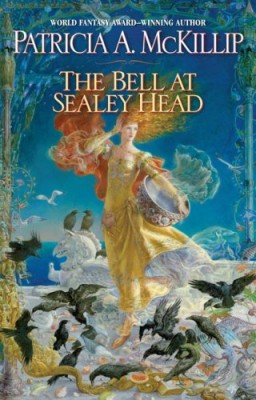
The Bell at Sealey Head

The Bell at Sealey Head contains the most outright sexual passage I can recall reading in any of Patricia McKillip’s work. Tellingly, it’s also a tongue-in-cheek commentary on bibliomania:

The odd thing about people who had many books was how they always wanted more. Judd knew that about himself: just the sight of Ridley Dow’s books unpacked and stacked in corners, on the desk and dresser, made him discontent and greedy. Here he was; there they were. Why were he and they not together somewhere private, they falling gently open under his fingers, he exploring their mysteries, they luring him, enthralling him, captivating him with every turn of phrase, every revealing page?”

A-hem.

McKillip was possibly my most protracted love affair during my high school reading. Though I’ve grown away from her work a bit since then (particularly since I wasn’t much taken with her last two novels), reading The Bell at Sealey Head was a pleasant return. It’s a bit like Georgette Heyer meets Ombria in Shadow. Much of the novel concerns itself with gentle comedy and small dramas of courtship, set in the titular seaside town “at the edge of the known world.” But the underlying mystery that drives the plot concerns a ghostly bell that rings at sundown, and a strange world of knights and ritual occasionally glimpsed through the doors of a decaying manor.

McKillip occasionally writes overwhelmingly large, hectic casts, but here the slow pace and loose plot give the characters room to breathe. I found most of them endearing, if not all terribly memorable as individuals. There’s a book-obsessed innkeeper’s son (Judd); a merchant’s daughter being courted by a cloddish squire, but who would much rather write novels; an itinerant scholar with a keen interest in the history of the phantom bell; a maid who has befriended the princess who lives in the manor’s past; and so on.

As in The Tower at Stony Wood, there’s a strong feminist thematic, with a particularly pointed attack being made on the conventions of the courtly romance: the princess is made to constantly fulfill fractured, meaningless rituals in service of the faceless knights who ride in and out of the castle, with the expectation of eventually being married off to one of them purely for the purposes of bearing another child to carry out the rituals. (Spoiler: We eventually learn that she has literally been imprisoned in images out of a storybook.) Several of the other female characters are quietly rebellious, and seek self-determination or otherwise subvert social expectations. One of the most interesting, though least-seen characters is a woman of wealth who is forced to conceal her intelligence and private desires by perfecting a mask of exquisite boredom and frivolity.

All in all, a sweet, thoughtful, and frequently witty read. Not as urgent or eerie as my favorites of McKillip’s works, but as usual, it’s full of memorable, otherworldly imagery, rich and occasionally glinting with menace. It also has some awesome lifestyle inspiration, in the form of an herbalist who runs around barefoot and lives in a book-filled, garden-surrounded house built in and around a hollow tree trunk. Excuse me while I radiate envy/aspiration…

P.S. Happy 2011, all!

Go to:
Patricia A. McKillip: bio and works reviewed

Tags: , , , ,

Reviewer: Emera

Err, couldn’t think of a semi-clever conglomerate title for this string of short story reviewlets, but onwards!

—–

Jeanne Desy‘s “The Princess Who Stood On Her Own Two Feet” (1981; read 4.19.10) is an obvious but not uncharming feminist fairy tale about a tall princess, her faithful (talking) Afghan hound, and a prince with questionable values.

For a bit of background, this apparently first appeared in Ms. magazine in 1981, became quite popular, and has since been frequently republished. Also, someone pointed me to it when, on behalf of a friend, I was trying to find out the title/author of a story (not this one) about a prince who thinks he’s a dog, and ends up having to be wooed by a princess who also thinks she’s a dog. If anyone’s read that one, let me know! The source remains elusive – the friend’s not even sure if it’s a short story or a side episode within a longer novel.

—–

Kelly Barnhill‘s “Homecoming” (2008; read 4.4.10, from Underground Voices) is a vignette about return from war, and small mercies. Not all of the prose gets to where it’s trying to go (“They tilted their faces to the ground and held their weapons weak, as though they were a great weight that they alone must bear”), but I like the earthy little details of the moment of hedgewitchery on which the story turns.

Go to:
Jeanne Desy
Kelly Barnhill
Tales of madness and depravity

Tags: , , ,

Date read: 2.8.09
Read from: Borrowed from Kakaner
Reviewer: Emera

Young, unworldly, and hopelessly shy, our nameless narrator finds herself swept off of her feet by the widowed and much older Maxim DeWinter while working as the companion of a wealthy American woman on the French Riviera. Maxim takes her away to his estate in England, Manderley, where the soon-disenheartened narrator learns that her lot is to live in the shadow of Rebecca, Maxim’s first wife. Rebecca was glamorous, flamboyant, the consummate wife and hostess; Mrs. Danvers, the housekeeper, is fiercely devoted to her memory, and regards Maxim’s second wife as an interloper and a poor replacement. Between Mrs. Danvers’ cruel manipulations and Maxim’s moody secrecy – which the narrator fears is a sign that he still loves Rebecca – the narrator finds herself without allies in Manderley, and is driven both to uncover the truth of of what happened to Rebecca, and to come into her own as a woman.

Hmm, awkward summary. Anyway, I read this following Isaac Marion’s The Inside, and together they ended up being a one-two punch of delicious, delicious suspense. I couldn’t read Rebecca in anything less than 100-page chunks – addictive to the max, it is.

Read the rest of this entry »

Tags: , , , , ,