noir

You are currently browsing articles tagged noir.

Reviewer: Emera
Date read: 12.1.11 (re-read; originally read circa 2006)
Book from:Personal collection

Hellboy, Volume 1: Seed of Destruction
Art by Mike Mignola, script by John Byrne

“When strangeness threatens to engulf the world, a strange man will come to save it. Sent to investigate a mystery with supernatural overtones, Hellboy discovers the secrets of his own origins, and his link to the Nazi occultists who promised Hitler a final solution in the form of a demonic avatar.”

It’s alllll about the broody menace. I was not too impressed by my first read of Hellboy’s first volume, five years back, having gotten hung up on what I dismissed at the time as “unoriginal” plot elements. (Evil Nazis and Rasputin, I’m looking at you – but I’ve since admitted that “originality” is not per se an indicator of creative success.) This time I just sat back and let the consummately pulp-noir atmosphere swallow me up, to much better effect.

After all, there’s so much to enjoy about Hellboy. The storytelling, even if often predictable, is crisp and fast-paced, cannoning the reader from a glimpse at Hellboy’s WWII origins into a present-day case featuring frog demons, an Arctic expedition gone awry, and a cursed family. The dialogue and exposition (vol. 1 is kinda exposition-heavy) are loaded with menace and portent, the action sequences are so beautifully composed as to look balletic (even when they mostly involve Hellboy punching demons), and now let’s talk about how much I love Mike Mignola’s art.

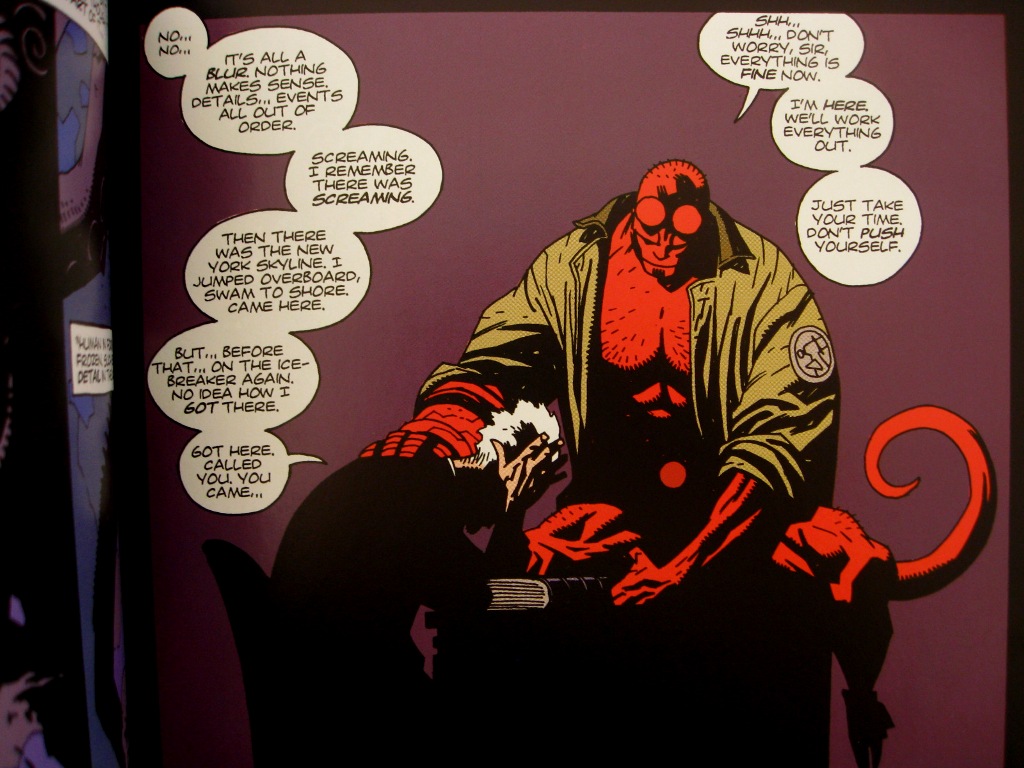
LOOOOVE. I love the way that he builds his compositions mostly out of shadows and looming statuary, frequently in suggestive poses (when Hellboy first manifests in a churchyard, the two angels carved in relief in the background seem to make gestures of threat and aversion); I love the way his craggy, massive, mostly stone-faced figures lend themselves to unexpectedly emotive interactions. One of my (many) favorite single panels in this volume is the one below, in which Hellboy attempts to comfort his adoptive father, the aged paranormal investigator Trevor Bruttenholm:

This volume includes generous art extras: early sketches of Hellboy, the two mini promotional stories in which he first appeared, and an excellent gallery of guest art. I should note though that the trade paperback edition has terrible binding – the cover cracked away from the glue on the spine after I’d been reading for about 45 minutes. So, definitely not worth it unless you happen to find it on sale.

That aside, Hellboy is eerie, tightly written, and features an intriguing cast and Lovecraftian/Revelations-inflected apocalyptic mythos. (The chapter headings have scenes from Revelations as their backgrounds: the seven-headed beast, the Four Horsemen, etc. Again, LOOOOVE.) This time around, I’m going to have to follow the series to its finish; I’d love to get to know Hellboy and his teammates better.

Go to:
Mike Mignola: bio and works reviewed
B.P.R.D.: Hollow Earth & Other Stories, by Mike Mignola, review by Emera

Tags: , , ,

Date read: 6.13.10
Book from: Library
Reviewer: Emera

Ah, with the beginning of every summer comes the shutting-off of my brain for approximately 24 hours, as I devour the newest installment of my beloved narcotic of choice, Jim Butcher’s Dresden Files series. Changes, as the twelfth book and approximate halfway point of the series (…I am simultaneously disturbed and awed to realize that I have, in fact, read all twelve), is, well, a game-changer. Butcher, who’s already infamous for his gleeful sadism towards his characters, ups the stakes tenfold in this book, and packs it with even more explosions, evil twists, and shocking revelations than usual.

On the first page of the book and in one stupendously awful phone call, Harry Dresden, Chicago’s only professional wizard, finds out from ex-girlfriend Susan Rodriguez that not only do they have a daughter whom he was never told about, but that she’s been captured by the vampires of the Red Court. Behind the kidnapping is Duchess Arianna Ortega, who’s out for revenge for Harry’s role in the death of her husband. With the wizards’ White Council both unwilling and unable to help him, Harry has few allies at his side and little time to accomplish a seemingly impossible rescue. Harry finds himself forced to weigh his love for his daughter against his principles, and may have to go further than ever before in sacrificing his beliefs for the sake of power.

Multitudinous OMGWUT moments aside, I actually didn’t enjoy Changes as much as most of the preceding books. Butcher is so heavy-handed in writing emotional distress that I was irritated pretty much as soon as I heard the novel’s premise and realized that Harry’s emotional state for most of the book would be Righteous Fury of Wrath and Righteousness. I love Harry as a protagonist, and generally find the improbable extent to which he holds to his principles endearing and actually pretty admirable, but reading Harry in continual high dudgeon for close to 500 pages just gets excruciatingly repetitive, even with my brain mostly turned off.

Read the rest of this entry »

Tags: , , , , , , ,

Date read: 5/31/08
Read from: Public library
Reviewer: Emera

B.P.R.D.: Hollow Earth and Other Stories collects side stories of the Bureau for Paranormal Research and Defense, from the Hellboy universe, though all (deliberately) absent the eponymous hero.

  • “Hollow Earth” (written by Mike Mignola, Christopher Golden, and Tom Sniegoski; art by Ryan Sook and Curtis Arnold): The fish-man Abe Sapien, Roger the homunculus, and a disembodied medium named Johann Krauss venture into the center of the earth, searching for their missing teammate.
  • “The Killer in my Skull” (written by Mike Mignola, art by Matt Smith and Ryan Sook): The B.P.R.D.’s Depression-era counterpart, Lobster Johnson, encounters a mad scientist.
  • “Abe Sapien versus Science” (written and inked by Mike Mignola, drawn by Matt Smith): A disquieting glimpse into the origins of both Abe and Roger.
  • “Drums of the Dead” (written by Brian McDonald, art by Derek Thompson): Abe and a young psychic investigate paranormal incidents – possession, inexplicable shark swarms, ghostly drumming – manifesting on an Atlantic shipping route.

I read the first Hellboy collection quite a while ago, and wasn’t impressed, but reading this actually motivated me to go back to the series. Though the stories aren’t terribly original, I’m a sucker for the art (most of the art in these stories closely emulates Mignola’s own, though whether that’s good or bad is debatable) and characters – particularly the erudite, gently tragic Abe. I love the art’s distinctively shadowy, bold look, and Dave Stewart’s dim colors give the series an appropriately eerie, pulp feel – the panels look as though they’ve had all the light sucked out of them, except for cigarette sparks and lantern glows and the occasional dose of phosphorescence or hellfire. This was especially effective for the haunted-ship story – I always love a good sea-ghost tale.

Bottom line: predictable stories, but the art and affecting characters win out for me.

Go to:
Mike Mignola

Tags: , , , , ,

Date read: 6.03.09

Book from: Personal Collection

Reviewer: Kakaner

Summary

The City & The City is dark, brooding, and meticulous. It is the story of Inspector Tyador Borlu who investigates a mysterious and highly delicate murder case. “Highly delicate” for Borlu soon discovers that he must invoke Breach, a mysterious judicial force that governs disputes in the rare case that they involve a crossing of the cities, Ul Qoma and Beszel. However, help is not so easily found and Borlu must undertake this investigation himself. Using not-exactly-by-the-book methods, Borlu uncovers mysteries of the murdered girl, the very archaelogy of these two odd cities, and Breach.

Review

Mieville pulls the reader in with promises of the same great and dark fantastical adventures of his previous novels– we concoct a terrible conspiracy in our minds when first confronted with the murder, we imagine the city divide must have come about as a result of a great otherworldly battle, we provide ancient magical powers for each mention of a mysterious artifact… and although these theories are shattered one by one as the novel progresses, we still imagine the epic Big Reveal will, in fact, prove all our thoughts to be correct. Instead, The City & The City is cold and harsh, and there is never a magical solution. There is definitely a depressing, suffocating atmosphere that comes from knowing that every death, every misunderstanding, every unnecessarily gruesome fact of life is caused for humans, by humans.

I have to say I harbored this niggling disappointment each time a plot turn indicated that there was in fact no magic. I was naive– I should have paid closer attention to the genre titles “noir fiction” and “weird fiction”, but Mieville has always had a way with enchanting the story no matter what genre. I found the mentions of Myspace and Chuck Palanhiuk highly jarring, but undoubtedly genius. These references really made the reader think and realize he was reading about a country off somewhere in the Middle East that existed in the same world at the same time, that if he travelled far enough he would perchance bump into the city of Beszel. This effect was definitely unnerving and brought the story closer to home.

In many ways, I found Beszel and Ul Qoma to be the darkest of any of Mieville’s cities to date. Beszel and Ul Qoma encapsulate the grimness of today’s most rundown urban centers, without the usual gems of beauty that one can find in Mieville’s other works. While New Crobuzon was covered with filth, death, and corruption, the reader was still made to understand the powerful potential of inner beauty– Lin’s amazing (although admittedly grotesque) artwork, the majestic surrealism of The Weaver, the slowly nurtured romance between Bellis and Silas– and in the end, the Baslag books were just as much about the good as they were about the bad.  And of course, the London underground setting of King Rat also contained an edgy artistically musical appeal. I didn’t see any of this hope or light in these cities– whenever I uncovered more about a good person or a seemingly magical concept, there was simply only… dirt and muck underneath. Basically, I didn’t come away seeing promise dangling on the ends of story threads in the same way I did for other Mieville works. This, perhaps more than the downward spiral to nowhere, frightened me the most and in many ways, made the story as a whole less appealing.

This is not to say that The City & The City isn’t another great work of art created by China Mieville. I was so accustomed to floating along in the waves of Mieville’s greatly fantastical settings and characters, only to find myself rudely shoved into a hard and entirely unforgiving setting. I am under the opinion that this novel is extremely mislabeled as a fantasy work…there is an explanation and a science behind everything plot turn, and ultimately, my point is do NOT walk into The City & The City expecting fantasy. Although I have not read much detective noir fiction, I can confidently say The City & The City must be among the cream of the crop– as usual with Mieville, you can see the literary quality dripping off the edges of each page and feel the weight of a great imagination.

Go to:

China Mieville

Tags: , , , ,

Date Read: 6.3.09

Book From: Library

Reviewer: Emera

A prequel to the first Dresden Files novel, “Welcome to the Jungle” is the first graphic novel addition to the series – a full adaptation of the first novel (Storm Front) is to come, apparently. The four-issue comic’s plot is boilerplate Dresden Files: a gruesome murder, this time at the zoo, has Lt. Karrin Murphy of Chicago PD’s Special Investigations calling in Harry Dresden, the only professional wizard in the phonebook. Harry has 24 hours to uncover the killer, and, of course, has no idea where to start. In the meantime, the murder has been pinned on one of the zoo’s prized (and innocent) gorillas, lending extra urgency to Harry’s search for the real culprit.

Unsurprisingly, the Dresden Files, with their spectacular action scenes, car chases, and colorful magical rituals, translate perfectly to comic-book form, with quick panels here capably taking the place of the lengthy descriptions required in the book. Indeed, Butcher explains in his introduction that his storytelling is strongly influenced by the multitude of comics that he read when young (something that I definitely sympathize with).

Read the rest of this entry »

Tags: , , , , , , ,