weird fiction

You are currently browsing articles tagged weird fiction.

Reviewer: Emera
Date read: 4.30.2012
Book from: Personal collection

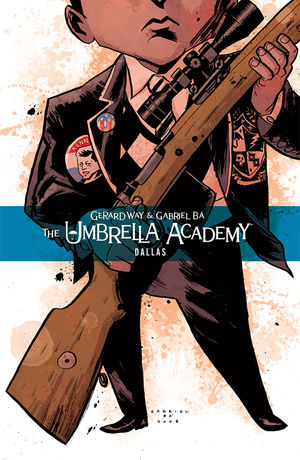
The Umbrella Academy, Vol. 2: DallasThe Umbrella Academy: Dallas begins and ends with presidential assassinations; in between, a whirlpool of crises sucks in the already battered members of the Umbrella Academy superhero “family,” and spits them out again even more embittered and doubtful of their humanity. In between, there’s extensive time travel, nuclear annihilation, a brief interlude in heaven, a man with a goldfish for a head, and page after page of Gerard Way’s incredibly sharp, incredibly funny, incredibly on storytelling and dialogue. (I found myself wanting to deliver affirmations like, “Why yes, Gerard Way, a pair of Girl-Scout-cookie-obsessed hitmen WOULD sound exactly like that!!”)

The presiding metaphor of this volume is of the jungle, and jungle beasts. (“I am in the jungle and I am too fast for you. You have teeth and stripes and things that tear. But I am much too fast… [...] Only I know where the jungle is… only I know…” goes Number Five’s crazed self-paean as he single-handedly destroys an army of time-traveling enforcers. It’s both hilarious and chilling, in combination with Bá’s increasingly saucer-eyed rendition of Five and Dave Stewart’s lurid colors for the scene.)

Umbrella Academy works off of the psychological model for superheroes that’s prevailed since Watchmen: they’re average human beings – willful, petty, self-absorbed – acting out their neuroses and capacity for brutality, both emotional and physical, on superhuman scales. Kraken is the series’ Rorschach, obsessed on a primal level with vigilanteism. Spaceboy began as (to jump comic universes) the moody, nobly pathetic X-Man, ashamed of his physical monstrosity (his head was grafted to a Martian gorilla’s body in a lifesaving operation at some point in the past), but by the beginning of this arc has gone over to Nite Owl – overweight, impotent, haunted by crumbling ideals of heroism.

Spaceboy is an obvious visual manifestation of the jungle-beast metaphor: the superhero who’s at least as much monster as man, a Frankensteinian creation as cognitively dissonant and surreally comical as the intelligence-augmented chimps that now constitute a significant proportion of the world of the Umbrella Academy. The chimps were also experimental creations of the Academy’s founder, Sir Reginald Hargreeves, of course. The brief glimpses we get of frigid, controlling Hargreeves are some of the most disturbing moments of the series; it’s a wonder that the Umbrella kids, his grandest experiment, didn’t turn out even more dysfunctional.

In the end, disaster is averted and the world is saved, but at the cost of the life of a good man, and further erosion of the tenuous bonds among the Umbrella Academy. I was pretty heartbroken by the end of the volume, especially after the emotionally devastating bonus story, “Anywhere But Here,” which reveals a pivotal moment from Vanya’s past. Way and Bá have taken their superheroes to such depths of despondency that it’s hard to imagine where they’ll go from here, but I trust that they’ll continue to unfold their heroes’ fates with style, wit, and humanity.

Go to:
Gerard Way: bio and works reviewed
The Umbrella Academy, Vol. 1: Apocalypse Suite (2008): review by Emera

Tags: , , , ,

I think I’ve just about expended all my book- and gift-book-buying budget at this point, but I couldn’t resist poring over Ann & Jeff VanderMeer’s Gifts for the Weirdie in Your Life book recommendation post – many many additions were made to my to-read list. The VanderMeers provide detailed recommendations for both classic weird and new releases, emphasizing both literary quality and visual appeal.

Also, recommendations for weird small presses whose catalogues I’ll have to look over in more detail at some point: Centipede Press, Tartarus Press, Chômu Press.

(I really, really wanted Centipede’s Algernon Blackwood collection – “with some fine Clarence John Laughlin photographs reprinted as exquisite duotones. Quarterbound in black Japanese cloth with blue European cloth panels, with a ribbon marker, and enclosed in a clothbound slipcase.” – and then I realized that it was $250. erk.)

- E

Tags: ,

Date read: 6.11.11
Read from: Subterranean Press Magazine
Reviewer: Emera

Assorted thoughts on K. J. Bishop’s “The Heart of a Mouse,” which recently won the Aurealis Award for Best SF Short Story. All the other reviews I’ve linked below offer good summaries of the story, if you’d like more situational context.

First thought: This isn’t (just) post-apocalyptic, it’s a dystopia. The government just happens to be invisible, unless maybe one considers an amoral universe – strange, brutal, incomprehensible from the individual perspective – to be a “governing body”… (Please note that I’m not in the least politically savvy and can’t comment with that kind of rigor.) But there’s an inflexible class system/food web:

“Deros and trogs and dogs live in towns, cats roam. Dogs and cats hunt everything except angels and bactyls. Volk hunt big game, raid towns and hold rallies. Pigs eat anything dead except angels, and bactyls eat anything dead and anything alive that doesn’t move fast enough to get away. Dreams hunt everything, eat anything. Angels don’t eat, but they kill, which comes to the same thing for you and me. And that’s all. It isn’t so much to keep in your head.”

and the economy likewise boasts all the flexibility and diversity of the shop system in a low-budget first-person shooter (more on this later). (Also, irony alert re: the role of the “dreams” in the food web.) The system – “mom and pop” shops, pig farms that provide wages and canned pork – keeps running stably enough to keep alive the inhabitants who don’t get themselves eaten by something else, and we’re given no reason to believe it won’t keep working that way. The end of the story sees one of the last few wrinkles in the system being ironed out, in a brief, carefully affectless paragraph of description that I found one of the most moving in the story. Against the backdrop of mouse-dad’s macho sentimentality, it’s the mostly uncommentated incidents that stand out, cleanly foregrounding the story’s surreal horror/beauty. The last image in the story is unforgettable, especially since I’m always a sucker for the kind of monstrousness embodied in Bishop’s many-faced, many-eyed angels and dreams. What is it about nephilim, seraphim, the angels in Neon Genesis Evangelion, that is so uniquely sublime and unnerving?

Second thought: This is what life would be like in a video game, but one without even the comfort of an objective, let alone a glowing textbox at the end to tell you you can progress to the next stage. Just enough rules exist to make it clear how terrifyingly arbitrary it is that any rules exist at all – who’s setting and enforcing them? Weapons and supplies and what amount to NPCs “punch in” at apparently predetermined intervals, and again there’s that disturbingly cartoonish food web, that reads like a game manual’s bestiary section…

Read the rest of this entry »

Tags: , , , , ,

Date read: 3.17.11
Book from: Library
Reviewer: Emera

book umbrella

From the back cover:

In an inexplicable worldwide event, forty-seven extraordinary children were spontaneously born by women who had previously shown no signs of pregnancy. Millionaire inventor Reginald Hargreeves adopted seven of the children; when asked why, his only explanation was, ‘To save the world.’ These seven children form The Umbrella Academy, a dysfunctional family of superheroes with bizarre powers. Their first adventure at the age of ten pits them against an erratic and deadly Eiffel Tower… Nearly a decade later, the team disbands, but when Hargreeves unexpectedly dies, these disgruntled siblings reunite just in time to save the world once again.”

The Umbrella Academy is clearly an enormous excuse for Gerard Way to make moody, tentacular love to all the tropes of the superhero comic. Father-figure issues, intra-team rivalries and romantic tensions PLUS frolicsomely deranged villains and a tortured, vengeful supervillainess PLUS nonstop, glibly surreal* storytelling = one gloriously dark, weird, and addictive series. I can’t speak to there being much real substance under the surface – other than Way’s manifest passion for superheroes and their particular brand of wounded humanity – but it’s a terribly stylish and entertaining comic, with occasional moments of real sweetness and charm.

Art highlights: Dave Stewart’s yummy colors – heavy on dark, desaturated oranges and purples. And I love the weight of Gabriel Ba’s figures, and their elastic, elongated torsos – makes for interesting stances and gestures. Also, I could stare at the cover forever. Hi, Vanya. What shapely F-holes you have.

(I know. I’m sorry.)

I devoured the first volume in one sitting, and am jonesing to get my hands on the second. Also, this may well be my favorite single line of comic-book dialogue: “And just as I suspected – ZOMBIE-ROBOT GUSTAVE EIFFEL!”

* The kids’ surrogate mother is an animate anatomical model. What’s not to love?

Go to:
Gerard Way: bio and works reviewed
The Umbrella Academy, Vol. 2, by Gerard Way & Gabriel Bá (2009): review by Emera

Tags: , , , ,

Date read: 3.21.11
Book from: Library
Reviewer: Emera

20th Century Ghosts, Joe Hill‘s first collection of short fiction, hit that unfortunate balance of being intriguing enough to keep me reading, but not-quite-excellent enough that I couldn’t shake the sense that my reading time would be better invested elsewhere.

In terms of style and subject matter, Ghosts will probably appeal to fans of Isaac Marion, Clive Barker, or Neil Gaiman‘s short fiction. There’s a Kafka tribute (“You Will Hear the Locust Sing”); a superhero accessory that becomes an object of contention between two brothers (“The Cape”); a vampire-hunting family in upheaval (“Abraham’s Boys”); and, of course, numerous variations on ghosts and the undead, whose literalness is frequently up for interpretation. The “zombies” in “Bobby Conroy Comes Back from the Dead,” for example, are former high-school sweethearts who reunite as gore-caked extras on the set of a George Romero film.

Hill’s tone is measured, melancholy, and spiked with black humor. His work is more homespun in texture than Gaiman’s silky irony, but shares that quirked, wry feeling, the “c’est la vie” shrug – not entirely resigned – at the varieties of disappointment, dysfunction, and violence visited on his protagonists. While his investigations of this emotional territory are mostly predictable, the empathy and sensitivity behind his writing are appealing.

Where Hill falls short is in his tendency to explicate his own themes and subtexts (“He killed him first – because he loved him”). Occasionally this works, to deadpan-creepy or wry effect. Mostly it just made me want to tell the narrator to stop talking and let me read by myself*. Similarly, visual motifs are sometimes elaborated to the point of belaborment. Finney, the teen protagonist of “The Black Phone,” feels unaccountably sickened and fearful when he sees a cluster of black balloons emerge from the car trunk of a grotesque man struggling with groceries. Later, following a terrifying abduction sequence, the narrator informs us: “Finney was one of the black balloons now. There was no one to pull him back, no  way to turn himself around. He was sailing away from everything he knew, into a future that stretched open before him, as vast and alien as the winter sky.” Do we really need to be told that much, that explicitly?

Read the rest of this entry »

Tags: , , , , ,

Date read: 11.1.07; reread once or twice since
Book from: Library originally; now personal collection
Reviewer: Emera

(There is nothing about this cover that does not amuse and please me. Consider it an honorary Bad Book Cover Friday?)

Tanith Lee‘s The Secret Books of Paradys are among the most exquisitely aestheticized and unabashedly Gothic works I’ve ever read, which means of course that I’m obsessed with them. The series is set in a parallel-universe version of Paris, known variously as Paradys, Paradis, Par Dis, and Paradise. (Lee has also written a more recent series about a para-Venice, The Secret Books of Venus, though I’ve yet to read them.) Each of the four volumes comprises interweaving, thematically unified stories. The books stand alone well, though they’re seeded with references to a few recurring elements within the universe – locations, names, a certain poet – and the fourth volume has a climactic finality to it. Each of the books is further themed by color (see what I mean about aestheticized?), frequently embodied in significant pieces of jewelry and, in The Book of the Damned, stained-glass windows. (Always makes me think of “The Masque of the Red Death.”)

The Book of the Damned takes as its themes sexual transgression and ambiguities of sex, gender, and identity, considered in three novellas. The first, “Stained with Crimson,” follows an ill-fated poet, Andre St. Jean, on a journey of sexual obsession in 19th-century Paradys. St. Jean is given a ruby scarab ring by a dying man on the hills of the Temple Church; soon after, he is introduced to the ring’s owner, the ineffably unobtainable Antonina von Aaron. Cue a game of predator and prey in which role reversals are linked with a cycle of death, rebirth, and sex changes. Oh yes, and vampires. I mean, obviously. This is perhaps my favorite out of all the Paradys tales, both for its sentimental associations, as it launched my Tanith Lee obsession, and for its no-holds-barred Gothstravaganza, ladled out in the most sonorous, decadent, purple-saturated language imaginable. Further layers of allegorical imagery incorporate Greek mythology (a Pan symbol, a trip down a deathly river) and the elements, the latter perhaps complementing the book’s primary-color triad.

“Malice in Saffron,” though little less wrought and hectic, takes a much grimmer turn. As with many of Lee’s works, its events are incited by sexual violence and abuse of women. The protagonist, Jehanine, is assaulted by her stepfather and rejected by her beloved brother. After fleeing the countryside, she finds shelter within a nunnery in medieval Paradys, but by night transforms herself into capricious, murderous Jehan, who roams the backstreets of Paradys with a gang of thieves. Like many of Lee’s vengeful heroines, Jehanine nears the brink of being consumed by her own desire for destruction, but ultimately finds peace and redemption. Jehanine, I suspect, is a distant Paradysian extrapolation of Joan of Arc/Jeanne d’Arc; her story also heavily references Cathar beliefs.

Read the rest of this entry »

Tags: , , , , , , ,

Date read: (incomplete) 10.8.10
Book from: Personal collection
Reviewer: Emera

I vaguely remembered reading a Ligotti story late one night and finding it enjoyably creepy, so – looking forward to restocking my horror reading for this winter -  I sprung for this revised edition of his first collection (originally published in 1986) when I saw it rolling out from Subterranean Press. The copious comparisons of the reclusive Ligotti to other luminaries of horror, particularly Lovecraft and Poe, didn’t hurt my interest either.

After a few weeks of dissatisfied page-flipping, I’d made it through a handful of stories at the beginning of the collection without remembering much of any of them. When jumping to a few stories to the end of the collection yielded the same results, I decided to give up. Irrespective of any thematic or philosophical  interest, which I couldn’t stay engaged long enough to extract, Ligotti is simply not a very good writer. His stories are saggy with talking-head exposition, and read as affected rather than stylized, especially since they tend towards the kind of faint, pervasive ungrammaticalness that makes you squint and think, “I don’t think that word means what you think it means” once every few sentences.

Similarly, his imagery is inexact and frequently redundant. A nurse, for example, brandishes “a slender syringe crowned with a silvery needle” (is it silver or isn’t it?), while a lamp is noted for its “glassy smoothness,” which manages to tell us the same uninformative thing twice. And then there’s some flat-out awful purple prose – a festival crowd being described as performing “gyrations of squealing abandon,” for example, which made me give up on a story that I’d otherwise alllmost enjoyed.

Then there’s all the usual demonic snickering and “nightmarish anatomies” and realms of indescribable chaos, which get old fast when nothing interesting is actually being done with them. Ligotti’s horror reads to me as either archly, brittlely nasty, filled with sneering, bloviating maybe-lunatics, or as a kind of smoggy pseudo-profundity. In the latter mode he occasionally painted some scenes that caught my imagination – the human-sized dollhouse in “Dream of a Manikin,” for example, or the rambling, murky city-in-a-book of “Vastarien.” But for the most part, there’s no sense of depth to the nastiness, none of the sublime horror of the expanse that lurks beyond and between things in Lovecraft or Kiernan – just a lot of hysterical gesturing towards it.

Go to:
Thomas Ligotti: bio and works reviewed

Tags: , ,

Date read: 10.31.09 (unintentional, but awesome)
Read from: Personal collection
Reviewer: Emera

It’s raining, my socks are wet, and for these reasons I think I’d rather finish up my long-overdue review of Caitlín R. Kiernan‘s The Red Tree than do anything else.  And as there’s a red oak outside my window, I took a picture of it looking appropriately old, red, and potentially carnivorous at about the same time that I finished the book:

The review is spoiler-free, by the way.

The Red Tree is one of the best books I’ve read all year, and I’ve already been itching to go back to it and let it screw with my head some more. I’m not quite sure what I was expecting when I started it (probably something more lushly Gothic, like Alabaster), but what I read wasn’t what I was expecting, and then it was better than what I expected. It’s a jagged, rattling, hurtful book, and incredibly atmospheric. The horror is creeping and primal, almost inarticulable. People and paintings and animal bones appear and disappear; proportions and distances are warped; the brittle, chain-smoking protagonists labor under constant, sapping heat and suffer from surreal nightmares. At the same time, the emotions underlying it are so real: reading the book feels like holding an artifact of life, a snarled-up package of fury and self-hatred and despair. Yeah, it’s not the happiest book to read, but its painful authenticity is a large part of what makes it so compelling. There are no pretensions to darkness or the Gothic here, just a lifetime’s worth of the real thing.

After all, protagonist Sarah Crowe is a clear analogue of Kiernan herself: she’s a snarly, black-tempered writer of obscure dark fantasy who lives in Rhode Island, and she struggles with writer’s block and a seizure disorder. In Sarah’s case, she leaves the South to escape the memories of her failed relationship with an artist named Amanda, who committed suicide. Once in New England, she settles into an ancient farm house whose property is marked by a red oak of incredible age and size. Unsurprisingly, she develops a morbid fascination with the mythology surrounding the tree – in particular a half-finished manuscript left by the house’s last tenant in the basement – at the same time that a painter named Constance moves in upstairs. Cue much petty sniping, frustrated desire, and poorly concealed, creeping obsession.

Read the rest of this entry »

Tags: , , , , , ,

Date Read: 9.24.07
Book From: Personal Collection
Reviewer: Kakaner

Summary

Stalking Tender Prey sets the stage for an epic trilogy by introducing the intertwining stories of the Grigori (fallen angels) family line which begin in a little countryside town, Lil Moor. Certain people in Lil Moor discover latent psychic abilities and the arrival of a traveling Grigori triggers a cascade of events that uncover the Grigori roots of Lil Moor. (First book of the Grigori Trilogy)

Review

Unfortunately, this book, and subsequently trilogy, pales in comparison to Wraeththu and the Magravandias trilogy. I’m a little bit surprised because Constantine has plenty of material to work with and sets up a rich landscape and sophisticated characters, but fails to do much with them.

I’d say the best point of this book was the character development, what I believe is consistently one of Constantine‘s strengths. Constantine somehow (I wouldn’t say masterfully) uses dialogue, subtle nuances of action, and atmosphere to create enchanting characters, who whether by their own self-realizations or due to the fantastical circumstances of their current lives, develop in amazing ways. Also unlike Wraeththu and Magravandias characters, each of the ones in Stalking Tender Prey seem to be shrouded in this veil of impenetrable mystery, and unfortunately I haven’t been able to quite grasp or connect to any on a personal level.

However, there was just about… no plot. The only plot that moved was a recurring flashback that mainly consisted of character develop of the Grigori traveler. Well, maybe “no plot” is a bit harsh, but the novel was basically a stagnant story about this little town in which nothing happens. Nevertheless, there was a climax and sex with a cat. Judging from this book, there is plenty of potential for the second book with respect to characters and plot threads, so I am still excited.

Go to:
Storm Constantine

Tags: , , , , ,

Date Read: 7.05.06
Book From: Borrowed from Kathy
Reviewer: Kakaner

Summary

A culling song is a song Africans used to sing to people about to die to ease the suffering of passing. However, one particular culling song is able to kill instantly upon being heard. A reporter investigating infant deaths discovers that by each infant’s death crib is a poem book opened to a culling song on page 27. He takes it upon himself to rid the evil and is determined to destroy all copies of the book.

Review

Lullaby has terribly interesting origins. Apparently,  Palahniuk’s father, Fred Palahniuk, and his girlfriend had been murdered by a man named Dale Shackleford in 1999. Palahniuk was asked to be part of the capital punishment decision, and this prompted him to start working on Lullaby, a novel very much centered on death. Shackleford was ultimately sentenced to death, and Palahniuk was said to have struggled very much with the decision.

Initially, I was incredibly excited to read this based on the summary. I mean, doesn’t it just sound so hauntingly dark and magical? And with an amazing horror premise to boot? The exposition was gripping, intense, and extremely interesting, but of course, weird. Lullaby is written in the signature Palahniuk prose– hard, gritty, a stop-and-go that is slightly nauseating. But as the book progressed, I grew more and more disappointed as the story of the book simply did not call for this type of prose. The story was still there, but it seemed so scattered halfway in.

Instead of experiencing horrible sucking immersion, I ended up plodding along noncommittally.  I think Lullaby definitely needed dark and lyrical prose to intensify the entire premise of the culling song. I feel like since Palahniuk’s writing is so abstract, it is much more appropriate for schizoid general ideas like in Fight Club rather than a concentrated linear storyline. Ultimately, the story fell apart for me and the ending was a huge letdown.

Go To:

Read More (Wiki article)
Chuck Palahniuk

Tags: , ,

« Older entries