photos

You are currently browsing articles tagged photos.

Reviewer: Emera
Date read: 2.28.2012
Book from: Personal collection, via Vertical, Inc.

(Yeah, the cover design is pretty punishingly cute. And also, classy! Oh Vertical, you know how to win my heart.)

The friend who egged me on in my desire to read this series, which has the proud distinction of siring the “princely girl” anime subgenre (i.e. Rose of Versailles, Revolutionary Girl Utena), described it as “nonstop shoujo bullshit.” Honestly, I can’t add much more to that than “but there’s lots of wacky gender stuff, too!!”

Adapted from the cover blurb:

“A mischief-making angel’s prank goes too far when the newborn princess of Silverland ends up with two hearts — one male and one female. Since the laws of Silverland only allow a male heir to ascend the throne, Princess Sapphire is raised as a prince. Princess Knight is the fast-paced tale of a heroic princess who can beat any man at fencing, yet is delicate and graceful enough to catch the eye of Prince Charming. Filled with narrow escapes, treacherous courtiers, dashing pirates, meddlesome witches, magical transformations and cinema-worthy displays of derring-do, you’ll be swept right along as Sapphire tackles one challenge after another.”

“One challenge after another” is only too right: the plot twists (potions, prisons, a desirous island queen, hellish pacts, Swan Lake references, etc. etc.) are addictive to a point, but past that point get exhaustingly frenetic. My patience was also tried by the fact that Sapphire is actually pretty dull. Apart from intermittent feats of gallantry, she doesn’t accomplish much other than throwing herself into defeatist fits of tears and mooning with disturbing passivity over her square-jawed and also dull main squeeze, Prince Franz. It comes as a relief to those of us rooting for a pluckier hero/ine that Tezuka has Sapphire close out her gender-bending with a bang: even though she ultimately prefers traditional femininity (she declares her desire to just get married in a dress, please), she’s still up for a swordfight even after her “boy heart” has been revoked.

One more photo and further thoughts on characters and gender after the cut:

Read the rest of this entry »

Tags: , , ,

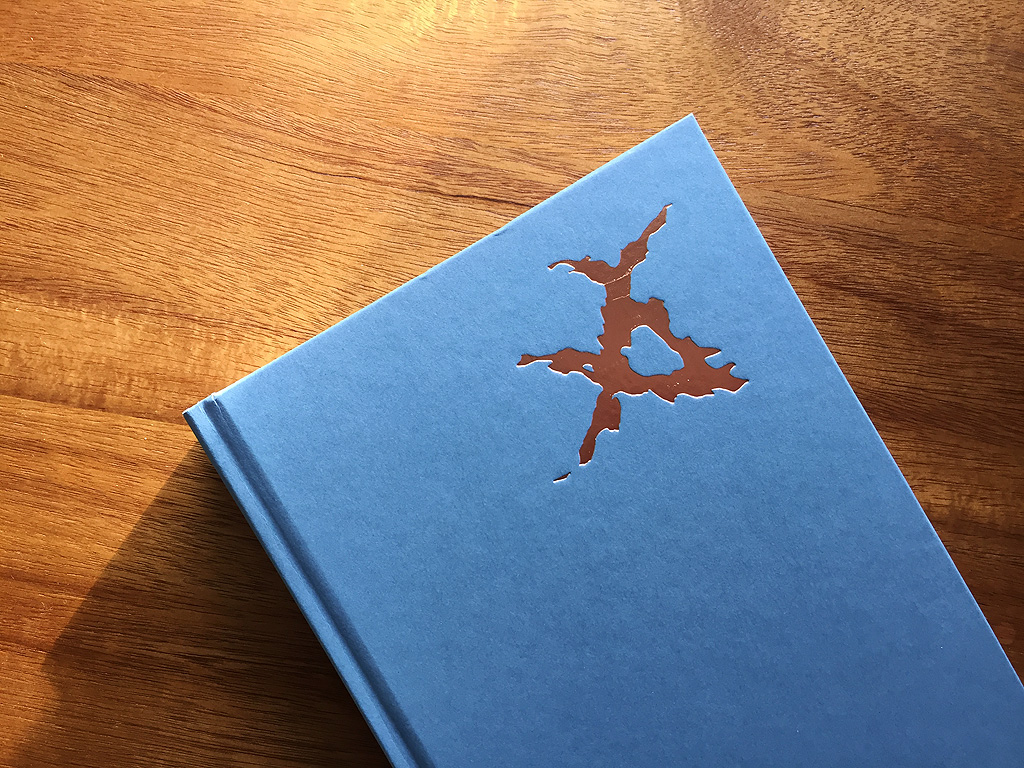
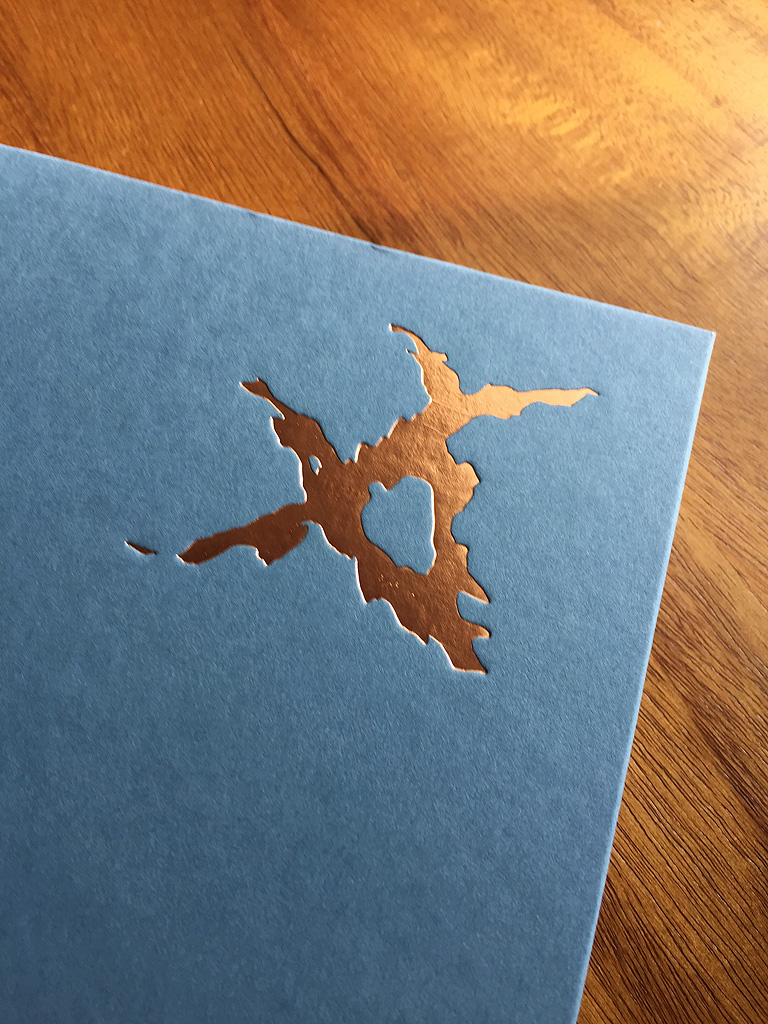
Here’s a photo-feature that I’ve been wanting to start for a while: a series featuring the subtle design quirks that I occasionally find under the dust jackets of hardcover books. First up on the plate is Kelly Link’s Pretty Monsters, whose full cover design you can see here. Will Staehle’s enigmatic, Victorian-funereal (with horned women) design easily ranks in my top, oh, twentyish? favorite book designs of all time. That thar is a very rough assessment, but hopefully my point is clear: there are a lot of book covers that I like, but I really, really, really like this one.

The little monster-mark underneath just seals the book’s place in my affections:

Undercover: Pretty Monsters, by Kelly Link

Rawr!

- E

Tags: ,

Seek Books
1747 Centre Street, Boston, West Roxbury, MA, 02132

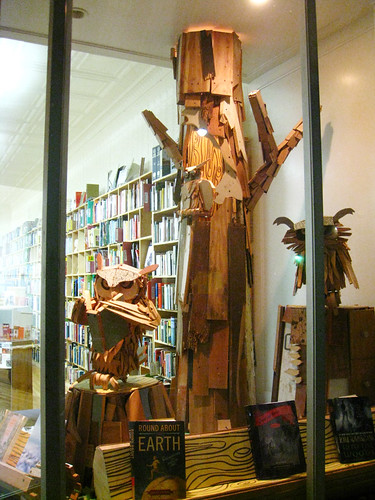
Seek Books storefront

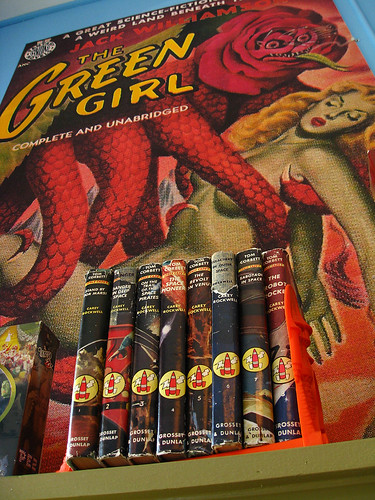
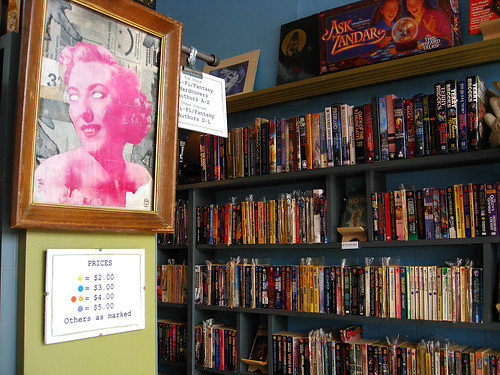
Seek deserves to be called something really grandiose, like “a repository of pulp splendor.” Seriously, if you’re an sff fan (especially if you’re the kind who has slightly off tastes and whose favorite authors are generally out of print… not that I’d know anything about this) and ever in the Boston area, don’t miss it. Seek has character.

Old posters and figurines and ’90′s boardgames abound; it smells like the kind of paperbacks that have banana-yellow edges; many of the books are battered within an inch of their lives (and rightly so, since Seek specializes in pre-1970′s fiction). The owners are as much curators as booksellers: series are carefully sorted out of the morass and shelved together, books with particularly loved cover art are wrapped in plastic.

The smiley-face-sticker pricing system is fun (and yes, the prices are ridiculously good), though sometimes the stickers do end up pulling off bits of binding off the spine. (Kakaner & I were also a little alarmed that sorted series are sometimes rubber-banded together, which means that spines and covers inevitably get bent.)

That aside, I don’t know too many other places where I could come away with a stack of eighteen or so Tanith Lee novels (I exaggerate, but not significantly) in one trip. Kakaner and I have been here twice so far, and each time we always end up finding way more things that we’d like to buy than we thought we were actually looking for – odd editions of favorite children’s books, copies of classics with actually frightening cover art (that Zelazny novel… SHUDDER)…

Some more photos under the cut, including some unbelievable monuments of SFF publishing history/nerd conversation pieces:

Read the rest of this entry »

Tags:

Stuff I like:

  1. Books
  2. Tiny things

Clearly Kakaner knows me well, because:

[muffled screaming!]

Miniature book necklace by Nico Paper Goods, sent to me by Kakaner. One more photo under the cut.

Read the rest of this entry »

Tags: ,

Lame Duck Books
12 Arrow Street, Cambridge, MA

“We are internationally known specialists buying and selling important modern books and manuscripts with an emphasis on rare literature and primary works in the history of ideas in English, German, French, Spanish, Russian and other languages. Our shop features the most significant selection of 19th and 20th century Spanish language literature in the world, as well as important holdings of 17th and 18th century English poetry.”

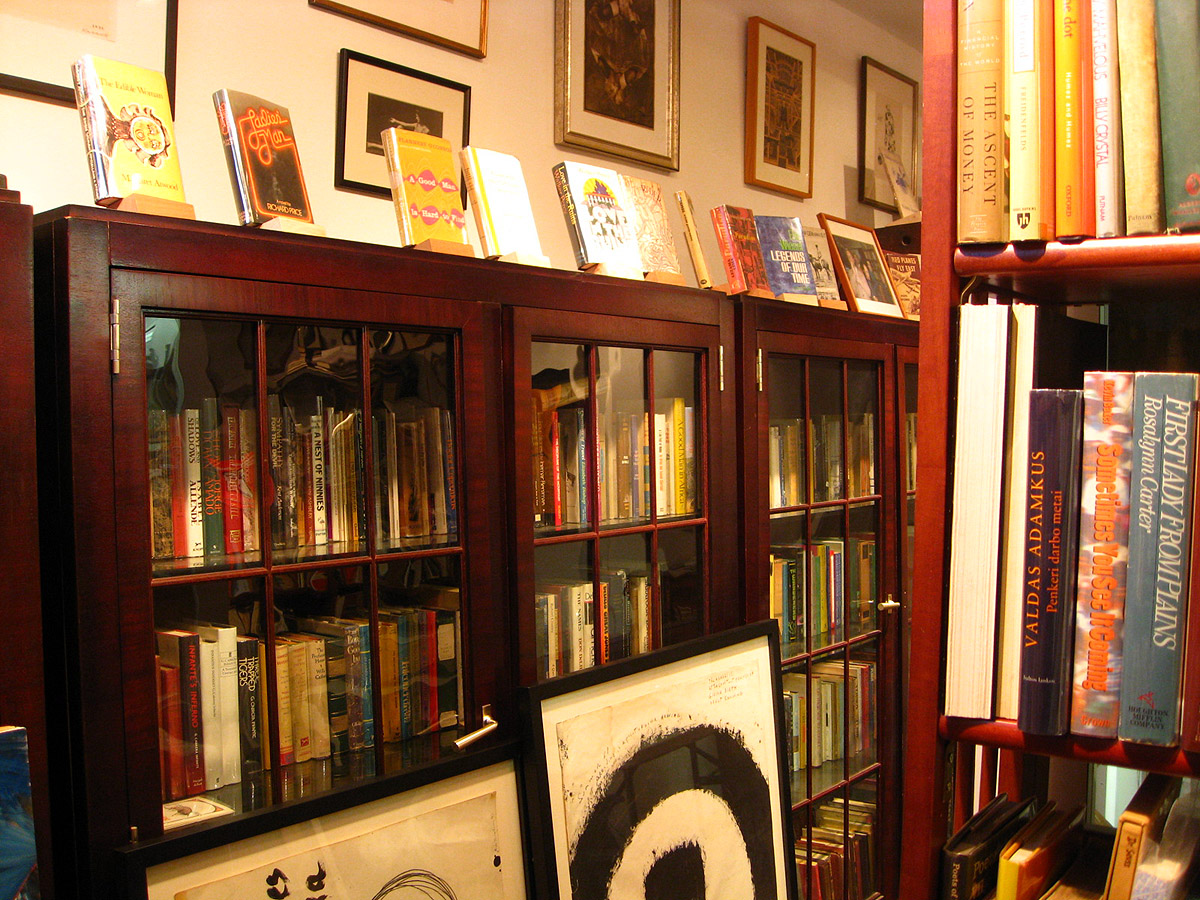
Significantly fancy-pantsier than the bookstores that Kakaner and I usually feel comfortable rummaging through, clearly, but a fun taste of the high life. You enter this basement bookstore through a hushed, minimalistic art gallery (unaffiliated); the bookshop itself is similarly hushed and artsy.

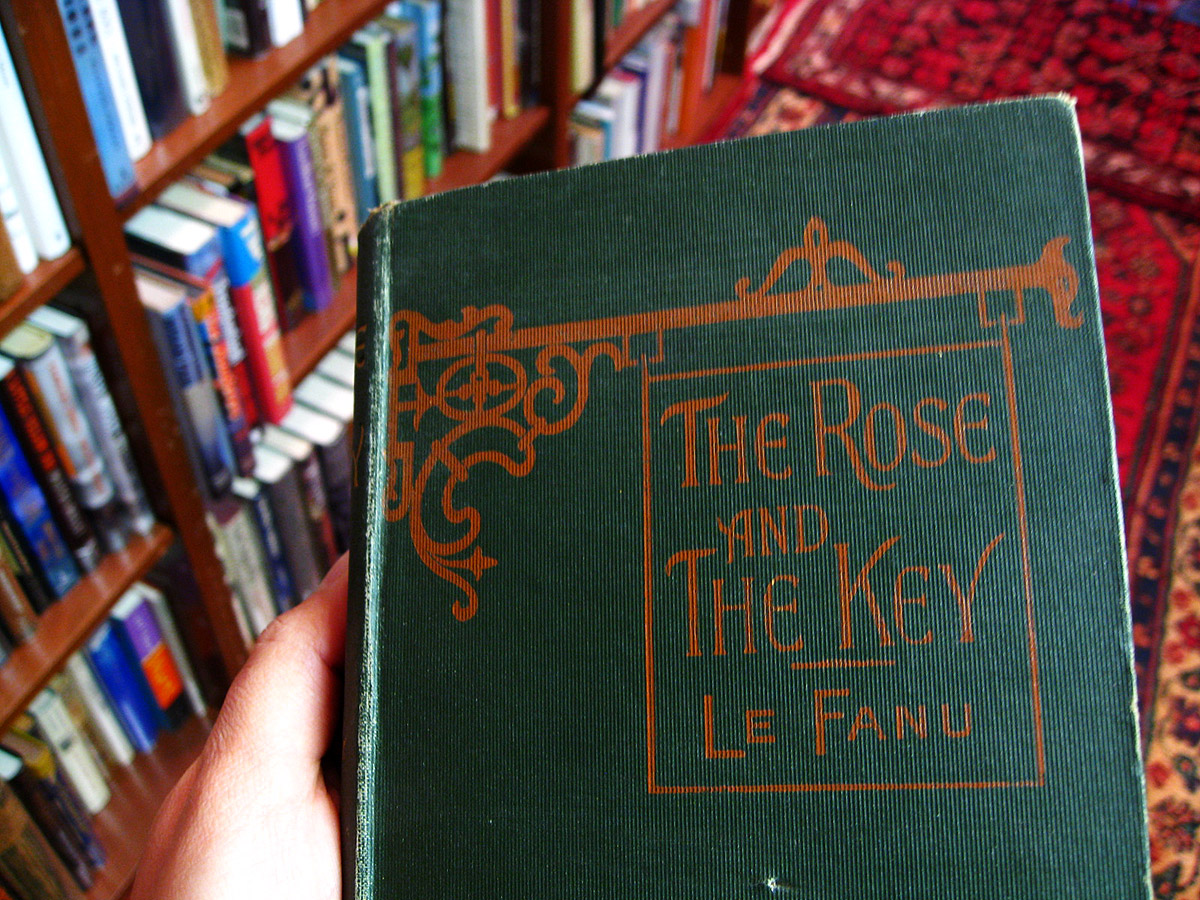
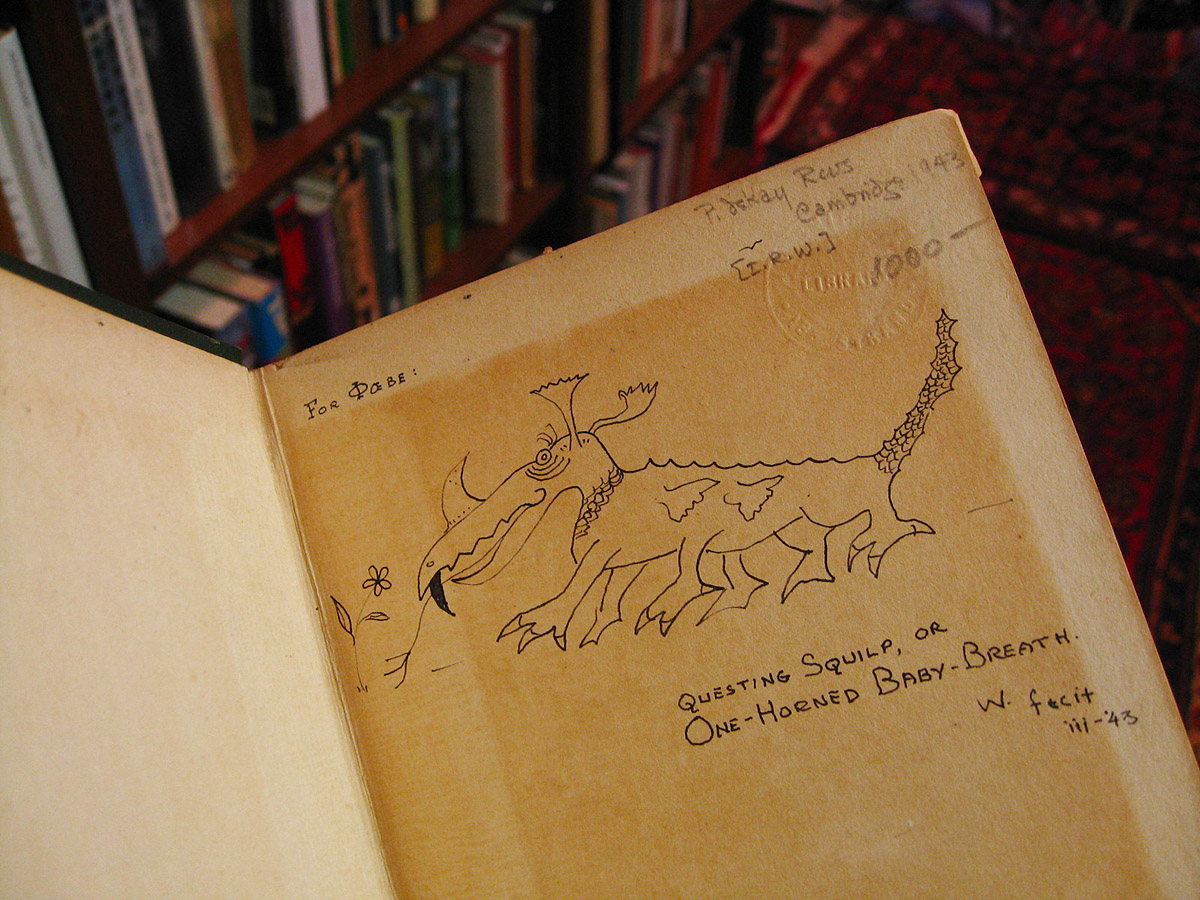
Kakaner thought their prices ran a little high, for the books with which we were more familiar, but we had a good time regardless ogling such volumes as a first edition of Margaret Atwood’s The Edible Woman, another Atwood volume (forget which – K, do you remember?) that contained a handwritten letter of hers, and this J. Sheridan Le Fanu novel…

…with a seriously charming dedicatory doodle for someone named Phoebe:

Continue below the cut for a couple more photos:

Read the rest of this entry »

Tags: ,

Date read: 8.1.11
Book from: Personal collection
Reviewer: Emera

This is one of my most treasured finds from Readercon, picked up from the fantastic Somewhere in Time Books: Tanith Lee‘s 1988 limited-edition novella, with illustrations by Tom Canty. From the title and pastel cover I expected a tale of genteel swashbuckling, possibly YA; should have remembered that Lee never goes in for gentility. Elegance, yes – Lee is manically elegant – but never gentility.

Madame Two Swords starts in a familiar place for Lee: a sensitive, fearful, recently orphaned young woman in an early 20th-century alternate France is treated cruelly by both circumstances and humanity; her only spiritual sustainment comes from a book of poetry discovered in a secondhand shop:

“The blue cloth binding was quite pristine under its dust. It was a slender book, without lettering. I opened it out of curiosity.”

“The book was my talisman. Other girls wore crosses or medallions.”

The narrator is unemployed and evicted, and finds herself in dire straits, chased from one end of the socioeconomic spectrum to the other: too middle-class for hard labor, too unskilled to be a seamstress, too unwilling to accede to customers’ advances to be a waitress in the seedier cafés. At the extremity of her despair – enter Madame Two Swords, a black-eyed old woman of terrifying intensity, in whose museum-like house the narrator comes to some strange realizations.

In this France, the Revolution was sparked by the poet-demagogue Lucien de Ceppays in the city of Troies. This Revolution culminated in the execution of the original revolutionaries, including de Ceppays, by the fickle mob, and the occupation of France by a fearful British monarchy. Inhabitants now speak “Frenish” as often as French, and labor in a depressed economy overseen by a puppet government. The narrator’s talisman-book is, of course, a volume of de Ceppays’ work, and contains besides a haunting watercolor portrait of him. The story quickly sees her devotion to his image and memory moving beyond girlish fantasy.

The final supernatural twist, when it comes, is powerful in effect, in large part because of the supreme delicacy with which Lee constructs the fleeting image central to the revelation. There’s an also-delicate but definite touch of gender-bending, which I wish I could discuss in more detail without being spoilery, but suffice it to say that I liked how Lee addressed its implications, a lot. This is a story that makes use of deeply Gothic-Romantic tropes (duh, Tanith Lee) yet resists being just romantic; it’s fierce and intelligent and ultimately insists on the dignity of all of its characters.

And so my love affair with Tanith Lee continues! If you like Revolutionary France and cross-lingual puns and intelligent Gothic fantasy, if you love Tanith Lee and beautiful books, you might consider treating yourself to a copy of Madame Two Swords

Two more photos (can’t help showing it off!) under the cut:
Read the rest of this entry »

Tags: , , , , , , ,

Book-repair station at the Strand in NYC; photo from when Kakaner and I visited together two years back.

One more photo of their upper (antiquarian) floor below the fold:

Read the rest of this entry »

Tags:

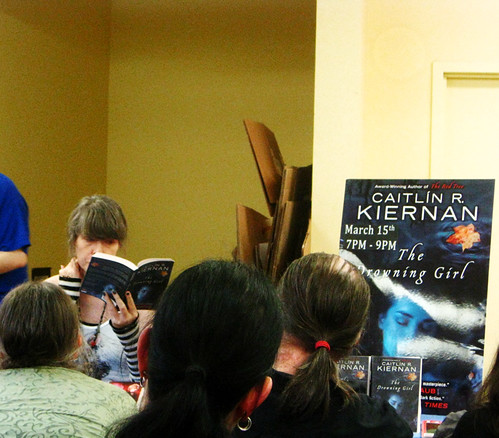
Readercon 22 took place Thursday – Sunday, July 14 – July 17, 2011; Kakaner and I made it to the associated reading at Porter Square Books in Cambridge on Thursday night, and Friday and Saturday of the con proper. This was her first literary con, and my first con of any sort, so needless to say we spent a lot of time being really, really, really excited. I’ll try to keep the frothing to a dignified minimum in our reports, though.

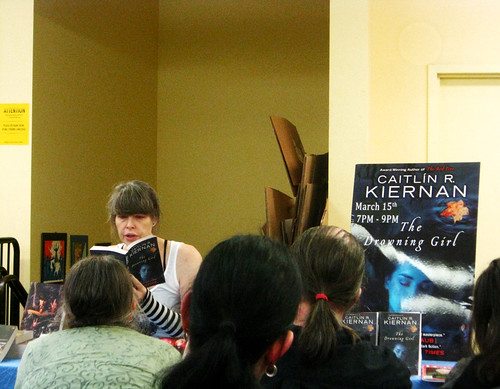
Thursday night! A reading from the Ellen-Datlow-edited anthology of urban fantasy, Naked City, featuring a line-up of six authors that had K and I, as above, really etc. goddamn excited: Kit Reed, John Crowley, Jeffrey Ford, Matthew Kressel, Ellen Kushner, and Caitlín R. Kiernan. All images link to high-res versions.

L-to-r (seated): Ellen Kushner, John Crowley, Ellen Datlow, Jeffrey Ford, Matthew Kressel (blue shirt)

(Also, that’s Theodora Goss in the center of the audience there.)

Editorial powerhouse Ellen Datlow introduces the collection. She explained that she hopes to reintroduce readers to urban fantasy as it used to be understood – e.g. the works of Charles de Lint, the Bordertown series – and do some work towards reclaiming the term from paranormal romances and magical detectives. Re: The Jim-Butcheriffic cover and prominent billing of other writers of said PR and magical detectives – “If it sells more copies, do you think I care?” Cover still gives me decidedly mixed emotions (guilty, compartmentalizing Dresden fan right here), but if Ellen Datlow can deal with it, so can I. Also, the totally flipping awesome cover for Supernatural Noir, another recently released Datlow collection, almost makes up for it.

On to the author readings, and numerous more photos:

Read the rest of this entry »

Tags: ,

Something that made me happy to see:

“Books are priced as marked by the sticker on the front cover. If you find a book that you want, please pay for it by putting the money in the locked box. Honor System Books has been a part of Cambridge for over 5 years now. Thanks so much to YOU and this awesome community

THANK YOU!!”

Brattle Street, Harvard Square, Cambridge, MA. I’m not sure how often it’s there; I’ve walked by it maybe twice now on good-weather days this spring and summer.

Tags:

Date read: 1.2.11
Book from: Public library
Reviewer: Emera

“The story I tell over and over and over and over is Beauty and the Beast.  It all comes from there.  There are variations on the theme–and it’s inside out or upside down sometimes–but the communication gap between one living being and another is pretty much the ground line.  And usually the gap-bridger is love.”

- from Robin McKinley’s blog (this post)

Mirasol, formerly a beekeeper, has become the Chalice of her demesne, charged with binding and unifying both its inhabitants and its restive magical energies. Unfortunately, her demesne is unsettled by the violent deaths of its last Master and Chalice. The arrival of the new Master only promises more strife. Previously banished by his brother, the last Master, to the priesthood of fire, he returns more than a little inhuman, terrifying to his own people and perhaps unable to command the land’s magic as he should.

The feeling that struck me as I was reading Chalice was that I was reading Sunshine again – which makes perfect sense, given McKinley’s above reflection. Chalice plays on that dynamic, and many more of her trademarks: fearful and inexperienced but pragmatic, good-hearted protagonists; magic that’s as often inconvenient and frightening as it is wondrous. (Mirasol, when receiving omens of her impending Chalicehood, spends most of her time cleaning up after the overflowing milk and honey that result.)

More than any of McKinley’s other books that I can recall (except maybe Rose Daughter), Chalice has an elusive, vignette-ish quality to it.  It feels as if we only spend a brief time with the characters and world before the curtain drops on the scene again. Mirasol’s world is rich with tradition and history – there are numerous mentions of a not-so-distant barbaric past, and Mirasol’s fellow Circle members have evocative, little-explained titles like “Talisman” and “Sunbrightener” – but we’re only privy to what detail Mirasol’s own experiences reveal. This guardedness lends the setting a pleasantly mysterious feel.

On the other hand, I was not so much a fan of the intense internality that controls most of the book. The vast majority of it happens inside of Mirasol’s head, with dialogue and action indirectly reported, and flashbacks and occasionally repetitive exposition occupying much of the first half of the novel. So while I was deeply intrigued by the setting and circumstances,  I felt a little stifled and not immediately involved. I was also put off by the flatness of the political conflict that eventually tests both Chalice and Master. I realize that for McKinley it’s always more about how her protagonists overcome difficulties, rather than what in particular they’re overcoming, but it can start to seem a little silly when all the villains are either greedy Overlords or mincing sycophants.

Overall, though, I was happy to sit back and enjoy the ride, just soaking up the odd, earthy details of Mirasol’s life, the rituals that she concocts and carries out, and the few characters with whom she interacts. Also, the love story is very sweet. Throughout, McKinley wields crisp, vivid language that particularly helps to crystallize Mirasol’s experiences of magic. Chalice is not a must-read if you’re not already a big McKinley fan, but it is beautiful and ultimately satisfying, if on the slower side.

Go to:
Robin McKinley: bio and works reviewed
Beauty (1976), review by Emera
Deerskin (1993), review by Emera
Deerskin (1993), review by Kakaner

Tags: , , ,

« Older entries