Darkly Dreaming Dexter, by Jeff Lindsay (2004) K

Date Read: 11.26.08
Book From: Personal Collection
Reviewer: Kakaner

Summary

Short version: Dexter S1.
Long version: Dexter, a serial killer of serial killers, works in the Miami Metro Police as a blood spatter analyst alongside with his foster sister Deb. We learn that Dexter was taken from a violent crime scene and raised by a cop. Upon learning that Dexter was prone to murderous intentions, his dad taught him the art of killing. Suddenly, a new wave of killings crop up and are accredited to the “Ice Truck Killer” and Dexter recognizes that these killings are somehow a message to himself. Using his skills as a killer and resources at the police department, Dexter helps track down the killer while trying to keep those that matter to him safe.

Review

Unfortunately, I have to say this is exactly what I expected. I watched two seasons of Dexter before picking up one of the novels (much to my shame), partly due to the horrible things I had heard about the books. Unsurprisingly, the writing was entirely mediocre, unsophisticated, and wholly disappointing.
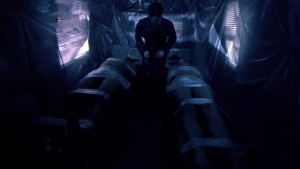
dexter-s1-dexter-killing

Naturally, I couldn’t help but compare Darkly Dreaming Dexter to the TV series. The novel is told from Dexter’s point of view, and really does try hard to achieve the same dark, cynical, wry atmosphere that the TV adaptation manages to accomplish so well… but just falls short. The pacing of the book was alright, as in there was always some action each chapter to propel the story forward. I feel like I’m really at a loss for what else to say about the novel. It was just unremarkable (again, comparison to the TV series). There are some minor plot differences between the novel and show, except for the ending; however, I don’t really care because I’m not reading anymore books.

dexter-in-blood-lab

At the least, reading Darkly Dreaming Dexter has made me appreciate the TV adaptation immensely. You really begin to gain an understanding of the skill involved in developing Dexter’s character for the screen, piecing together the soundtrack and film style for that perfect cynical criminal atmosphere, and the screenplay is just impeccable. The TV show has really come a long way from the novel and certainly shaped a masterpiece from raw materials.

Go To:

Jeff Lindsay

The Remains of the Day, by Kazuo Ishiguro (1989) E

Date read: 1.4.06
Read from: Personal collection
Reviewer: Emera

Stevens is the quintessential English butler: dignified, humorless, and obsessively devoted to his work, he defines his life through his service to the late Lord Darlington. Convinced for decades that he has contributed to humanity by serving a great man, Stevens begins to reevaluate his experiences as he embarks on a country drive through postwar England. As he does, he finds that many of his memories – of his unthinking adulation of Lord Darlington, and of his difficult relationship with Miss Kenton, the former housekeeper – begin to take on a disturbing cast.

The Remains of the Day, like all Ishiguro novels, is intimately psychological and beautifully, beautifully written. Ishiguro always strikes a balance between wandering reminiscence and tight, artful construction. Reading one of his novels is like opening a tiny box to find an intricately meandering labyrinth inside. It takes patience to make your way through, but the delicate tension throughout presses you onward and lends a sense of direction and quiet urgency to the narrative. I haven’t read a novel of his in several years (this is an old review), but I have always had the sense that he paints with light and shadow: my memories of scene from his books are suffused with soft light and atmosphere, like dreams or out-of-focus photographs.

Ishiguro’s characters often seem to exist in voids of their own creation, set adrift in their memories until they are finally driven to seek out real contact and attempt resolution. For the first half of The Remains of the Day, you meet almost no other characters except through the lens of Stevens’ recollections, so that you half-believe his immaculate persona – until Miss Kenton appears on the scene as a disruptive force and exposes his pettiness and hypocrisy, both to the reader and himself. This is a novel about self-delusion, history and personal history, and the ways in which we can be reconciled with them – again, themes central to most of Ishiguro’s works.

The only disappointment to me in reading The Remains of the Day was actually the last two pages. I found the ending was a little too abrupt and pat, too suddenly transformative, almost out of character. Perhaps it will sit better with me with a re-read and a reintroduction to Stevens’ character, especially since a lot has changed in my understanding of people since my first read.

Go to:
Kazuo Ishiguro

Slam, by Nick Hornby (2008) K

Date Read: 6.14.09
Book From: Personal Collection
Reviewer: Kakaner

Summary

Well. Sam is a normal teenager obsessed with skateboarding and sports crushes here and there. He gets his girlfriend pregnant, and suddenly, he has a world of responsibility and decisions to face.

Review

Overall it was meh. Straight off I’m going to say I don’t think Hornby should be a YA writer. I felt like it was very clear he was an adult fiction author writing a YA novel. It didn’t feel effortless and simple like I think YA books should feel– it was almost as if he wrote the book as an adult novel, then went through and edited down each sentence, but in the end, you could still feel the weight of words meant for an older genre underlying the novel. That is not to say the writing is bad (*quite* the contrary), but it wasn’t quite natural.

I think the main thing I want to talk about is Tony Hawk. So Sam is well…. obsessed with skateboarding and Tony Hawk. And guess what? Tony Hawk is Sam’s imaginary friend! During about half the book, Sam talks to the Tony Hawk in his head, asking him life questions and advice for decisions, and “Tony Hawk” responds. Sam formulates these responses for himself based on what he knows of Tony Hawk from his autobiography. And I have to say, it is a rather cheesy concept and very apparently something that screamed “I AM A CHARACTERISTIC YA PLOT ELEMENT! I PROVIDE A ROLE MODEL AND SOURCE OF COMFORT FOR THE MAIN CHARACTER.” And of course, there’s the obligatory “run away from home because you feel overwhelmed and need to find yourself” chapter.

I think all my gripes stem from the fact that Sam is simply an uninteresting main character. He has no quirks, he’s a typical American teenage skater, and I am simply not sympathetic to his plight. He is boring as boring gets. And maybe that is supposed to be the appeal of Sam, that he’s Sam Everyboy, but there is definitely a way to pull that off and Hornby did not do it.

I guess I just wasn’t swept up by many elements which I’m sure others found mature and insightful– the premise of teenage pregnancy and the admittedly realistic ending. Even though I ripped it apart, it’s still a decent book, solidly constructed, though not memorable.

Go To:

Nick Hornby

Pompeii, by Robert Harris (2003) E

Date read: 1.22.06
Read from: Public library
Reviewer: Emera

Attilius, newly appointed aquarius (engineer) to the great aqueduct Augusta after the disappearance of the previous aquarius, is charged by the scholar and general Pliny to repair the disrupted aqueduct. With the water supplies of nine cities at risk, Attilius travels to the corrupt and vice-filled Pompeii to investigate the mysterious break, near Mount Vesuvius. As he travels, he finds that the damaged aqueduct and missing aquarius are only two of many strange omens – sulfur contamination, strange smoke, earthquakes, and inexplicable sounds like those of “walking giants,” all issuing from Mount Vesuvius.

Pompeii was very well-written and full of fascinating historical detail, but it simply failed to hold my interest as a novel. I pin this on a lack of interest in the characters, who seemed like afterthoughts of the historical research: realistic in their various roles of Roman citizenry, but psychologically uninteresting. The heroine, for example, was a rather generic  “No, father, I shall not marry without love!” type. The atmosphere is satisfyingly gritty and ominous, however, and gathers strength as the book continues, culminating in a fantastically powerful description of the volcano’s final eruption.

All in all, Pompeii is a readable, carefully researched record of the last days of Pompeii, but lacks in character development and emotional involvement.

Go to:
Robert Harris

Affinity, by Sarah Waters (1999) K

Date Read: 12.26.07
Book From: Personal Collection
Reviewer: Kakaner

Summary

Margaret Prior becomes a “Lady Visitor” at the Millbank prison. There, she takes in the prison experience, from the food to the garb to the treatment of the prisoners and takes steps to befriend and be a source of comfort for many of the inmates. As her visits progress, she finds herself drawn to one girl in particular, a spirit medium Selina Dawes, convicted of spiritualistic fraud and assault. Soon, between her own declining health and the nature of her friendship with Selina, Margaret finds herself hopelessly committed to the Millbank prison and tangled up with mysterious spirits.

Review

Well, I don’t really know how to approach this review. I could either review it superficially and not give away the story, or try to convey everything I want to and ruin everything by implication. I’ll… just… charge ahead as best I can and see where it takes me.

Overall Affinity was a much easier read than either Tipping the Velvet or Fingersmith because it was so linear and set in one place– the prison and Margaret’s house were the only settings and the prison was the only plot. As a result, the circumstances definitely called for a slow, steadily snowballing story.

Continue reading Affinity, by Sarah Waters (1999) K

Lullaby, by Chuck Palahniuk (2002) K

Date Read: 7.05.06
Book From: Borrowed from Kathy
Reviewer: Kakaner

Summary

A culling song is a song Africans used to sing to people about to die to ease the suffering of passing. However, one particular culling song is able to kill instantly upon being heard. A reporter investigating infant deaths discovers that by each infant’s death crib is a poem book opened to a culling song on page 27. He takes it upon himself to rid the evil and is determined to destroy all copies of the book.

Review

Lullaby has terribly interesting origins. Apparently,  Palahniuk’s father, Fred Palahniuk, and his girlfriend had been murdered by a man named Dale Shackleford in 1999. Palahniuk was asked to be part of the capital punishment decision, and this prompted him to start working on Lullaby, a novel very much centered on death. Shackleford was ultimately sentenced to death, and Palahniuk was said to have struggled very much with the decision.

Initially, I was incredibly excited to read this based on the summary. I mean, doesn’t it just sound so hauntingly dark and magical? And with an amazing horror premise to boot? The exposition was gripping, intense, and extremely interesting, but of course, weird. Lullaby is written in the signature Palahniuk prose– hard, gritty, a stop-and-go that is slightly nauseating. But as the book progressed, I grew more and more disappointed as the story of the book simply did not call for this type of prose. The story was still there, but it seemed so scattered halfway in.

Instead of experiencing horrible sucking immersion, I ended up plodding along noncommittally.  I think Lullaby definitely needed dark and lyrical prose to intensify the entire premise of the culling song. I feel like since Palahniuk’s writing is so abstract, it is much more appropriate for schizoid general ideas like in Fight Club rather than a concentrated linear storyline. Ultimately, the story fell apart for me and the ending was a huge letdown.

Go To:

Read More (Wiki article)
Chuck Palahniuk

The Shape-Changer’s Wife, by Sharon Shinn (1995) E

Date read: 1.6.06
Read from: Public library
Reviewer: Emera

Always hungry for new knowledge, the magician Aubrey leaves his master to become the apprentice of the famed and reclusive shape-changer Glyrenden. Surrounded by a forest in Glyrenden’s decaying mansion, with only two eccentric servants for company, Aubrey becomes increasingly mesmerized by Glyrenden’s aloof and otherworldly wife, Lilith.

I read The Shape-Changer’s Wife at about the time that I began to be bored with standard fantasy, as evidenced by the fact that when I got it out of the library, I lost interest as soon as I looked at the cover. I read it anyway, just because it was relatively short and I liked the title, but overall it got a big shrug from me. I think it’s a combination of the aforementioned boredom, the book being Sharon Shinn’s first, and the fact that her prose is generally very… unassuming, as I’ve gathered from the others of her books that I’ve read (namely, the Samaria series, which I must admit to having enjoyed a good deal nonetheless). Granted, I prefer reliable writing over poorly attempted style, but Shinn’s writing is so straightforward and so devoid of stylistic interest that it leaves no impression on me afterwards. Add in the fact that I guessed Lilith’s “secret” 20 or so pages in, and a few annoying clichés and illogicalities, and there wasn’t much to be read. Still some nice details and scenes, but not enough to make this a memorable novel.

On a separate note, the [Profession/Status/etc.]’s [Wife/Sister/Daughter] titling convention/cliché has been amusingly documented by Isaac Marion here.

Go to:
Sharon Shinn
Archangel, by Sharon Shinn (1997) [E]
The Alleluia Files, by Sharon Shinn (1999) [E]

The Alchemist, by Paulo Coelho (1988) E

Date read: 1.24.06
Read from: Public library
Reviewer: Emera

A young shepherd boy in Andalusia dreams of finding treasure among the Great Pyramids, and, determined to follow his dream, makes his way towards Egypt. As he travels, he encounters (among others) a gypsy, a king, a thief, an Englishman, and finally, an alchemist, each of whom aids him in his journey towards understanding of his “Personal Legend—” the dream that, in being accomplished, helps to nourish the universe itself.

As I put it when I originally reviewed this book: this is a very, very sweet book. Normally I hesitate to read “inspirational” books, and I did occasionally find it difficult to take The Alchemist seriously, particularly because the author kept on repeating several “key phrases” throughout the book, such that they eventually took on the feeling of spiritual buzzwords.

However, The Alchemist is so peaceful and simply told, with its spare, folkloric language, that it’s a pleasure to read by itself – it leaves you with a comforting afterglow, so to speak. To my surprise, I also found myself liking the nameless main character a good deal in the end, despite the story largely being allegorical, and the characters hence representative rather than specific. I can see why this is such a popular book, and has become a chief inspiration to a number of my acquaintances, including the friend who encouraged me to read it to begin with. It’s very gently encouraging, and espouses a luminously optimistic view of the universe and the place of individual humans within it. This would be useful to those who might feel they’ve been faltering in following their passions, I think.

Go to:
Paulo Coelho

King Rat, by China Miéville (1998) E

Date read: 10.10.08
Read from: Personal collection
Reviewer: Emera

The day after stumbling drunk into his father’s flat, Saul Garamond wakes to find that he is the chief suspect in his father’s killing – which occurred as he slept one room over. Sprung from jail by a raggedly pompous, sinuously sinister figure who calls himself King Rat and claims that Saul’s mother was herself a rat, Saul uncovers the truth of his father’s death, and of his strange heritage in the sewers of London.

So this was an “eh” sort of read. Very Miéville (twisty, dark, and Urban with a capitual u, and an umlaut for good measure), and  good for a first novel, but still obviously a first novel – it’s clear why he didn’t make it big until Perdido Street Station. I found the book intriguing, but not compelling: I was convinced of its mythology and milieu, but not terribly interested, and it simply didn’t have the heft and engrossing sense of reality that the Bas-Lag books do. Add in a general sketchiness as far as character development goes, and the result was that that I imagined Miéville sitting down one day and telling himself that he wanted to write a novel about the Pied Piper legend…. WITH DRUM ‘N’ BASS. And of course a good helping of Socialism. So: too many pet elements without enough connective tissue for them to hang together comfortably. I did like the ambiguity of the King Rat character, though, and found him a memorable figure.

For the record, those interested in other Pied Piper retellings might try looking up Terry Pratchett’s The Amazing Maurice and His Educated Rodents and the first story, “Paid Piper,” in Tanith Lee’s collection Red as Blood. The former is very polished and amusing, and the latter is very weird. There’s also a not-so-great one with a silly twist ending in Ellen Datlow & Terri Windling’s Snow White, Blood Red (from their retold fairy tale anthology series), whose not-so-greatness is manifest in the fact that I can’t remember the author, although the title was something along the lines of “A Sound, As of Angels.” Hmm.

Go to:

China Miéville
Looking for Jake (2005) K
The City & The City (2009) K

Ender in Exile, by Orson Scott Card (2008) K

Date Read: 12.28.08
Book From: BNN Piracy now Personal Collection
Reviewer: Kakaner

After Emera posted her Shadow Puppets review, I was inspired to dig this up, so here it is.

Summary

After the Bugger Wars, Ender is caught in social crossfire and a political tug-of-war on Earth; as a result, he ultimately decides to embark on a deep space colonization journey with his sister Valentine. Through the eyes of other colonials, Ender’s Battle School acquaintances and mentors, and Ender himself, we learn of Ender’s journey to becoming Speaker for the Dead. Along the way he encounters many of his old Battle School jeesh and finds himself once again involved in and responsible for their actions.

Review

This will be a rather spotty review– at the time I read Ender in Exile, I simply wrote down different aspects or parts that really jumped out at me or about which I had something to say. And since that is what I have to work with, that is what you’ll get.

I picked this up (like I suspect most others did) after having been away from the Ender universe for years. So many things were disconcerting yet familiar… such as the ever-present discrepancy between the age and maturity of characters. For example, whenever Card reminded us that Ender was 12, I would do a huge double-take. Same with Valentine. And Virlomi. And basically all other world/nation leaders. When I read Ender’s Game as a child, I thought the concept was brilliant, and really admired Ender and his jeesh for being so ahead of their time and age. However, the more I read into the Ender universe the more I wonder if it’s possibly Card‘s inability, disregard, or lack of willingness to embrace the YA characters and genre.

Continue reading Ender in Exile, by Orson Scott Card (2008) K