Favorites from the stash: Orlando

Mentioning Virginia Woolf’s Orlando in the Argosy Books post made me remember that I had taken a couple of photos this past winter to show off my copy, just after I’d finished reading it. Of course I meant to review it, too, but my mind was so thoroughly blown that I still haven’t been able to take on the task of putting together anything coherent and less than thirteen pages long. (I think one of the only concrete things I said about it to Kakaner after I finished it was OH MY GOD LITERARYGASM. Textuality, sexuality, creation of artistic/sexual/romantic identity over time, creation of history, individual experience of time, all delivered with outrageous style and wit… It’s the kind of book I wish I could take a course or three on, but I loved equally what I understood of it, and what I didn’t.)

So, have some pictures of the book in the  meantime. Maybe they’ll go partway towards communicating the extent to which I love this book.

It’s not an outstandingly pretty edition, but there are so many little things I love about it: the size (it’s about the same height as but an inch or two wider than a modern mass-market paperback), the worn teal binding, the fact that it’s still printed in letterpress, the unmistakable dry sweetish old-book smell. Also, it was one of the few things that I bought at the archetypal local bookstore-that-was-independent before the owners sold it in 2007.

Also, the brief and mysterious inscription on the endpapers:

Anyone out there who can read Sanskrit…?

Just two more photos under the jump.

Continue reading Favorites from the stash: Orlando

Miéville and Moore in the New York Times

Sending me into fangirl ecstasies, the New York Times featured two substantial pieces on speculative-fiction luminaries, this week and the last:

In “Making  Squid The Meat of the Story,” China Miéville talks about his preferences in cephalopods; his newest novel, Kraken (speaking of which, I covergasmed recently over the art for Subterranean Press’ limited edition); why he found Star Trek horrifying as a child; and more.

“At a certain stage some people end up not trusting their own imagination,” Mr. Miéville said. “You get this kind of baleful set of voices in your head that tell you, ‘That’s silly; you’re being silly.’

“But I think most people have more ideas in their heads than they think they do. It’s just that those of us in the fantastic fields — either we don’t listen to our own filters, or we have a much higher ridiculousness threshold.”

And in “Hero of Comic-Book World Gets Real,” Alan Moore discusses his current work-in-progress, “a lengthy spoken-word recording accompanied by an atmospheric musical soundtrack and a book of photographs” about Steve Moore, the comics writer and early mover and shaker within British comics. (Sorry if this is completely not-news within the realm of Moorephilia; I’m behind on news about pretty much everything imaginable.)

Also made my week to see continued confirmation that Moore will be continuing work on The League of Extraordinary Gentlemen, one of my most-beloved series, despite his plans to otherwise leave behind the world of graphic novels.

– E

http://www.nytimes.com/2010/07/24/books/24mieville.html?hpw

Go to:
China Miéville

The Arcanum, by Thomas Wheeler (2004) E

Date read: 7.26.10
Book from: Borrowed from a cousin
Reviewer: Emera

Incomplete read – one of those books that you start to get a bad feeling about as soon as you notice the back-cover blurbs are all by third-rate authors and obscure newspapers. The Arcanum is a supernatural thriller that attempts to gather together Sir Arthur Conan Doyle, Harry Houdini, renowned voodoo practitioner Marie Laveau (who died 38 years before the book is set, but oh well), and H. P. Lovecraft on the trail of some mystery involving the Cthulhu mythos. Blah blah blah, all been done before.

I skimmed about three chapters, and it reads like mediocre fanfiction or The Da Vinci Code, full of dun dun DUN chapter breaks and phrases like “carnal treasures” and “In a swirl of a black topcoat he was gone.” It does make a lot of sense if you consider that Wheeler is primarily a screenwriter, not a novelist.

Go to:
Thomas Wheeler

Bookstores of New York: Argosy Books

Argosy Books
116 East 59th Street, New York, New York
Date visited: 07.16.10

You might remember that back in January, I attempted a visit to Argosy (Old and Rare Books, Prints and Maps) in New York, only to find that it was unexpectedly closed for most of the month. Two weeks ago, Kakaner and I finally made it there together, this time in some borderline torturous heat and humidity. It proved to be possibly the handsomest bookstore I’ve ever visited:

Argosy Books

Everything immaculately labeled and presented, and gorgeously lit. (You can also see the store’s namesake dangling from the ceiling in the above photo – I neglected to take a better photo of it, but it was a marvelous model.) Very rich, very Old World.

Argosy Books

Continue reading Bookstores of New York: Argosy Books

Un Lun Dun, by China Miéville (2007) E

Date read: 7.17.10
Book from: Personal collection
Reviewer: Emera

What is Un Lun Dun? It is London through the looking glass, an urban Wonderland of strange delights where all the lost and broken things of London end up… and some of its people, too – including Brokkenbroll, boss of the broken umbrellas; Obaday Fing, a tailor whose head is an enormous pin-cushion; and an empty milk carton called Curdle. Un Lun Dun is a place where words are alive, a jungle lurks behind the door of an ordinary house, carnivorous giraffes stalk the streets, and a dark cloud dreams of burning the world. It is a city awaiting its hero, whose coming was prophesied long ago, set down for all time in the pages of a talking book.

When twelve-year-old Zanna and her friend Deeba find a secret entrance leading out of London and into this strange city, it seems that the ancient prophecy is coming true at last. But then things begin to go shockingly wrong.

Un Lun Dun is basically Neil Gaiman‘s Neverwhere meets The Phantom Tollbooth, and owes debts – some playfully acknowledged in the text itself – to many other classics of children’s and fantasy literature, including A Wrinkle in Time and, of course, Alice’s Adventures in Wonderland. It’s a cleverly crafted and delightful book: Miéville lets loose yet again with his famously phantasmagorical imagination, filling out his alternate London with topsy-turvy architecture (houses constructed of obsolete technology, a ghost town whose buildings constantly flicker through various historical incarnations, a web-cocooned “Webminster Abbey”), a lovingly detailed bestiary, and a vast arsenal of puns (some of my favorites: UnLondon’s sister cities include Parisn’t and Lost Angeles).  All of these are complemented by Miéville’s appropriately inky, energetic illustrations. For fans of his adult fiction, there are also plenty of touches of eerie, deeply unsettling dark fantasy, some of which could have come straight out the New Crobuzon books – I couldn’t help feeling that the Black Windows of Webminster Abbey might be lesser cousins of Bas-Lag’s Weavers. With his usual anti-authoritarianism, Miéville also takes a good amount of pleasure in dismantling and inverting the tropes of the fantasy quest, so that we get a very unintended heroine who quite literally refuses to go by the rules of the (talking) book.

For all its delights, though, Un Lun Dun somehow failed to really surprise and engage me. It felt a bit like a themepark ride: there’s plenty to see, but it all goes by rather quickly, and you’re not sure how much it really meant to you at the end of it all. The characters are all likable enough, including the quick-thinking, occasionally snarky heroine, but few are really memorable enough to be lovable, and I had about the same feeling about the book as a whole. Its pleasures lie more in its ingenuity and dazzling wordplay than in any real emotional connection. I also had a little difficulty with the writing style, which is heavy on short, bluntly declarative sentences. And though I appreciated the plot’s pro-environmental, pro-literacy bent, the messages were shoehorned in a little awkwardly and obviously.

So, like Kakaner, I’m going to have to make a conditional recommendation for this one: try it out if you’re a big Miéville fan, are looking for pure entertainment, or have a younger reader of strong constitution to share it with. I would have loved this so much more had I read it when I was about twelve – too much younger and I think certain scenes might have kept me from sleeping at night, though I would have read them with relish anyway.

Go to:
China Miéville
Un Lun Dun, by China Miéville (2007) K

The Innkeeper’s Song, by Peter S. Beagle (1993) E

Date read: 5.7.10 (or thereabouts)
Book from: University library
Reviewer: Emera

After witnessing the resurrection of his dead love from a riverbed, a village boy sets off in wild pursuit of the cloaked women in whose company she now rides. One is a sailor-swordswoman-storyteller; the other, a soldier-nun on the lam from her convent. Under the roof of one inn in a distant land, all of these stories interweave with those of a varied cast of characters, including a fox who’s not always a fox, a stable-boy dreaming of adventure, and a cantankerous innkeep.

Alas. I’m a Peter Beagle fan to the end, primarily on the basis of The Last Unicorn, but The Innkeeper’s Song was a dud for me. Wondrously imaginative concepts, compelling characters – but only in summary. In execution, the rapid multi-character narration distracts from the action, and while Beagle does an impressive job of differentiating the various voices, I found most of them – and I really hate to say this – unbearably irritating, with “folky” or “lilting” speech patterns that came off as stilted and artificial.

About the same sentiment applied to the plotting. While there are moments of incredible emotional intensity and sublime, twilit weirdness, they were by far outnumbered by the points at which I had to put the book down and say “REALLY? Did that really just happen?” (Also – for one of the most awkward sex scenes I have ever had the displeasure of wincing through – “was it really just described in those terms?”)

Considering my reaction more carefully, it’s not so much that the events in question (most of them) were that outrageous. Rather, the affected narration left me disengaged, fenced outside the story and its characters by a barricade of theatricality. Half the time I felt that I had no idea what the characters were doing, or why – and not in the good, pleasurably mystifying kind of way; I was just left squinting in skepticism/confusion as this massive cast frantically played out acts of obscure significance. Even worse, I didn’t really care, despite all the potentially thrilling setpieces, like a showdown between Nyateneri (the soldier-nun) and a pair of ninjas assassins in the inn’s bathhouse. The only sequence that I wholeheartedly enjoyed was the second-to-last chapter, in which one of the characters undertakes a nightmarishly intense descent into death – as in many of Beagle’s works, mortality is a chief concern of The Innkeeper’s Song.

Unfortunately, the novel’s stagy, borderline sententious quality undercuts the obvious care with which it’s crafted. Under all the bluster, I could still dimly glimpse all of the things that I normally associate with Beagle’s works, the bittersweetness and the playful lyricism and the dusky, mysterious feel. Here, they just left me all the more bummed that I didn’t actually enjoy the book.

Go to:
Peter S. Beagle

Bel Canto, by Ann Patchett (2001) E

Date read: 6.8.10
Book from: Borrowed from my brother
Reviewer: Emera

Since I’ve been wasting too much time trying to write summaries and not enough actually reviewing, I’m deploying a back-cover summary here:

Somewhere in South America, at the home of the country’s vice president, a lavish birthday party is being held in honor of the powerful businessman Mr. Hosokawa. Roxane Coss, opera’s most revered soprano, has mesmerized the international guests with her singing. It is a perfect evening – until a band of gun-wielding terrorists takes the entire party hostage. But what begins as a panicked, life-threatening scenario slowly evolves into something quite different, a moment of great beauty, as terrorists and hostages forge unexpected bonds and people from different continents become compatriots, intimate friends, and lovers.

So my main difficulty with Bel Canto laid in the fact that it’s halfway a rapturously romantic fable about the power of art – opera in particular – and love, and halfway a grim tragedy. Now, that’s basically the story’s selling point, that the author plays on the tension between romance and realism, but it left me feeling a little cold and mostly troubled throughout. The romance reaches such giddy heights, with character after character discovering hidden talents and unexpected love, that my suspension of disbelief (which is notoriously generous) just gave up and wandered away about halfway through, leaving me reluctant to be really convinced and moved by any of it. (I still teared up at the ending, though.)

This despite Patchett’s coolly, dreamily elegant and often funny prose, the artfulness of the entire set-up, and my wanting to really care for the characters, all of whom are very human and carefully drawn. There’s a French ambassador who just wants to go home to his wife, a vice president who throws himself with increasing satisfaction into his role as maid to captors and captives alike, a translator who’s forced to find words of his own for the first time in his life, a weary Red Cross negotiator who watches the breakdown of the hostage-terrorist divide with growing unease… I did think that their development suffered from the fact that the cast is so large, so that many don’t get much further than sketches, even if those sketches are evocative.

All in all, I found the book pleasing in style and admirable in craft, but as a whole it just didn’t click for me.

Go to:
Ann Patchett

Just a Pilgrim: Garden of Eden, by Garth Ennis, art by Carlos Ezquerra (2002) E

Date read: 5.5.10
Book from: Borrowed from Kakaner
Reviewer: Emera

On an Earth whose surface has been scorched into uninhabitability by the expanding sun, a lone, gun-toting traveler arrives at what may be humanity’s last outpost. At the bottom of the former Marianas Trench, a group of scientists have established a settlement complete with gardens and a space shuttle equipped for escape from the burned-out planet. The new arrival, who simply calls himself the Pilgrim, is at first welcomed as a much-needed defender against the various mutated beings that prowl the trench, but his fanaticism-fueled taste for destruction may bring unwanted consequences.

This mini-series (a sequel to the 2001 Just a Pilgrim, which I realized only belatedly) got a big meh from me. While the concepts and imagery are gratifyingly ambitious, the overall direction of the plot is way too obvious if you know anything at all about Garth Ennis and his pet topics, i.e. have read Preacher. As much as I love Preacher, Ennis’ expression of his anti-Christianity is so extreme and lacking in nuance that I had no interest in swallowing it twice. Just a Pilgrim was pretty hilarious to read shortly after seeing the recent film The Book of Eli, though, which is diametrically opposed in its message and about as lacking in depth – I think if you put a copy of Pilgrim and a recording of Eliin the same room, they’d explode each other.

Artwise, I did like Ezquerra’s monumental vistas and Paul Mounts’ mucky textures and bruised, sweltering color palette of intense purples and oranges, although occasionally the color choices did end up being hard on the eyes.

For the record, I also tried to read the original series but couldn’t maintain interest, for about the same set of reasons that I had a hard time getting through Garden of Eden, but also because the art had a much cruder look to it, despite the artistic team being the same.

Conclusion: if you’re looking for Western grit, post-apocalyptic atmosphere, and fairly mindless violence involving mutant jellyfish and hammerhead sharks, you may like this. Just don’t expect depth or anything approaching meaningful commentary on… anything, really.

Go to:
Garth Ennis
The Boys, by Garth Ennis and Darick Robertson (2006-200*) E

“Where is Rowan Morrison?”

In which Christopher Lee is amazing

I’ve always wanted to see the 1973 drama/thriller/sorta-horror classic The Wicker Man, and it ended up being a rollickingly fun watch for last week’s summer solstice.

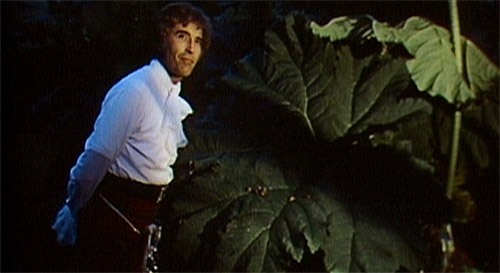
In the film, straight-laced Sergeant Howie is dispatched to investigate the disappearance of a young girl named Rowan Morrison on Summer Isle, a remote Scottish island, only to find that not only does every villager on the island deny any knowledge of Rowan Morrison, but that his visit coincides with the island’s highly enthusiastic and – to the devoutly Christian Howie – unwholesome May Day preparations. Cue an increasingly frenzied search by the valiant but humorless Howie, a collision of equally blind faiths, and more references to to Celtic folklore and fertility symbolism than you can shake a Maypole at. There’s an inn named the Green Man; a sweet shop stocked with pastries and chocolates in the shape of women, leaping hares, and what look like rams’ heads; lots of nubile gamboling in graveyards and stone circles; a lush estate encircled by phallic topiaries… Oh, and Christopher Lee as the island’s erudite neo-pagan lord, who enjoys nothing so much as wearing a kilt and soliloquizing about the joys of the animal world while intercut with footage of glistening snails intertwining and set over a soundtrack of hypnotically pulsating drums and recorder.

Christopher Lee, plus kilt

No, I didn’t have too much fun watching this movie, I don’t know what you’re talking about.

Continue reading “Where is Rowan Morrison?”

The Woman Who Loved Reindeer, by Meredith Ann Pierce (1985) E

Date Read: 6.10.09 (fourth[?] reread)
Book From: Personal collection
Reviewer: Emera

Caribou is a dreamer of dreams, a solitary figure isolated from her tribe ever since the death of her father. One day her sister-in-law comes to her, bearing a strange golden child whom she begs Cari to conceal and raise. At first unwilling, Cari is nevertheless struck by the child’s beauty and takes him in, naming him Reindeer – for as she reluctantly comes to realize, he is a trangl, one who can take the form of both human and stag. Though she longs to keep him by her side, his blood will always call him to run with the wild deer that course the land. As the years pass, stirring spirits and strange upheavals in the mountains and hot springs send the tribespeople to Cari’s door for advice. From Reindeer, she learns that the world is being remade, and that if she is to save her people, she and Reindeer must guide them over the Burning Plains to the safety of the lands that lie beyond the Pole, where only the wild deer have run before.

Of all the authors I’ve read, I’ve most deeply identified with the work of Meredith Ann Pierce, for the longest period of time. I first read her books when I was eight or nine, and though there were many literary loves before then, and have been many, many more since, I always think of Pierce’s books – particularly her Darkangel Trilogy – as The Milestones. She’s most often written tales about strange, wise girls who become strange, wise women, fall in love with transfigured or supernatural lovers, and have adventures in worlds of beautifully realized mythology. Mythology, because her books often read to me like myths from alien planets: her images and language have a timeless, jewel-like purity to them, coupled with deliciously archaic diction and – this might be the part that most gets me – a deep, deep sense of yearning that encompasses both human and immortal desires.

This was the first time I’ve re-read one of her books in about eight years, and since a lot has changed in that time, this doesn’t have quite as immediate an emotional impact on me as it used to. I used to get a lot of vicarious rage and anguish on Cari’s behalf. The older me is both slightly more phlegmatic (though really not that much less romantic), and slightly savvier: this time around, I was a little squicked at Cari having a relationship with her foster child, despite Pierce’s care in emphasizing his inhuman nature and unfamilial relationship with Cari.

Regardless, I was still deeply affected by the wondrous and joyful imagery: gambling trollwives, rivers of silver caribou running, a sledge with belled harness and golden runners, firelords with lava-seamed palms… And while the younger me fumed (again on Cari’s behalf) when she read the inconclusive ending, the older me was pleasantly surprised to recognize its maturity and realism. This will continue to be a story, and a world, that I treasure, and that I suspect will still surprise me every time I re-enter it.

Meredith Ann Pierce’s works will very likely appeal to fans of Patricia McKillip and Robin McKinley; I’ve never entirely understood why she hasn’t become more well-known and widely read. Not that I’m biased or anything.

Go to:
Meredith Ann Pierce