Articles by kakaner

You are currently browsing kakaner’s articles.

… are three reasons why Margaret Atwood believes we should keep the paper book.

There’s a little bit of a spat going on in the comments of Margaret Atwood’s blog concerning the digitalization of books. While many people do fervently agree with Atwood’s reasoning (well, if they’re reading the blog they probably enjoy reading good literature and therefore probably appreciate books), people are accusing those against ebooks for not realizing the vital advantages of the cyberbook.

No one is contesting the advantages, convenience, and necessity of digitalizing information. With online text we can use Ctrl + F and access all the information of the world using a 1-5 pound laptop.  When it comes to books, the appeal of being able to download another form of media for free is too tantalizing, even for those who would prefer to read a physical book.

Atwood uses the reasons cited above as the pragmatic basis for the argument in support of books. Although these occurrences are unlikely and probably far from anyone’s list of immediate concerns, let’s see what does hit home. How many times have you accidentally scratched a CD, or come home to find your harddrive corrupted? Blue screen of death anyone? It doesn’t work quite the same for books They’re pretty durable– they can withstand many scratches and beatings, and I doubt anyone has come home to find that their book suddenly won’t open or the words have turned into some Wingdings jargon straight on the page.

Read the rest of this entry »

Tags:

Date Read: 6.27.09
Book From: Personal Collection
Reviewer: Kakaner

I have finally waded out of a merciless sea of deadlines, grad apps, visiting parents, and other such nonsense to bring you a review of scifi crack in book form. So I apologize for my contribution to any recent TBL droughts.

Antibodies is the story of a pale anorexic woman, Diandra, who nurtures an unhealthy desire to become a machine. She is true in every way to the Antibodies cult– starving and draining the blood from her body to entirely prepare herself for mechanical integration. However, circumstances prevent her from completing her transition smoothly. She is captured by the notorious hedonistic psychiatrist Julian Nagy who runs a therapy clinic to heal, and eventually exploit, those of the cult. At the same time, her only guides through this process are vague and ominous directions from the Antibodies authority while contending with the resentment of the public.

I discovered this book through a Coilhouse link Emera flinged my way over a year ago and behold, it bobbed up to the surface of my 100+ TBR pool and I have actually managed to read it. Well, I was pretty hooked after Coilhouse described it as a “deeply disturbing, brutally unsparing book” which sounded right up my twisted alley.

Don’t be fooled by the summary. Antibodies certainly sounds fascinating– a solid mix of cyberpunk and cult fantasy with a generous dollop of scifi fetish braincandy– but it is altogether entirely horrific. It takes many elements of our current society and exaggerates and stretches them into a possible future universe in which people worship and want to become the technology they have created. The depravity of humanity is evident as its constituents are each proponents of some broken part of our very system. Let’s see what Coilhouse has to say:

That’s what Antibodies is, at its heart: a horror novel. There are no heroes here, only the deluded and the ruthlessly predatory. But for all its Gran Guignol touches, Antibodies hits home. In a rush to the future, it’s easy to forget or ignore the wreckage that draws in the alienated and insane into any dream that offers them easy transcendence from their previous lives.

Read the rest of this entry »

Tags: , , , ,

Date Read: 9.24.07
Book From: Personal Collection
Reviewer: Kakaner

Summary

Stalking Tender Prey sets the stage for an epic trilogy by introducing the intertwining stories of the Grigori (fallen angels) family line which begin in a little countryside town, Lil Moor. Certain people in Lil Moor discover latent psychic abilities and the arrival of a traveling Grigori triggers a cascade of events that uncover the Grigori roots of Lil Moor. (First book of the Grigori Trilogy)

Review

Unfortunately, this book, and subsequently trilogy, pales in comparison to Wraeththu and the Magravandias trilogy. I’m a little bit surprised because Constantine has plenty of material to work with and sets up a rich landscape and sophisticated characters, but fails to do much with them.

I’d say the best point of this book was the character development, what I believe is consistently one of Constantine‘s strengths. Constantine somehow (I wouldn’t say masterfully) uses dialogue, subtle nuances of action, and atmosphere to create enchanting characters, who whether by their own self-realizations or due to the fantastical circumstances of their current lives, develop in amazing ways. Also unlike Wraeththu and Magravandias characters, each of the ones in Stalking Tender Prey seem to be shrouded in this veil of impenetrable mystery, and unfortunately I haven’t been able to quite grasp or connect to any on a personal level.

However, there was just about… no plot. The only plot that moved was a recurring flashback that mainly consisted of character develop of the Grigori traveler. Well, maybe “no plot” is a bit harsh, but the novel was basically a stagnant story about this little town in which nothing happens. Nevertheless, there was a climax and sex with a cat. Judging from this book, there is plenty of potential for the second book with respect to characters and plot threads, so I am still excited.

Go to:
Storm Constantine

Tags: , , , , ,

Date Read: 11.03.09
Read From: Asimov’s July 2008
Reviewer: Kakaner

Well, after reading “Spar”, I was mighty curious to see what all the fuss with Kij Johnson was about so I searched up her most famous story. “26 Monkeys, Also The Abyss” won the 2009 World Fantasy Award for Best Short Fiction and is currently nominated for the 2009 Hugo and Nebula Short Story awards.

The story is about a girl with little-to-no prospects who buys a traveling monkey act from the current owner. The act makes her rich and famous, but she is never quite satisfied mainly because she isn’t able to figure out how the monkeys perform their disappearing act. I was drawn in by so many aspects of this tale– the circus, monkeys with personalities, magic, and the very bizarre human-human and human-monkey relationships.The implied imagery is actually eerily haunting, from 26 brilliant monkeys pursuing pastimes in their cages to the scene in which they disappear one by one into a suspended bathtub. However, I was very disappointed by the ending. I felt like Johnson did a fantastic job keeping me guessing throughout the entire story but failed to deliver an ending of the same caliber, and I didn’t come away with much food for thought. Once again, one of those “What was the point?” moments for me.

Go To:
Kij Johnson
Asimov’s Science Fiction

Tags: , , ,

Date Read: 10.12.09
Book From: Personal Collection
Reviewer: Kakaner

Summary

Jimmy Jibbett is a boy who dreams of becoming a comic book artist and spends his days in the basement making his stories come to life on paper. His mother is also an artist, but his father is a humorless businessman and his two sisters are brats; overall, his family doesn’t really support his aspirations. But Jimmy finds hope through his friends, certain members of his family, and ultimately his imagination.

Review

This is a pretty charming little story, complete with full illustrations  drawn by the author in the style of a 10 year old. I was lured to buy this book when my friend pointed it out to me on a shelf and said something along the lines of, “Dude! That’s one of my favorite children’s books! It’s about this kid that draws comics!”. I mean, who doesn’t love a kid who loves and draws comics? Case and point.

I had no trouble envisioning Jimmy as this scrawny kid with a constantly runny nose who simultaneously entertained wild dreams of inventing the world’s favorite superhero and nurtured a secret desire for that superhero to come to life and be his best friend. Jimmy is pretty much the quintessential dorky pre-pubescent boy, and subsequently, loser so if you were one of those, read this book.

My one gripe is that it seemed like the entire story was covered by a slight sheen of awkwardness. Although the story is touching and relatable, the writing doesn’t achieve that level of lighthearted elegance usually found in Newbery winners and Jimmy as a character doesn’t really stay with you after you finish reading. The plot was a little bit too simple and straightforward, and the few plot devices seem like they were devised and then inserted into the story. However, I do have to say The Main in the Ceiling has one of the absolutely cutest endings ever.

Go to:
Jules Feiffer

Tags: , ,

Date Read: 10.28.09
Read From: Clarkesworld Magazine
Reviewer: Kakaner

“Spar” is a grim, vulgar, unrelenting torrent of images and words that will leave you mouth agape and reeling. It is the horrifying tale of neverending rape and an examination of the human psyche under a most extreme duress. The storytelling definitely fits the actions and story– short, hard sentences and fragments contrasting wistful remembrances of a life before. Johnson has created somewhat of a short fiction monster here, and I personally still don’t know quite what to make of it.

Go to:
Kij Johnson
Clarkesworld Magazine

Tags: , ,

Date Read: 9.26.09
Book From: Personal Collection
Reviewer: Kakaner

Summary

The story follows Doctor Faraday, a lonely bachelor who calls upon the residents of the once glorious Hundreds Hall and begins to form a friendship with the remaining family and staff that reside there. His friendship to the family becomes a crux on which they rely, and soon he finds himself involved in ever stranger circumstances at Hundreds Hall.  The interactions of the story are characterized by mysterious fires, writings, and sounds with the underlying ever-increasing tension of Faraday’s relationship to the mother and daughter of the house.

Review

It took me a really long time to review this because I couldn’t form a concrete opinion. Basically, there was good and bad, but the good was oh so good and the bad was characterized by raging mediocrity. Every time the scales tipped in favor of one side, I’d remember something to the contrary and the dilemma would reassert itself.

The Good: Superb writing and storytelling. Of course, it is apparent from Waters‘ four previous novels that she knows how to write, and once again she demonstrates her ability to spin a tale out of not an incredible amount of material. I was reading along the first 100 pages, and I was still, somewhat inexplicably, waiting eagerly to find out what would transpire during Faraday’s fourth visit to the same dreary hall. There’s no rampant drama or lgbt overtones that characterize her previous novels, which I found quite refreshing, as if I were here for the sole purpose of enjoying raw word manipulation.

Read the rest of this entry »

Tags: , , , , ,

Once upon a time, Emera and Kakaner were high school students who shared roughly half their classes and more importantly, were badminton partners in gym.

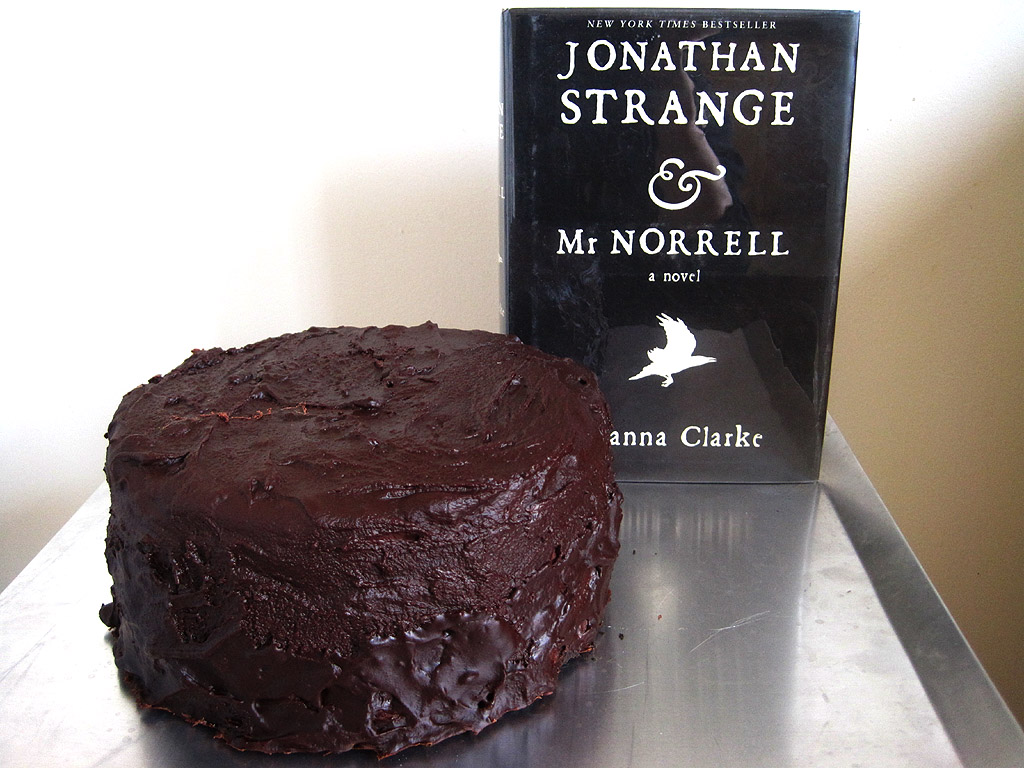
I am writing to tell you all about a peculiar period of time in our senior year of high school during which we tried to memorize the hulking blaring entirety of Jonathan Strange and Mr. Norrell, by Susanna Clarke. Emera had read this first and strongly impressed upon me that if I did not read it soon, my very existence would dwindle and die away. In no time, we were both completely obsessed with JSMN and literarily worshipped its texts, and for a long time, could speak of nothing else. Reviews of JSMN will be forthcoming– it’s just that our current reviews are rather explosive and incoherent. JSMN also made it to our The Black Letters Top Books list, so you can understand what kind of literary entity we are dealing with here.

We were inspired by Ray Bradbury’s Farenheit 451. Although both of us had already read the book before being assigned to read it in AP English, the second time around, the concept of memorizing an entire book in secret really tickled our fancies. So, we conferred, and somehow decided that the 800-page JSMN was the obvious choice.

Read the rest of this entry »

Tags: , , , , ,

Date Read: 3.31.07
Book From: Personal Collection
Reviewer: Kakaner

Summary

Deeba and Zanna begin to experience strange phenomena until suddenly, one day, they find themselves in the alternate universe of Unlondon. Here they find that Unlondon has been waiting for a long time for Zanna, the “Shwazzy,” to fight the evil Smog, an evil cloud of pollution. However, things are not what they seem when events contradict the prophecies and Deeba is forced to fight the Smog on her own.

Review

I MISS BEING 12.

I have a feeling that if I read this while in middle school, I would have deemed Un Lun Dun The Best Book Evar. The book is incredibly reminiscent of Phantom Tollbooth, chock full of strange realizations of imagination, each a quirky interpretation of something we find in our reality. There’s not much to say plot-wise… the bulk of content was simply the adventure and development of Unlondon and numerous characters, a delightful afternoon romp for the appreciative reader.

As I organized my thoughts for this review, I remembered the China Miéville event I attended at which I saw him speak about Un Lun Dun and the entire YA genre with vivid boyish excitement, and the memory is coloring my opinions of Un Lun Dun with much fondness. I crushed hard on the fact that so much of the humor and wit in Un Lun Dun was derived from references and puns concerning books. Some pun examples, though not necessarily book-related, are the Black Window, Unbrellas, and Bookaneers! But most of the circumstantial humor was centered around books, and made me suspect that Un Lun Dun was really a huge elaborate scheme to write a book to promote the message: “BOOKS ARE TEH SH*T!” and it made me extremely happy.

Unfortunately, I actually don’t consider Un Lun Dun a must-read. But if you’re a die hard Miéville fan, definitely check it out. The main character is very likeable, and it is an insanely easy read with maximum 4-page chapters. To top it all off, you get to see Miéville‘s very own original illustrations. There’s nothing better (or sometimes worse) than observing an author treading new ground, and Mieville does so quite expertly. There is indeed a deep understanding of the YA psyche and which elements excite the imagination.

Go to:
China Miéville
Un Lun Dun, by China Miéville (2007) E

Tags: , , , , ,

Date Read: 12.27.08
Book From: Personal Collection
Reviewer: Kakaner

Summary

A look at the life of Benjamin Button who was born old and died young.

Review

I have never been a fan of F. Scott Fitzgerald, my only experience having been The Great Gatsby. I feel horrible saying that I didn’t enjoy it in the least bit, although it certainly stands to argue that if I revisited it now with a slightly more mature eye, I would probably quite like it. Being the incredibly anal purist I am, after learning about the upcoming release of The Curious Case of Benjamin Button in theaters, I headed over to my local BN to read the short story first. I wasn’t blown away by the story, but it was so quaint, indirectly emotional, and beautiful that I ended up spending $13 on the somewhat overpriced newest edition with full-color illustrations.

100_3340

Read the rest of this entry »

Tags: ,

« Older entries § Newer entries »