The City of Ember, by Jeanne DuPrau (2003) E

Date read: 1.26.10
Book from: Borrowed from Kakaner
Reviewer: Emera

Jeanne DuPrau - The City of Ember

“The city of Ember was made for us long ago by the Builders. It is the only light in the dark world. Beyond Ember, the darkness goes on forever in all directions.”

At the age of twelve, every child in Ember is assigned a job. Curious, bright-spirited Lina Mayfleet longs to be a messenger, but is instead assigned to dreary, dirty work in the underground Pipeworks. Doon Harrow, her classmate, is convinced that the sporadic blackouts of the great lamps of Ember – the only lights in a world of immeasurable darkness – forebode worse troubles for the city. He longs to investigate the enormous generator in the Pipeworks that provides the city with all of its power, so when he receives the job of messenger, he and Lina eagerly swap their assignments. As the blackouts increase in frequency and fear spreads among Ember’s citizens, Lina soon comes to share Doon’s suspicions that Ember is a dying city. Together the two embark on a search to uncover Ember’s origins, and to find a way to lead their people to the bright city that Lina is sure exists somewhere in the Unknown Regions beyond Ember.

I didn’t enjoy The City of Ember nearly as much as I thought I would, for all that it’s a rather endearing book. The characters and setting are warmly evoked, with detailed and frequently beautiful descriptions, and of course the concept is fantastic to begin with – Ember is one of those fictional realms you wish you could visit, and more often than not end up carrying around with you in your head after reading. (I imagined it looking like a less anarchic version of the city in the film La Cité des Enfants Perdus/The City of Lost Children, and would pay a large amount of imaginary money to run along its streets and peer into its shops.)

Continue reading The City of Ember, by Jeanne DuPrau (2003) E
The Woman in the Wall, by Patrice Kindl (1998) E

Date read: 3.22.06
Book from: Borrowed from Kakaner
Reviewer: Emera

book-kindl-woman

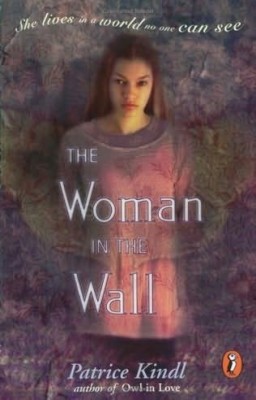
Rendered nearly invisible by her painful shyness, Anna is the middle girl of three sisters living with their mother in a rambling Victorian home. At seven years old, terrified by the impending threat of school, she retreats into passageways and secret rooms of her own construction, and lives within the walls of her home for the next seven and a half years. Anna is content to hide away as a sort of household ghost, nearly forgotten by even her family, until her own growth as a woman renders her “invisibility” no longer possible. A stray love note pushed through the walls of her refuge appeals to her developing emotions, and the time approaches for Anna to once more venture into the outside world.

I randomly spotted The Woman in the Wall on Kakaner’s bookshelf at some point around when we first began exchanging reading material on a regular basis, and the premise deeply appealed to me since I’m a. sorta shy and b. obsessed with secret nooks and passageways, to the point that a home-within-a-home sounds right up my alley. Even outside of my particular quirks, the concept is an emotionally powerful and imaginatively appealing one.

Unfortunately, Kindl’s writing isn’t up to the task. Although the book aims for a wistful, playful mix of Gothic fairy tale and magical realism, it increasingly dissolves into a weepy, unconvincing pastiche, with the narration lurching between “artsy,” “quirky” whimsy and banal adolescent histrionics. Too much pretension (or, more charitably, ambition), not enough substance. Though Anna’s story could have been a moving modern fairy tale about escapism and self-isolation, The Woman in the Wall more often seems clumsy, superficial, and implausible.

Go to:
Patrice Kindl

Rebecca, by Daphne du Maurier (1938) E

Date read: 2.8.09
Read from: Borrowed from Kakaner
Reviewer: Emera

Young, unworldly, and hopelessly shy, our nameless narrator finds herself swept off of her feet by the widowed and much older Maxim DeWinter while working as the companion of a wealthy American woman on the French Riviera. Maxim takes her away to his estate in England, Manderley, where the soon-disenheartened narrator learns that her lot is to live in the shadow of Rebecca, Maxim’s first wife. Rebecca was glamorous, flamboyant, the consummate wife and hostess; Mrs. Danvers, the housekeeper, is fiercely devoted to her memory, and regards Maxim’s second wife as an interloper and a poor replacement. Between Mrs. Danvers’ cruel manipulations and Maxim’s moody secrecy – which the narrator fears is a sign that he still loves Rebecca – the narrator finds herself without allies in Manderley, and is driven both to uncover the truth of of what happened to Rebecca, and to come into her own as a woman.

Hmm, awkward summary. Anyway, I read this following Isaac Marion’s The Inside, and together they ended up being a one-two punch of delicious, delicious suspense. I couldn’t read Rebecca in anything less than 100-page chunks – addictive to the max, it is.

Continue reading Rebecca, by Daphne du Maurier (1938) E

In the Company of the Courtesan, by Sarah Dunant (2006) K

Date Read: 12.14.06
Book From: Boston Public Library
Reviewer: Kakaner

Summary

Bucino is a dwarf who serves one of the most beautiful and successful courtesans in Rome. However, the war forces them to flee to the courtesan’s birthplace, Venice, where she is forced to build her career and reputation again out of nothing.

Review

In a much tighter and well-written second novel, Sarah Dunant takes us through the intriguing and dazzling world of the courtesan. The plot is basic yet appropriately ambitious, the simple voyage of a determined woman who manages to rebuild her life through hard work and large helpings of wit. The linearity of the story made room for a lot of other elements to shine through, particularly character development. It is apparent that this book was well-researched, and Dunant’s comfort with the subject matter allowed her to weave a fresh story with historically educational tidbits. Sometimes there were couple page long descriptions of courtesan techniques and how-to’s for wooing men, and they were terribly fun and interesting. Despite the very controlled approach to the novel overall, Dunant definitely took some liberties towards the end and added some flair and drama to the story. However, the novel as a whole was very effective and engaging, a relatively easy read for any historical fiction fan.

Go to:

Sarah Dunant

The Summer of the Ubume, by Natsuhiko Kyogoku (1994) E

Date read: 12.27.09
Book from: Personal collection, via Vertical, Inc.
Reviewer: Emera

Natsuhiko Kyogoku - The Summer of the Ubume

Translated 2009 by Alexander O. Smith & Elye J. Alexander. Original title Ubume no Natsu.

“Concerning the Ubume –
Of all the tales told, that of the ubume is the most confounding. It is said that when a woman who is with child passes away, her attachment to the babe takes physical form. She appears then as an apparition, drenched in blood from the waist down, and crying like a bird, saying “wobaryo, wobaryo.” Presented with stories of people transforming into such creatures after they die, how can we truly believe in Hell? It is beyond understanding.
Report on One Hundred Stories
Yamaoka Motosyoshi, Junkyo 3 (1686)”

In the classic mode of the genteel ghost story, a man visits his friend, and shares with him a strange tale: the daughter of a distinguished family of medical practitioners has been pregnant for twenty-one months without giving birth – a pregnancy that was discovered soon after her husband inexplicably disappeared from a sealed room. Scandalous! Throw in Japanese folklore, Gothic dread, and way too much pop psychology, and you have The Summer of the Ubume.

Continue reading The Summer of the Ubume, by Natsuhiko Kyogoku (1994) E

Nurk, by Ursula Vernon (2008) E

Date read: 2.18.09
Book from: Personal collection
Reviewer: Emera

Ursula Vernon - Nurk
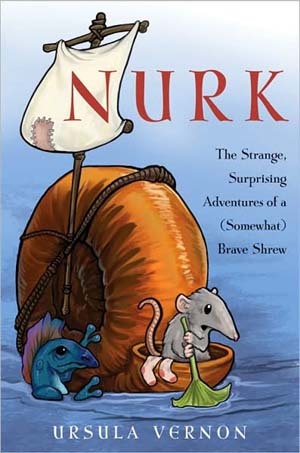
Nurk, a timid but sensible shrew, one day receives an urgent letter addressed to his famous grandmother Surka, the warrior, pirate queen, and general adventurer. Unfortunately, no one has seen Surka for seasons, and so Nurk packs Surka’s diary and some clean socks into his trusty snailboat, and heads off in search of adventure for the first time in his life. Dragonfly royalty in distress, perilous climes, and strange beasts aplenty await him.

I’ve been a huge fan of Ursula Vernon for years now, both of her vibrant, wildly imaginative artwork – she created the cover and interior illustrations for Nurk, of course – and of her equally weird and hilarious life and writing, as seen in her blog.

Nurk is her first mainstream published book, and is par for the Vernon course, combining a deeply practical, deeply likable hero (à la the protagonist of her long-running webcomic Digger, in which grandmother Surka is a character) with earthy wit, tooth-shattering cuteness, quick pacing, and occasional jolts of very enjoyable, very deeply creepy imagery. As a sampler: unripe salmon growing on trees; silent, voracious, cow-sized caterpillars…

Though for an adult reader, the plot is rather unmemorable (predictable twists, there-and-back-again structure), the individual elements are sufficiently weird and entertaining to make it worth the read. I do wish I knew some young persons of an age to be suitably gifted with it. Well, in a couple of years some of my cousins will be thereabouts, and in the meantime, it’s a quick, fun, slightly twisted adventure for readers of any age.

Go to:
Ursula Vernon

Antibodies, by David Skal (1988) K

Date Read: 6.27.09
Book From: Personal Collection
Reviewer: Kakaner

I have finally waded out of a merciless sea of deadlines, grad apps, visiting parents, and other such nonsense to bring you a review of scifi crack in book form. So I apologize for my contribution to any recent TBL droughts.

Antibodies is the story of a pale anorexic woman, Diandra, who nurtures an unhealthy desire to become a machine. She is true in every way to the Antibodies cult– starving and draining the blood from her body to entirely prepare herself for mechanical integration. However, circumstances prevent her from completing her transition smoothly. She is captured by the notorious hedonistic psychiatrist Julian Nagy who runs a therapy clinic to heal, and eventually exploit, those of the cult. At the same time, her only guides through this process are vague and ominous directions from the Antibodies authority while contending with the resentment of the public.

I discovered this book through a Coilhouse link Emera flinged my way over a year ago and behold, it bobbed up to the surface of my 100+ TBR pool and I have actually managed to read it. Well, I was pretty hooked after Coilhouse described it as a “deeply disturbing, brutally unsparing book” which sounded right up my twisted alley.

Don’t be fooled by the summary. Antibodies certainly sounds fascinating– a solid mix of cyberpunk and cult fantasy with a generous dollop of scifi fetish braincandy– but it is altogether entirely horrific. It takes many elements of our current society and exaggerates and stretches them into a possible future universe in which people worship and want to become the technology they have created. The depravity of humanity is evident as its constituents are each proponents of some broken part of our very system. Let’s see what Coilhouse has to say:

That’s what Antibodies is, at its heart: a horror novel. There are no heroes here, only the deluded and the ruthlessly predatory. But for all its Gran Guignol touches, Antibodies hits home. In a rush to the future, it’s easy to forget or ignore the wreckage that draws in the alienated and insane into any dream that offers them easy transcendence from their previous lives.

Continue reading Antibodies, by David Skal (1988) K

The Red Tree, by Caitlín R. Kiernan (2009)

Date read: 10.31.09 (unintentional, but awesome)
Read from: Personal collection
Reviewer: Emera

It’s raining, my socks are wet, and for these reasons I think I’d rather finish up my long-overdue review of Caitlín R. Kiernan‘s The Red Tree than do anything else.  And as there’s a red oak outside my window, I took a picture of it looking appropriately old, red, and potentially carnivorous at about the same time that I finished the book:

The review is spoiler-free, by the way.

The Red Tree is one of the best books I’ve read all year, and I’ve already been itching to go back to it and let it screw with my head some more. I’m not quite sure what I was expecting when I started it (probably something more lushly Gothic, like Alabaster), but what I read wasn’t what I was expecting, and then it was better than what I expected. It’s a jagged, rattling, hurtful book, and incredibly atmospheric. The horror is creeping and primal, almost inarticulable. People and paintings and animal bones appear and disappear; proportions and distances are warped; the brittle, chain-smoking protagonists labor under constant, sapping heat and suffer from surreal nightmares. At the same time, the emotions underlying it are so real: reading the book feels like holding an artifact of life, a snarled-up package of fury and self-hatred and despair. Yeah, it’s not the happiest book to read, but its painful authenticity is a large part of what makes it so compelling. There are no pretensions to darkness or the Gothic here, just a lifetime’s worth of the real thing.

After all, protagonist Sarah Crowe is a clear analogue of Kiernan herself: she’s a snarly, black-tempered writer of commercially unsuccessful dark fantasy who lives in Rhode Island, and she struggles with writer’s block and a seizure disorder. In Sarah’s case, she leaves the South to escape the memories of her failed relationship with an artist named Amanda, who committed suicide. Once in New England, she settles into an ancient farm house whose property is marked by a red oak of incredible age and size. Unsurprisingly, she develops a morbid fascination with the mythology surrounding the tree – in particular a half-finished manuscript left by the house’s last tenant in the basement – at the same time that a painter named Constance moves in upstairs. Cue much petty sniping, frustrated desire, and poorly concealed, creeping obsession.

Continue reading The Red Tree, by Caitlín R. Kiernan (2009)

The Alleluia Files, by Sharon Shinn (1999) E

Date read: 2/20/06
Read from: Public library
Reviewer: Emera

[Warning: Summary contains spoilers for the last two books of the Samaria trilogy, though the back-cover summary of the very first book spoils it all anyway (wtf).]

On the angel-governed planet of Samaria, Tamar is a member of the Jacobites, a cult persecuted and nearly destroyed by the Archangel Bael for their insistence that the god Jovah is no more than a mechanical spaceship that once ferried the original Samarian settlers to their new planet. Once again forced to flee the destruction of her friends and comrades, Tamar finds herself unwillingly entangled with the angel Jared, who, despite his lazy and easygoing nature, is expected to become the next Archangel. Jared himself is wary of Bael’s increasing fanaticism and strongly anti-technology stance. In a Samaria that is on the brink of industrialization, Jared begins to aid Tamar in her search for the Alleluia Files, the mythical documents that reveal the truth of Jovah’s identity.

I expected to be not-very-impressed as usual by Shinn’s work, and several times had second thoughts about bothering to pick up The Alleluia File, which is the third book of the Samaria trilogy. Nevertheless, I actually rather enjoyed this one, so I’m glad I took the time to finish up the trilogy. To reiterate my review of Archangel, the Samaria books are very conceptually engaging, this one especially so, as it’s rare for authors in fantasy to push the typical pastoral-feudal (or Renaissance, tops) society towards industrialization. In this sense, it’s a satisfying close to the overall arc of the trilogy. Particular fans of Jovah’s Angel, the second book in the trilogy, may also be gratified by the numerous nods made to characters and plot points of that book – though I get the feeling that it’s one of the least liked in the series, given its goody-two-shoes protagonist. (I’d comment more on Jovah’s Angel but I never wrote a review of it.)

To return to The Alleluia Files – as a whole, it’s significantly weakened by its loose construction and annoying reliance on coincidence to move the plot, and although Shinn generally writes good romance, a number of the romantic scenes in this book were unaccountably dorky and saccharine. Also, though its characters are likable and often moving, I found myself quite unable to remember anything about them only a little while after reading the book – which was also the case for me with the first two Samaria books. Ultimately, I found the Samaria trilogy entertaining and readable, but not outstanding. I haven’t bothered to follow up on the two standalone novels that follow it.

Go to:
Sharon Shinn
Archangel, by Sharon Shinn (1997) [E]
The Shape-Changer’s Wife, by Sharon Shinn (1995) [E]

Archangel, by Sharon Shinn (1997) E

Date read: 9/15/05
Read from: Public library
Reviewer: Emera

Samaria is a utopian, hierarchical world, its people divided into strict social castes, from the wealthy, land-holding Manadavvi to the nomadic Edori. All are guided by the winged angels, who arbitrate mortal disputes and pray directly to the god Jovah through their music. Gabriel is an uncompromisingly principled angel due to become the next Archangel, who must therefore find his wife, the Angelica, in time for the next Gloria, when mortals and angels from across Samaria must gather and sing to show Jovah their unity. Unfortunately, he finds that his wife is Rachel, an embittered Edori slave girl who couldn’t care less about Gabriel or becoming the Angelica. Complicating Gabriel’s problems is the current Archangel, Raphael, who seems increasingly unwilling to cede his power, and has begun to foster corruption in the ranks of the angels.

Sharon Shinn‘s Samaria books are romantic science fantasies much along the same lines as Anne McCaffrey’s Pern books. I actually read the second book of the original trilogy, Jovah’s Angel, first, but liked Archangel much more because the characters were so much stronger in personality.

I find, though, that the main interest of the books lies in the fascinating and well-developed world concept – almost more than I enjoy actually reading the books, I enjoy playing with the world-building and geography in my head after reading. (The same holds true for me, to varying degrees, for series like Garth Nix’s Old Kingdom books and Storm Constantine‘s Wraeththu books.) Shinn writes what I might call “workhorse” fantasy – it’s reliably well-written, and there’s nothing really wrong with it, but it lacks spark and stylistic interest. But after all, having a compelling world is one of the main selling points of fantasy, so Shinn certainly succeeds there, as she also does in her romantic plotlines. Her descriptions do grow a shade purple every now and then, but in general she avoids mush and plays out convincing character chemistry.

But really, it all comes back to the world-building for me. I can’t help wishing that her books would explore more of Samarian culture, particularly that of the angels – I’d love to know details of how angel children are raised, for example…

Go to:
Sharon Shinn
The Shape-Changer’s Wife, by Sharon Shinn (1995) [E]
The Alleluia Files, by Sharon Shinn (1999) [E]