Blood Oranges, by Kathleen Tierney (2013) E

Reviewer: Emera
Date read: 2.8.2013
Book from: Personal collection

“My name’s Quinn. If you buy into my reputation, I’m the most notorious demon hunter in New England. But rumors of my badassery have been slightly exaggerated. Instead of having kung-fu skills and a closet full of medieval weapons, I’m an ex-junkie with a talent for being in the wrong place at the right time. Or the right place at the wrong time. Or…whatever.

Wanted for crimes against inhumanity I (mostly) didn’t commit, I was nearly a midnight snack for a werewolf until I was ‘saved’ by a vampire calling itself the Bride of Quiet. Already cursed by a werewolf bite, the vamp took a pint out of me too. So now… now, well, you wouldn’t think it could get worse, but you’d be dead wrong.”

The recently released Blood Oranges looks to be kicking up some dust in the vicinity of urban/paranormal fantasy, which is as it should be: Caitlín Kiernan, writing under the pseudonym of Kathleen Tierney, aimed it as a rejoinder to many of the more questionable indulgences of the genre, whether they be tramp-stamped, pleather-clad heroines or beglittered vampires. It’s also a fast-paced, profane, and combustive little thriller with an unapologetically queer, thoroughly ornery protagonist who’s suffered the tragicomical fate of being transformed into the world’s only werepire. (At least her heroin addiction is gone.)

Since I lack a generalized sense of vindictiveness towards urban-whatever fantasy, I don’t find particular satisfaction in trope-busting per se, and some of Quinn’s acid meta-commentaries – about how if she had been a character in that kind of book, this would have happened that way, but she’s not, so it didn’t – do go on a bit. What does interest me about the device is how it helps inform Quinn as a character. As fun as pyrotechnics and various deaths-by-werewolf can be, I found it far more rousing to watch the way that, tedious particulars aside, Quinn constructs and references narratives, then unceremoniously shreds them in her wake. Junkies lie, she tells us very early on. And so, after she’s rattled off a grimly spectacular rendition of her origins as a monster-slayer, it soon comes out that in fact she’s “been stretching the truth like it was a big handful of raspberry-flavored saltwater taffy.” The real origin story involves significantly more clumsiness and bad timing on the part of the defunct monsters.

While Quinn never repeats that gambit to quite that degree in the rest of the novel, digressions and evasions continue to criss-cross and loop around her narration – pop-cultural riffs and potshots, reminiscences that slide back and forth across time and various shadings of the truth. Combined with the raw prose (Quinn warns us that she’s no writer), what comes across is the voice of a young woman who’s talking too fast, sometimes too loudly or too softly, compulsively running her hands through her hair, and not much meeting your eyes – someone rough, vibrant, and, despite the efforts of numerous supernatural beings, very much alive.

Quinn doesn’t have enough agency to be a really free-wheeling trickster character (like many of Kiernan’s characters, she’s trapped in a relationship with a dubiously benevolent protector/mentor/creator), but in her exuberant roughness, her scrappiness, her avowed suspicion of anything resembling a moral code, there’s a definite, electric touch of the trickster spirit. Temper that with the sense of submerged loss that’s another constant in Kiernan’s work, and you have a protagonist whose wry, sometimes melancholy self-awareness convincingly undergirds the satire.

Go to:
Caitlin R. Kiernan: bio and works reviewed
“So Runs the World Away,” by Caitlin R. Kiernan (2001): review by Emera
Alabaster, by Caitlin R. Kiernan (2006): review by Emera
The Red Tree, by Caitlin R. Kiernan (2009): review by Emera

The Bohemian Astrobleme, by Kage Baker (2010) E

Reviewer: Emera
Date read: 1.26.2013
Read online at Subterranean Press, Winter 2010 edition.

“The Bohemian Astrobleme” (2010) is another droll, diverting spy romp in Baker’s Company universe, the second to feature the spyin’, whorin’, but mostly shruggin’-at-the-foibles-of-men Women of Nell Gwynne’s. (After Baker’s death in 2010, her sister, Kathleen Bartholomew, finished her final novel of the Women, On Land and at Sea, which was just released this past December.)

This time, Lady Beatrice is dispatched to serve in a transcontinental operation regarding the acquisition of the titular mineral, of great scientific interest to the Company’s efforts, which are described as follows:

“The Society’s goal was the improvement of the human condition through the secret use of technologia, until such time as humanity became advanced enough to be made aware of its benefits. It was generally agreed that some sort of world domination would be necessary before that day arrived, but at the present time the Society was content merely to gather power and pull strings attached to certain government officials.”

The story is elegant, economical, briskly paced, and, as above, full of deadpan humor perfect in its quiet delivery. My only disappointment is that the depiction of Lady Beatrice doesn’t progress beyond that initially introduced in “The Women…” (cool, self-contained, effortlessly competent), since she’s a character begging for further development. A static sketch of a hypercompetent cipher is rarely fulfilling, no matter how entertaining. Inevitably, I’ll have to make it my business to pick up the novel.

Go to:
Kage Baker: bio and works reviewed
The Women of Nell Gwynne’s, by Kage Baker (2009): review by Emera
Read “The Bohemian Astrobleme” online

The Boneshaker, by Kate Milford (2010) E

Reviewer: Emera
Date read: 4.24.2012
Book from: Personal collection

 “Strange things can happen at a crossroads, and the crossroads outside of Arcane, Missouri, is no exception. Thirteen-year-old Natalie Minks knows all the odd, mysterious tales about her little town – she grew up hearing her mother tell them. But even Natalie is not prepared for the strangeness that’s unleashed when Dr. Jake Limberleg’s Nostrum Fair and Technological Medicine Show rolls into Arcane with its bizarre tonics and elaborate, inexplicable machines. When Natalie finally gets a close look at the intricate maze of the medicine show, she knows in her gut that something about this caravan healers is not right… and that Arcane is in grave danger.”

Like Bradbury’s classic Something Wicked This Way Comes, Kate Milford’s The Boneshaker is a spooky circus mystery-adventure set in a Midwestern town, and featuring young protagonists who must reckon with the insinuation of evil into their lives. Realizations about both mortality and morality loom large. The Boneshaker has more of a Western feel, though, shaded with near-apocalyptic gloom; the seductions of the circus have an even more explicitly diabolical flavor. Nick Cave’s “Red Right Hand” would be right at home on a soundtrack for the novel, I think.

As protagonist, Natalie is an intriguing foil to the unearthly disruptions of Limberleg’s Nostrum Fair: inquisitive, skeptical, mechanically minded, a little bristly and imperious. Admirably, her inquisitiveness extends to the emotional realm, as increasingly throughout the book, she tries to get inside the heads of the people she’s known for all her life, but frequently taken for granted. From the townspeople who have encountered evil in its various forms before, including her own mother, she gleans haunting snatches of narrative that deepen the novel’s Biblical mythos and lend it an absorbing sense of grandeur and pathos.

Unfortunately, Milford’s prose, though carefully detailed, is on the flat and list-y side, even when she write scenes that should be demonically animated:

“She didn’t have to be told to run. The harlequin lunged after her.

She sprinted and dodged, not caring which twists and turns she took in the maze of tents. Bells jingled overhead; the harlequin had taken to the wires again.

Her feet kicked up dust and slid on old straw. The things in her arms stirred restlessly. The Amazing Quinn raced alongside and above on a wire parallel to her path.”

And so on; the rhythm and syntax remain monotonous, and the descriptive choices expected. It’s troublesome, too, that one of Natalie’s mentors seems to have been tipped out directly from the Magical Negro mold. “Nothing to do but play my guitar and dispense advice to white folks in need, doot de doo…”

What Milford does do beautifully is frame rational-minded Natalie’s collision with the realization that the world is insistently, terrifyingly irrational. Her town and the crossroads are much older and stranger than she thinks they are; many of the adults around her have known far more suffering and struggle than she could have imagined; and moreover – worst of all, even – they, too, are fallible and vulnerable. Milford has things to say, too, about the power of story and memory, and weaves in the usual YA subplot of learning to stand your ground in the face of fear, but Natalie’s coming to grips with the pervasiveness of evil and mortality is by far the most affecting narrative strand.

I won’t be seeking out the sequels, but all in all, The Boneshaker was an entertaining read, both thoughtful and goosebumpily suspenseful, with satisfying lashings of American folklore and Christian mythology. I’d recommend it as a companion for a thunderstormy summer afternoon.

For a previously reviewed dark fantasy also featuring Western and Biblical touches (and, coincidentally, a red-haired doctor of dubious humanity), see: The Music of Razors, by Cameron Rogers.

Go to:
Kate Milford: bio and works reviewed
The Music of Razors, by Cameron Rogers (2007): review by Emera

“Nashvillians woke up one morning and found that we no longer had a bookstore”

…and Ann Patchett’s “secret was that [she] did not much miss those mall-size Gargantuas.” So she set out, more or less on impulse, to recreate the kind of bookstore experience that she did miss: a cozy space with carefully curated shelves and employees who double as a personal recommendation system. Partnered with Karen Hayes, a former Random House sales rep, Patchett set out to open Nashville’s newest independent bookstore, despite numerous warnings (and her own fears) that “the bookstore is dead.”

Her article in The Atlantic, recounting her experience of the precipitous process, is a thoroughly enjoyable read. Highlights: her eager gleaning of bookstore know-how during the signing tour that coincided with Parnassus Books’ incubation period; and the narrative she began to craft, with increasing conviction, during interviews: that the moment of the small independent bookstore is now.

And whether or not Parnassus’ success is replicable, it’s still vicariously thrilling to read about Patchett’s realization of her ability to accomplish every reader’s ultimate social joy: “I could talk strangers into reading books that I love.”

Go to:

Ann Patchett: bio and works reviewed
Bel Canto, by Ann Patchett (2001): review by Emera

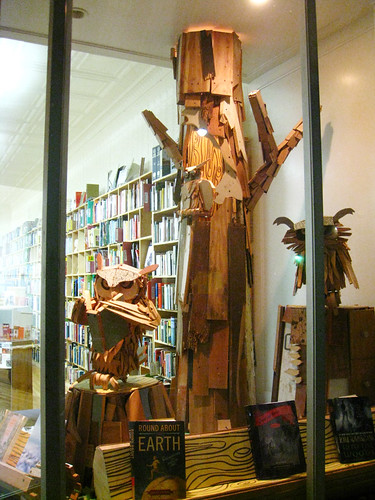
Bookstores of Boston/Cambridge: Pandemonium Books

4 Pleasant St., Cambridge, Massachusetts (a few blocks away from the Central T stop)


(Photo taken during the first of the unrelenting series of snowstorms that hit early in 2011.)

Here’s quick but much overdue tribute to one of my most frequent bookish haunts in Cambridge. Pandemonium is a compact sff and gaming store with a very active schedule of author readings and signings (I’ve gotten to see Cat Valente read there twice, and Caitlín Kiernan once), and a broad representation of genre periodicals; new and used books; comics; and geek paraphernalia like calendars, artbooks, prints, and, obviously, gaming materials. Sadly, they did have to cut back severely on their magazine stock this past summer due to declining sales, and now stock only about half a dozen titles.

As Boston/Cambridge genre bookstores go, Seek Books is significantly more historically exhaustive, offering more in the way of rareties and out-of-print titles; Pandemonium is more up-to-date.

In-town customers may also enjoy their occasional special events, like the yearly holiday Geekfaire, where vendors offer sff-themed goods – Doctor Who scarves and the like.

Out-of-town browsers might like to investigate new titles via their nicely curated online catalogue, which can be searched by handy categories including awards won, character traits, plot elements, and writing style.


– E

“Chamber of Secrets: The Sorcery of Angela Carter”

Marina Warner writes with beautiful force and exuberance about Angela Carter’s fairy tales, sensuality, ethics of the erotic, and more, here in the Paris Review.

A particularly breathtaking passage, arising from a remark on the origin of one of the stories in The Bloody Chamber as a radio play:

‘Very few writers use the imperative as she does—conspiratorially. Carter wanted to practise the atavistic lure, the atavistic power, of voices in the dark. “The writer who gives the words to those voices,” she wrote, “retains some of the authority of the most antique tellers of tales.”

The voice isn’t on its own, ringing in a hollow space. Open any page and a full score rises from its word-notes, of winds howling, teardrops falling, diamond earrings tinkling, snapping teeth, sneezing, and wheezing. Storytelling for Angela Carter was an island full of noises and sweet airs, and like Caliban, who heard a thousand twangling instruments hum about his ears, she was tuned to an ethereal universe packed with sensations, to which she was alive with every organ. Acoustics are not the only means, however, that she draws on to convey the lucid dreams she creates in her action. Her imagination is spatial, an architect’s axonometric vision, as she moves us through palaces and castles, forests and tundras, dungeons and attics, tracking with us down pathways towards her various sealed depositories of secrets, those bloody chambers. What reader does not explore with her these passages and woodland tracks? Who does not feel the Beast’s dark carriage like a hearse rumbling towards his eerily uninhabited domain? And who does not sense, through her powerful evocations, the pricking of thorns, the jaw-cracking stringiness of granny, the jangling of bed springs, the licking of a big cat’s tongue, the soft luxurious furs and velvets and skin, and the piercing contrasts with ice, glass, metal?’

Warner’s essay is from the new Folio edition of The Bloody Chamber. (Folio’s gorgeously illustrated editions might be my new crack, by the way. I’m particularly hankering after the Jillian-Tamaki-illustrated Irish Myths and Legends.)

– E

The Grand Tour, by Patricia C. Wrede & Caroline Stevermer (2004) E

Reviewer: Emera
Date read: 10.15.2012
Book from: Borrowed from cousin

or, The Purloined Coronation Regalia: being a revelation of matters of High Confidentiality and Greatest Importance, including extracts from the intimate diary of a Noblewoman and the sworn testimony of a Lady of Quality

Dear Reader,
We are having the most wonderful time on our tour of Europe with our new husbands, Thomas and James. We’ve been shopping in Paris, sightseeing in the Alps, and riding gondolas in Venice – there’s nothing like exploring the Continent!

However, there have been some troublesome moments. There was the midnight intruder who left behind a fashionable Turkish slipper. We also always seem to be running into the same peculiar people on our visits to ancient sites. And, oh yes, there was our discovery of the mysterious parcel that hints at a murderously magical plot of international importance!

Clearly, this isn’t quite the calm and relaxing journey we were expecting. But this Grand Tour is turning out to be the best adventure of our lives!

Love,
Cecy and Kate

The Grand Tour is an equally witty and fun sequel to the classic Regency fantasy Sorcery and Cecelia (my review). Plotwise, it’s over-reliant on convenient coincidences to move things along – the first half of the book verges on tiresome in this respect, as the girls and their husbands meander from attraction to attraction and just keep on bumping into those “peculiar people.” Eventually, though, the protagonists do go on the offensive and start trying to think one step ahead of the evil conspirators, as the extent of their plot becomes increasingly clear. But even before then, the affectionately combative dialogue, occasional brushes with danger (thieves! highwaymen! societal embarrassment!), and opportunities for secondhand touristry (there’s plenty of amusing and curious detail on 19th-century European travel, with the bonus of magical conveniences like anti-flea charms) kept me trundling on through the pages.

One of my only disappointments with Sorcery and Cecelia was the authors’ exceedingly light touch when it comes to fantastical worldbuilding, so I was gratified that The Grand Tour, with its international stakes and post-Napoleonic anxieties about war and rulership, goes a bit further in weaving magic into the world’s political and historical fabric. Its climax, especially, hints intriguingly at the depth of ancient magical practice.

Mostly, though, The Grand Tour is happy to remain a character-driven romp. The epistolary form rarely generates any real plot tension, since dramatic events are necessarily recounted after the fact, so I found that more tension arises from any distress the characters might be feeling during the events, than from the events themselves. This is especially so since the universe is a quite moral one, and threats to life and limb of the main characters are rarely serious and never permanent. Very comforting.

I did previously also complain about it being difficult to distinguish the personalities of the main characters; it turns out the nearly 500 pages’ worth of sequel is an effective cure for that, especially when one of the major subplots is Kate’s continued efforts to overcome her nervousness at all social obligations. This is resolved in a heavy-handed but still charming way.

The last page of the book suggests, of course, the possibility of another sequel, which I’ve only just realized was released in 2006: The Mislaid Magician, or, Ten Years After, which I’ll have to keep in mind for the next time I’m looking for the bookish equivalent of a frothy cup of hot chocolate. All three books have recently been released as ebooks with beautifully designed covers (link includes an interview with Stevermer on the trilogy).

Go to:

Patricia C. Wrede: bio and works reviewed
Caroline Stevermer: bio and works reviewed
Sorcery and Cecelia, by Patricia C. Wrede & Caroline Stevermer (1988): review by Emera

The worst sentence I have seen

– in recent memory, courtesy who else but H. P. Lovecraft:

“And yet, as I have said, vague new fears hovered menacingly over us; as if giant bat-winged gryphons looked on transcosmic gulfs.”

from “The Lurking Fear”


Don’t you just HATE it when those giant bat-winged gryphons look on your transcosmic gulfs?

(Also, the semi-colon is [sic]. Lovecraft abuses them as if he were being paid by the punctuation error rather than the word.)

I’m reading a fat paperback collection of Lovecraft right now, to get in the Halloween spirit, and thinking of making a drinking game. Drink for every “demoniac,” every “unutterable,” every “hideousness,” every “unutterable cacodaemoniacal hideousness”…

– E

“Huntswoman,” by Merrie Haskell (2005) E

Reviewer: Emera
Date read: 10.7.12
Read online at Strange Horizons Fiction.

“Huntswoman,” a Snow White retelling, is a quietly moving and thoughtfully constructed puzzle-story – the kind that invites you to read it again from the start once you’ve finished, reexamining each piece of language and dialogue for new significance. It works very effectively with dream-symbols and -logic to create a sense of wordlessly uneasy compulsion and claustrophobia. Ultimately, Haskell subverts the original story’s subtext of female jealousy and competition for male attention (which Angela Carter placed at center stage and heightened to grotesque effect in “The Snow Child”), turning it instead into an argument for healing within a specifically female community.

Looking at readers’ responses online, there seems to be some confusion as to interpretation of the story. The following is to me the most straightforward (spoilers follow, naturally): The huntswoman is the embodiment of Snow White’s dissociated and wandering consciousness during her poisoned sleep; there is an implication of previous abuse by her father, the king, who repeatedly and brutishly breaks things, and refers with desperately insistent imperiousness to Snow White as “my girl.” The stepmother queen, by contrast, is a repairer and healer, but conditioned by the canonical Snow White framework, we regard her magic at first with suspicion and incomprehension. (After all, she does keep asking for Snow White’s heart and hands.)

The bone china and pastry offered by the queen turn to humbler items in the huntswoman’s hands because she reflexively rejects knowledge of her true (royal) self. When she finally achieves synthesis and reawakening, it is overseen by her witch-stepmother, whom we now understand to be nurturing and benevolent, and contingent on her own efforts, rather than those of “a thousand princes.”

Go to:

Merrie Haskell: bio and works reviewed
Read the story online