March 2010

You are currently browsing the monthly archive for March 2010.

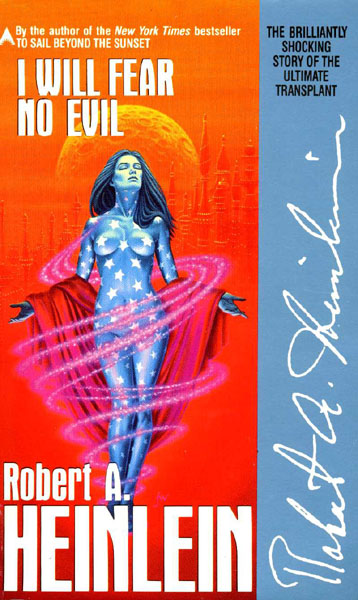
So when it comes to book covers, there’s overly literal, and then there’s this kind of thing, courtesy the mass-market paperback cover of Robert Heinlein’s I Will Fear No Evil:

Robert Heinlein - Fear No Evil

Allegorical representation of Something Profound About America, With Purple Pixie Dust? Thinly veiled excuse for female nudity? Who knows?

Go to:

Bad Book Covers Friday Archive
BBCF: The Technic Civilization Saga
BBCF: Relationships II
BBCF: The Saga of Recluce
BBCF: Moonsinger’s Friends
BBCF: The Alphabet Mysteries

“Undertow”

This has been my generally favorite thing since I found it last week. I’ve been reading it a couple times a day since, and it still hits me every time – it’s like being grabbed by the sternum and then having the rug pulled out from under my innards. whaaaaaat. But no, seriously, I love and am extremely envious of this poem.

Undertow

People looking at the sea,
makes them feel less terrible about themselves,
the sea’s behaving abominably,
seems never satisfied,
what it throws away it dashes down
then wants back, yanks back.
Comparatively, thinks one vice president,
what are my frauds but nudged along
misunderstandings already there?
I can’t believe I ever worried
about my betrayals, thinks the analyst
benefitting facially from the sea’s raged-up mist.
Obviously I’m not the only one suffering
an identity crisis knows the boy
who wants to be a lawyer no more.
Nothing can stay long, cogitates the dog,
so maybe a life of fetch is not a wasted life.
And the sea heaves and cleaves and seethes,
shoots snot out, goes to bed only to wake
shouting in the mansion of the night, pacing,
pacing, making tea then spilling it,
sudden outloud laughter snort, Oh what the
heck, I probably drove myself crazy,
thinks the sea, kissing all those strangers,
forgiving them no matter what, liars
in confession, vomitters of plastics
and fossil fuels but what a stricken
elixir I’ve become even to my becalmed depths,
while through its head swim a million
fishes seemingly made of light
eating each other.

- Dean Young

“raged-up mist,” “cogitates the dog”! I need to find and read more Dean Young, clearly. One or two of the more obviously sonically playful bits sound more decorative than meaningful (it’s mainly “stricken / elixir” that bothers me), but overall this poem is so on. The humor, the psychological understanding, the perfect fit and clarity of the final image…

Tags:

I’ve been thinking lately about how readers interact with the books that they read, and I have a few questions that I’d be interested in seeing others’ opinions on. I’m interested in the idea of the reader-writer contract – the idea that some type of mutual obligation exists between readers and writers.

At the most basic, almost purely commercial level, we have the opinion of someone named Susan Rand, whose article is the first Google hit for “reader-writer contract:”

When an author sits down to write a book, she enters into a contract with the reader. The reader’s part is to buy the book, and to recommend it to his friends. For her part, the writer promises the reader that she will take his hand and guide him safely through the world created in the book. She promises she will not suddenly push him off the path into an abyss, or put boulders – big or small – in his way, to trip him up. She will not lead him down side paths that lead nowhere. She knows that readers have many other activities to distract them, so she will make the book as intriguing, easy to read and compelling/enlightening as possible.

That is, the author should always remember that they’re reliant on the attentions of a paying audience, and therefore must cater to that audience’s desires and comfort level. This is reader as consumer – that the reader enjoys the book or thinks about its contents isn’t even an explicit provision of “the reader’s part;” it’s simply written into his or her purchase and promotion of the book.

Obviously, this model holds true at some level for any author who hopes to make any kind of living off of his or her writing.  So where does that leave the author who wishes to write not purely for an audience, but for him or herself – as well as, one hopes, make a living off of it? Put one way, this kind of author writes his or her beliefs or self , and then casts them out in print form, hoping to touch others with them, like-minded or not. Put another way, this kind of author is sacrificing accessibility and commercial feasibility for art and integrity, and therefore can’t be expected to be taken seriously if he or she then complains about not being appreciated or supported.

Anyway, that’s all very vague, “commercialism” vs. “art” and all the compromises that lie in between, yadda yadda; what I was interested in actually asking was, for you personally, where does the balance lie in the reader-writer contract, if you think one exists at all? To give more concrete examples – because of my particular intellectual bent, I enjoy being mystified and nudged off-balance. I like having the feeling that there are things I will never be able to grasp, and that I’m going to have to scrabble after clues if I want any satisfaction, and that I’ll probably end up dirty and tired and unsatisfied anyway, and have to just lie down on a rock and breathe for a while and wonder about all the things I’ll never understand. On the other hand, one of my friends strongly dislikes the feeling of being off-balance, of her understanding being deliberately obfuscated. Not because she’s intellectually incapable of dealing with it, but because it makes her feel nervous or even belittled when the author holds things out of reach over her head.

Each response make sense for our respective personalities, and because of that, I’m also interested in how personal outlook reflects on reading style and preferences. Where do your preferences lie ? How much are you willing to invest in understanding an author’s aims, presuming the author is good enough to be worth any investment? How much do you think the author is him/herself obligated to make his/her books a welcoming place for readers? And, if you’re willing to talk about it, do you see any of this as growing out of how you generally relate to other people, sources of information, authority figures, The Universe, whatever? I realize this is all highly conditional, so feel free to ramble about anything that seems relevant.

Also, if anyone has any perspective on how this may have changed historically and culturally, I’d love to hear more about it – I have the vague suspicion that the development of reader-response criticism may have changed things, but I don’t really have a broad understanding of how readers’ expectations about books and authors have changed over time and space.

- E

Date read: 4.10.08
Read from: Public Library
Reviewer: Emera

The kingdom of the Six Duchies is stricken with shock when its beloved king-in-waiting, Chivalry, is forced to acknowledge the existence of an illegitimate child. In the wake of his abdication, his bastard son, Fitz, is delivered to the castle at Buckkeep, where he is put into the care of his father’s grim stableman. Despised and half-forgotten, Fitz grows up among the castle’s hounds and horses, and in the streets of Buckkeep’s bustling seaport. Inevitably, though, he is drawn into the affairs and intrigue of the castle itself. Facing mounting unrest and the threat of invasion, King Shrewd seeks out new means of securing his power, and calls upon Fitz to serve the throne as an assassin.

When I picked up Assassin’s ApprenticeI’d been meaning to read Robin Hobb’s work for a Really Long Time – most recently because I’d been craving a return to epic fantasy, but also because I remember being fascinated by the covers of the Farseer Trilogy, of which this is the first book, in an airport bookstore at least ten years ago. Luckily, it met my expectations. Hobb’s prose isn’t particularly stylish or striking, but it clumps along solidly. She does have a particular talent for conveying the rhythms and concerns of everyday life, which is refreshingly grounding in a genre that’s often plagued by grandiosity. Her settings and characters are believable and absorbing (if not terribly complex, in the case of the latter), and the book keeps a meditative pace appropriate to a coming-of-age tale without dragging.

Overall, I found it a consistently enjoyable read, with the bonus – if you’re into that kind of thing – of boundless homosocial/homoerotic undertones*. There’s also a good dose of character-driven angst, and the promise of lots more to come. I will say that as a first book this isn’t a showstopper, thanks in large part to the tight circumscription of Fitz’s life in Buckkeep; I was actually undecided at the end as to whether I’d continue the series. (Hobb’s lackluster prose was the other major detractor.) But that promise of higher stakes in the future, along with my quickly growing love for many of the characters, kept me reading, and indeed, the plot and emotional payoffs in both the second and third books are immense. Basically, if you try the first book and like anything at all about it, stick with it, because all that momentum-gathering is worth it in the end.

Read the rest of this entry »

Tags: , , ,

So this week’s BBCF stars are tasteless enough that I’m putting them both under a cut. Very much borderline NSFW/NSFpeaceofmind/Ican’tbelievethisactuallyexistsandwasapproved.
Read the rest of this entry »

Date read: 2.13.10
Book from: Personal collection
Reviewer: Emera

Bear and His Daughter is a collection of enormously depressing short stories about unhappy people with unhappy pasts and, frequently, drug dependencies. There’s a washed-up poet in Mexico trying to escape his need for the validation of his strung-out friends as they hustle him up the side of a volcano on a putative spiritual quest (”Porque no Tiene, Porque le Falta”); two war veterans struggling with fear and confusion (”Absence of Mercy” and “Helping”); a trepidatious drug-runner (”Under the Pitons”); a hippie mom who has an unnerving encounter with a dolphin at an aquarium (”Aquarius Obscured”); and a widowed woman who channels her grief and anger into macabre nighttime undertakings on behalf of the anti-abortion movement (”Miserere”). Oh, and another washed-up poet, a relapsed alcoholic taking a cross-country trip that draws him closer and closer to his estranged daughter, an erratic, poetical junkie and park ranger who spins myths about the caves where she gives tours (”Bear and His Daughter”).

All told, there’s a lot of rage and fear and aimlessness and rejection of meaning or acceptance of the lack thereof, and the stories end in senseless fistfights on subway platforms or gunshots or suicides or drowning or people otherwise hurting themselves and others. BUT for all that, I did enjoy (…not quite the right word) reading it. Stone delineates his characters’ psychology with finesse, and I was a little in awe of his prose: it’s incredibly lean and stripped-down, with descriptions, particularly of landscapes and seascapes, that are piercingly vivid in their concision. There’s a kind of architectural purity to his writing, coupled with an intense attention to details of setting and sensation.

Read the rest of this entry »

Tags:

[Sorry for the lateness - apparently I specialize in redefining "Friday."]

Oh small presses, sometimes (frequently) I just don’t know what you were thinking. So far I’ve tried to stay away from small-small-press covers because they do what they do under so many constraints, but sometimes – yeah, I just really don’t know what they were thinking. According to the publisher, this is “a collection of seven stories about relationships, loving and passionate, thought-provoking and inspiring. Some verge into the familiar Anthony territory of fantasy and science fiction, where others focus on the eroticism of contemporary life, proving that love has many facets.”

Piers Anthony - Relationships II

Apparently one of love’s facets is reenactment of bondage scenarios with Parcheesi gamepieces after a few hits of acid…?

Go to:
Bad Book Covers Friday Archive
BBCF: Birth of the Firebringer
BBCF: The Saga of Recluce
BBCF: Moonsinger’s Friends
BBCF: The Alphabet Mysteries

TEMPORARY NOTICE: Today is the last day for the signed book giveaway!!!

Date Read: 1.16.07

Book From: Boston Public Library

Reviewer: Kakaner

I happened across this book during one of my genre frenzies (this particular one being religious fiction), and after being bombarded with recommendations for this book in every genre search I conducted, I decided to read it. The story is about Father Agostino who is sent by the church inquisition to investigate Leonardo Da Vinci’s current painting, The Last Supper, and to find proof to convict Da Vinci as a heretic. Cue Christian religion conspiracy subplots.

As I am sure you can tell from the gist of my setup, this was like The Da Vinci Code in 300 pages, of which you may have already discovered Emera and I are entirely not fans. Admittedly, it wasn’t as excessively dramatic as The Da Vinci Code — now that would be an amazing feat– but it was an intensely painful read. Above all, it was *boring*, one of those books where you stop every 20 pages to look at the cover or read the blurb again to get a sense of what you’re holding out for. The main character was completely devoid of personality, although the supporting characters were slightly more developed. There was a crapload of anagramming and cryptogramming that required huge reaches of the imagination to seem plausible. Not only was the plot weak, but each 3-page chapter was also a subplot that didn’t really lend any meat to the overarching story, therefore rendering the quality of storytelling nil. Overall, I’d say this experience was a frustrating waste of time.

I’m curious as to whether this novel was influenced directly by The Da Vinci Code/Angels & Demons. After all, both garnered international fame and were published before The Secret Supper. However, it seems that Sierra has been publishing historical intrigue for many years and perhaps it’s just bad luck that he chose Da Vinci at this time and that I’ve been holding him up to Dan Brown.

Interestingly, The Secret Supper won the Premio de Novela Ciudad de Torrevieja award, a Spanish literary prize which is awarded to a promising unpublished novel and the third highest monetary literary prize in the world. Whew. I’d venture a guess and say Sierra’s writing is probably stronger in his native language, and the translation may have messed with the word games, but I doubt it would still be able to make up for all the plot and story faults.

Go To:

Javier Sierra

Tags: , ,

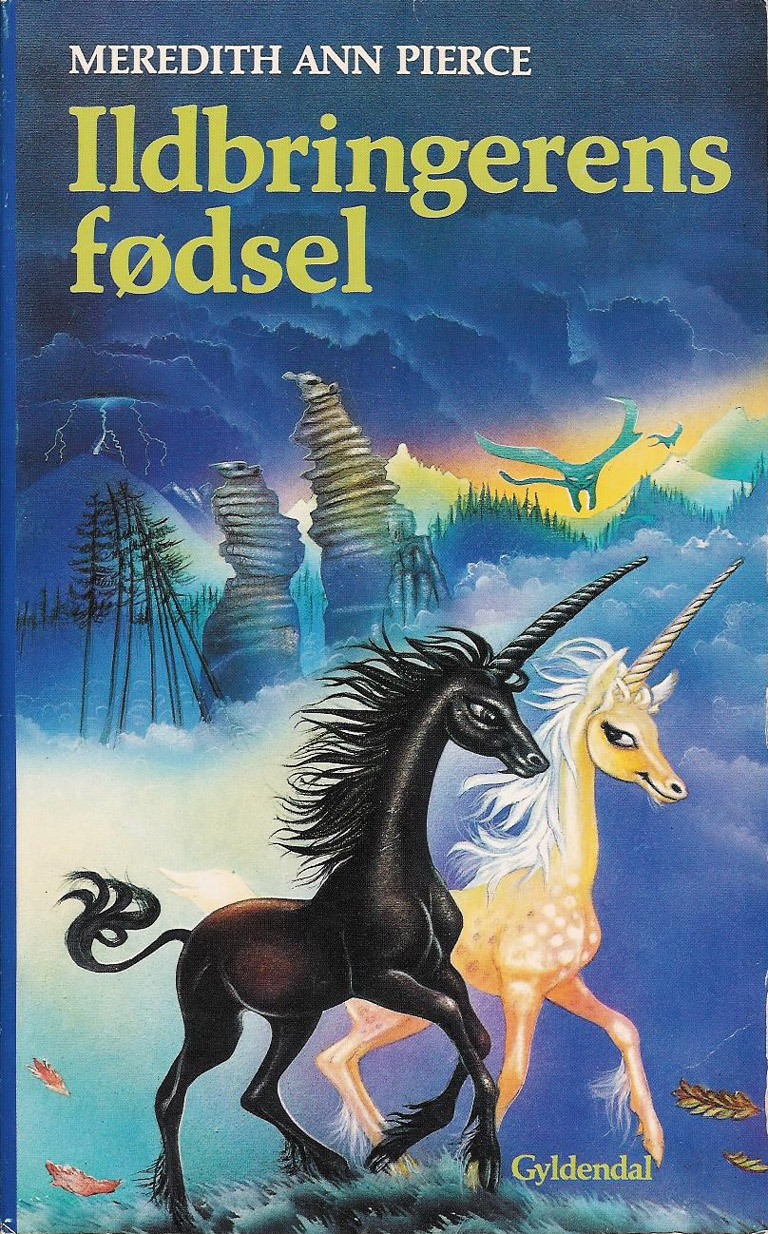
Foreign-language editions of fantasy novels tend to be particularly fertile grounds for weird book covers. And man, I love many a Scandinavian illustrator, but their covers also tend to be the loopiest among European editions that I’ve seen. Here’s the Danish paperback cover of Meredith Ann Pierce’s Birth of the Firebringer (which is the first book in a childhood-favorite trilogy, so this is another case in which I can vouch for the cover being accurate in its details, yet not… shall we say, entirely representative of the book as a whole):

Meredith Ann Pierce - Birth of the Firebringer, second Danish edition

50% cute, 50% acid-trip unhinged. I don’t think I want to be friends with these unicorns – they look like they’d shake me down for my lunch money, then threaten to cut me if I told.

Yet at the same time, I kind of want a t-shirt with them on it.

Go to:
Bad Book Covers Friday Archive
BBCF: The Saga of Recluce
BBCF: Moonsinger’s Friends
BBCF: The Alphabet Mysteries
BBCF: Diamond Star

Author: Joe Hill

Date: 2.22.10

Book: Horns

Venue: Porter Square Books

Reviewer: Kakaner

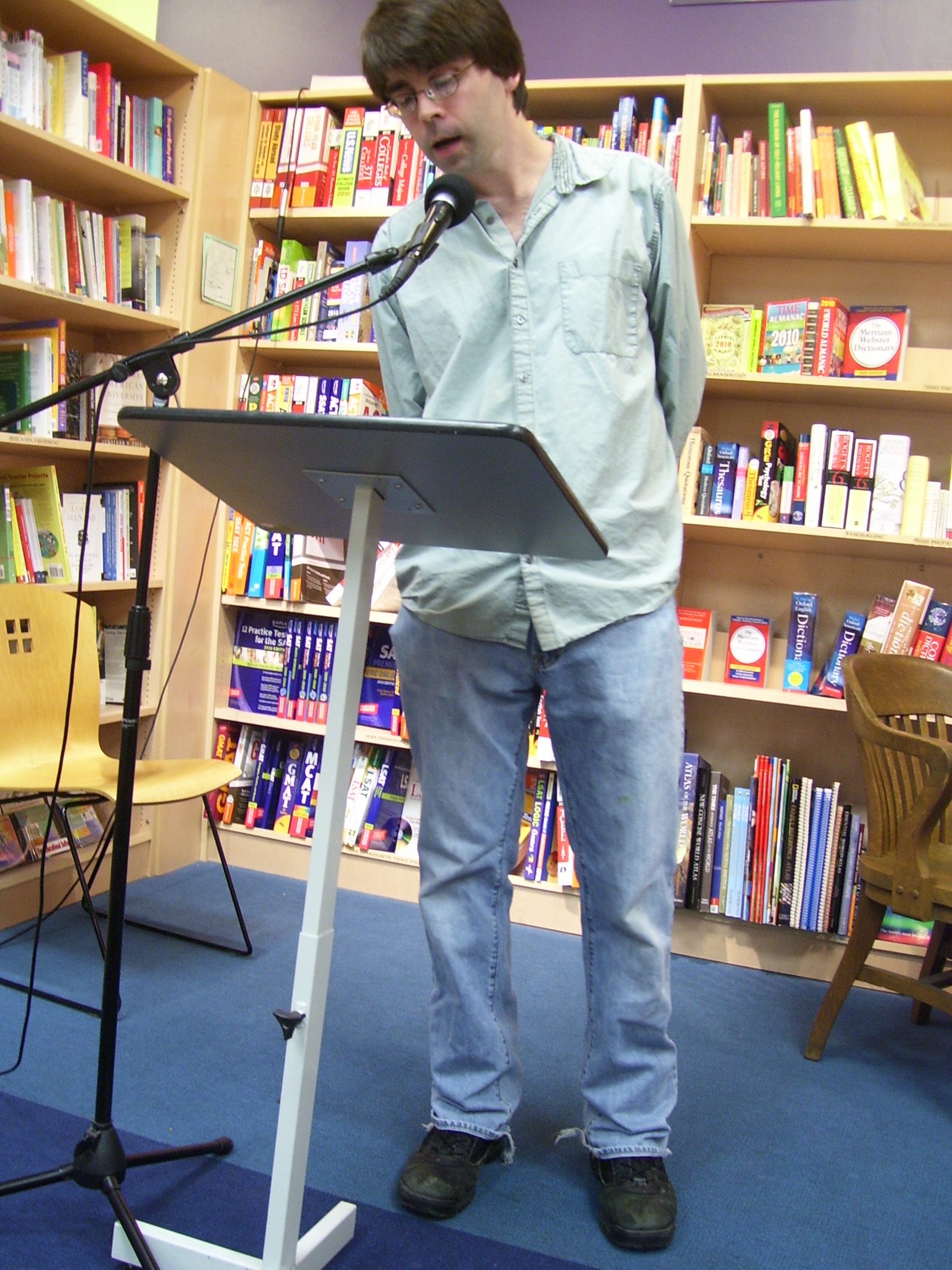
Joe Hill Porter Square Signing Locke and Key Horns Heart Shaped Box reading

Porter Square Books is a quaint bookstore tucked away in Porter Square, Cambridge and features a popular fair-trade cafe. We arrived early for front row seats, and discovered while waiting that we had been seated in the… SAT prep and pregnancy help section. Huh?

Anyway, enter Joe Hill, tall and lanky, and a spitting image of his father. He exuded a very distinct “accomplished nerd” appeal, as in awkward yet confident. I have to say I was a little taken aback by his appearance because the only photo I had seen of him was this:

Which incidentally kind of coincides with the mental image I have of Judas Coyne from Heart-Shaped Box– jacket, rock, auto-enthusiast. Oh author portraits. How you mislead us so!

Read the rest of this entry »