“Portrait of Lisane de Patagnia,” by Rachel Swirsky (2012) E

Reviewer: Emera
Date read: 10.8.2012
Read the story online at Tor.com here.

This is my first time reading anything by Rachel Swirsky; I’ve had her multiply-award-winning/nominated “The Lady Who Plucked Red Flowers Beneath the Queen’s Window” bookmarked for a while, but got lured into this one first on the basis that it’s illustrated by Sam Weber, one of my favorite contemporary illustrators of weird stuff.

“Portrait of Lisane de Patagnia” is a dark, erotically charged tale concerning an embittered artist with more magical than painterly ability, who is summoned to fulfill a final commission for her former teacher, the incandescent, ambition-devoured Lisane de Patagnia. In this world, magically imbued artwork is considered inferior to sheer human talent, which is a good parallel to contemporary regard of technology-assisted/-enhanced skills – the devaluation by some of digital artwork as compared to traditional, say.

The story’s Italian-Renaissance-inspired setting is refreshing, and the few descriptions of magic are unsettlingly beautiful, playing off of the cool poise of the narrator’s voice. (I particularly liked the opening description: the narrator’s process of painting a river sips away at the jug of water next to her.)

However, though Swirsky is clearly familiar with the principles and history of visual art (the story touches on a Brunelleschi-analogue who invented linear perspective, which serves as the basis of a pleasing image of his artistic lineage stretching out into the present), she doesn’t write about any of it very movingly. The descriptions of composition are labored (“the oval of his head bowed toward the shaking rectangle of his chest, his newly shorn hair dark against his pale scalp”), and when writing about color, rather than the evocative, alchemical specificity of actual artists’ pigments, she relies on a commonplace toolkit of “emerald” green, “faint yellow,” and so forth. When you could be using names like Naples yellow, madder lake, azurite, and bone black instead, why wouldn’t you? The cumulative effect was that I rarely felt as if I were actually inside an artist’s head.

When it comes to the story’s negotiation of the relationship between artist and art, I cringed to see a scene dramatically hinged on the old chestnut, “What is art but madness anyway?” Clearly it’s meant as an indictment of Lisane’s psychological failings that she pulls that one out, but such literal use was to me indicative of the story’s failings as a whole: it renders a conflict centered on romantic clichés about art in careful but often broad strokes, and lacks in freshness and exactitude of image and feeling as a result. It’s thoughtful, but not complex. (See also the fact that it explains its own conclusions in the last few paragraphs, when it could have ended just as well with them hanging unsaid but obvious.)

Go to:

Rachel Swirsky: author bio and works reviewed
Read the story at Tor.com
Princess^2

Apologies for the utter deadness around here lately; Kakaner is fiendishly, horrendously, unspeakably busy with a very exciting new job, and I’ve been occupied trying to not get kicked out of wildly succeed in my graduate program.

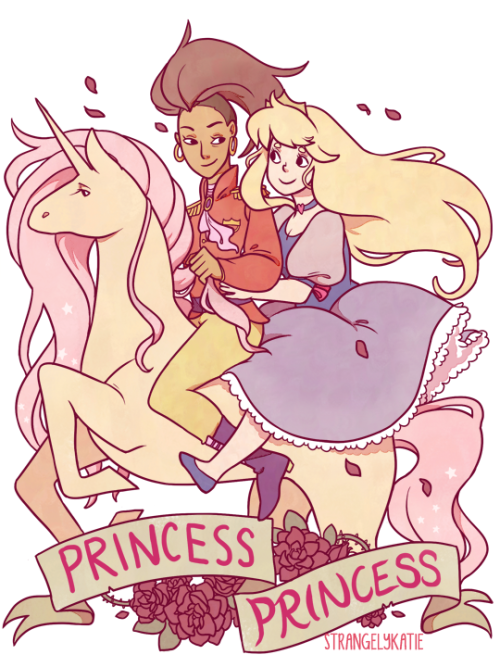
But here’s another round of gender-subversive fun for fans of Revolutionary Girl Utena, and anyone whose interest was piqued by my review of Osamu Tezuka’s Princess Knight: Katie O’Neill’s gently goofy and heartfelt new webcomic Princess Princess, in which a dashing princess errant is the one to rescue a tower-immured damsel.

“I have a sword, a unicorn, and kick-butt hair!” – Princess Amira

Princess Princess updates once weekly, and is predicted to run up to 30 or 40 pages. You can also find additional art and bonus comics over at its Tumblr.

– E

“Recovering Lolita”

Recovering Lolita (via design blog Imprint) is one of the most visually/literarily fascinating and provoking posts I’ve seen this year.

Several years ago, blogger John Bertram held a contest inviting designers to create new covers for Lolita, citing a history of coy misrepresentation of Nabokov’s novel. In Bertram’s words, “We are talking about a novel which has child rape at its core.” Yet as Imprint points out, “[Lolita is] chronically miscast as a teenage sexpot—just witness the dozens of soft-core covers over the years.”

Bertram was not that much more satisfied with the results of the competition, and invited 60 new designers (most of them women) to contribute images, accompanied by essays by both designers and Nabokov scholars, for a book entitled Lolita: Story of a Cover Girl. The book will come out next spring; in the blog post you can check out a number of the images submitted to the contest, as well as a brief interview with Bertram, in which he touches on the ethical considerations that accompany creating a cover for Lolita (or even simply enjoying it as a novel), and the way that book covers can, indeed, change our perception of a book and its meaning.

Some of the images in the post are visually pleasing but entirely noncommittal from a thematic standpoint (e.g. Kelly Blair’s); I think the best combine cool wit with a deep sense of the ominous and invasive, i.e. Jamie Keenan’s:


– E

The New Deadwardians #1, by Dan Abnett & I. N. J. Culbard (2012) E

Reviewer: Emera
Date read: 7.22.2012
Book from: Personal collection

I know the universe loves me because there’s a new comic called The New Deadwardians, and it’s about vampires, zombies, and class conflicts in alternate Edwardian England. I saw the first issue (from March of this year; there are to be 8 issues total) still hanging around in a comic store, picked it up, read it as soon as I got home, and wished I had bought the rest.

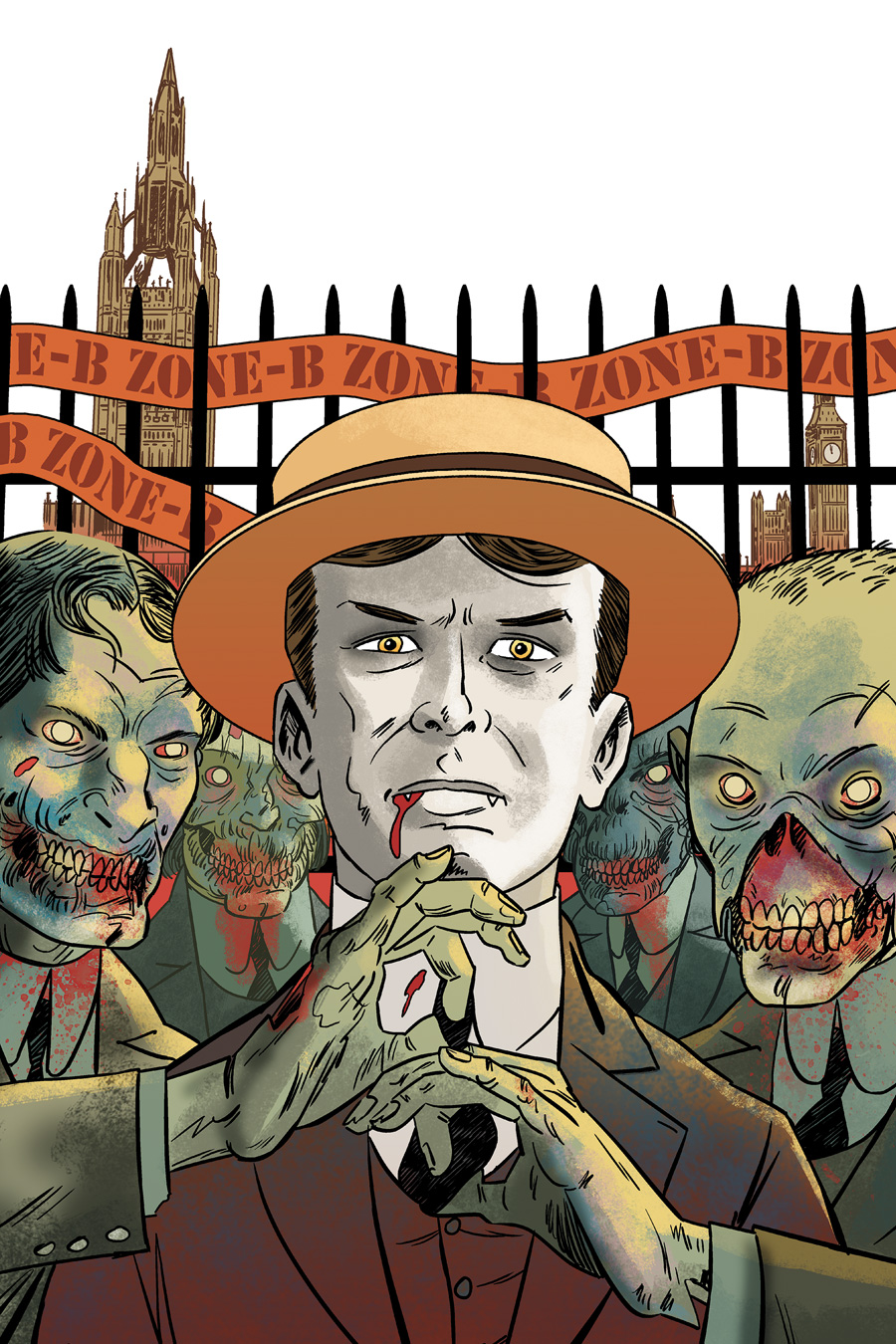
The cover art gives away the punchline, though the first issue never says it outright: the English aristocracy have embraced vampirism – “the cure” – in order to escape the zombified lower classes. (It’s not clear yet what’s happened to the rest of the world.) As Twilight literalized class (and race) conflict via Bella’s choice between sleek, chilly, uber-white vampires vs. rough-n-tumble, blue-collar, Native American werewolves, so Deadwardians does with poker-faced pish-posh vampires vs. sloppy Cockney zombies. Caught in between are living servants, police officers, and other members of the working class, who also appear distantly as angry unionists demonstrating against the military zoning of London. The undead – and presumably some living survivors – have been pushed back beyond “Zone B,” and hence are referred to as Zone-B’s. Har de har. I also winced at the use of “Deadwardian” in the comic itself – it’s too cutesy to be believable in-universe. Luckily, it’s the only false note struck in this issue.

The protagonist is George Suttle, a vampirized detective afflicted with some degree of existential angst, and a pruny mum who should appeal to fans of Maggie Smith as the dowager duchess in Downton Abbey. The end of the issue sees Suttle confronted with a puzzling mystery: the murder of an already undead man.

Most of the issue is devoted to building up atmosphere and setting. Artist I. N. J. Culbard and colorist Patricia Mulvihill work gorgeously together in the ligne clair/clear-line style, with smooth inking and planes of muted color that emphasize the setting’s eerie placidity and the script’s deliberate, brooding pace. A scene of Suttle walking into his almost entirely deserted office building, its many untenanted desks draped over with white sheets, and numerous shots of meticulously rendered architecture looming over sparse inhabitants, recall the trademark scenes of deserted London streets that opened 28 Days Later – this is just a century earlier.

Gloomy atmosphere, sociopolitical satire, a burgeoning mystery, immersive art: I’m hooked. I can’t wait to see what Abnett and Culbard do with the rest of the series; I’m particularly excited to see how hard they’ll play the alternate history angle. The Edwardian era was characterized by both great economic disparity, and increasing social mobility and political activism – I can’t imagine the latter two will do very well against an immortal and literally parasitic upper class…

You can see a free 6-page preview of The New Deadwardians and a brief interview with Culbard here (source: L. A. Times – did you know they covered comics? I didn’t).

Go to:
Dan Abnett: bio and works reviewed


Aspirational reading

From Carl Sagan’s notes as an undergraduate: have a look at his list of planned “Outside Readings” for the “Autumn Quarter, 1954.” It’s an impressive sampling of scientific and Western thought; there’s Hubble, Oppenheimer, the Bible, André Gide – and also, of course, a science fiction anthology from Ballantine’s Star line. If I’m looking at the right one, it included short novels by Theodore Sturgeon, Lester Del Rey, and Jessamyn West.

– E

A dispatch from SDCC

What Neil Gaiman has been working on for the past 18 months.

If you’d like to cut to the chase: it’s a Sandman prequel, with art by DC artist JH Williams, explaining from what travails Morpheus was returning when he was captured by Roderick Burgess at the very beginning of the series. “This has been an incredibly long time coming. It was one of the few stories that actually felt, when I finished Sandman, like I had failed because I had not told this story.”

See Williams’ first piece of promotional art – which I quite enjoy, it’s a weird slick space-agey Art Deco-ish Klimt-y portrait of Dream – for the comic here! I have mixed feelings about prequels generally (when I saw that there were Watchmen prequels coming out, I… … …), but they’re shaded positive here since this is a story that’s always been a part of the Sandman universe; it just hadn’t yet been shared.

– E


Go to:

Neil Gaiman: bio and works reviewed

“Vikings will work for plunder. Geeks and artists will work for a dream. But businesspeople require… other forms of motivation.”

SF icon Neal Stephenson wishes video games with swords were more fun. And why the hell shouldn’t we help him out with that?

See: Neal Stephenson’s Kickstarter for CLANG (a.k.a. “Guitar Hero with swords”).

Basically: “Hi, I’m Neal Stephenson. I like hitting other people with sharp objects. I am dissatisfied with representation of this activity in existing virtual entertainment for nerds. I would like to make better virtual representation of this activity.” [N.B. I’m a gamer. No actual nerd-hate contained in this post; that would be silly.]

Even if you’re not inclined to contribute, make sure to watch the accompanying videos, which are delightfully absurd. If you’ve ever wanted to hear Neal Stephenson dryly comment on the current state of video-game combat, watch him recruit a Viking berserker to lure a caged CEO into fueling their failing studio’s electricity via human-sized hamster wheel, or witness the same Viking berserker testing a hipster’s reflexes, now’s your chance!

– E

Author Event: Caitlín R. Kiernan reads from The Drowning Girl

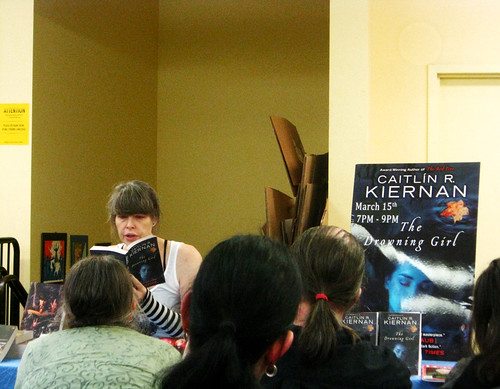
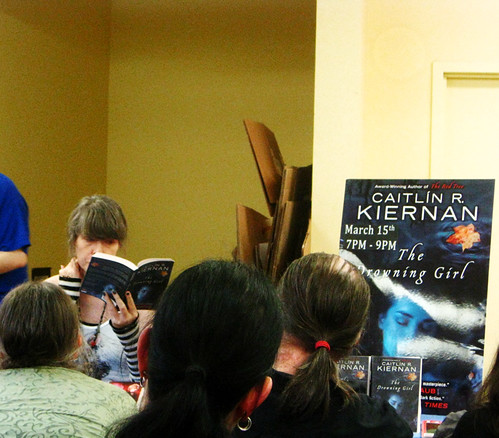
Only a bajillion days overdue (approximately), but here’s a quick event report of Caitlín Kiernan’s reading at Pandemonium Books (Cambridge, MA) in the spring of this year. The event took place on March 15th, on no less than the 75th anniversary of H. P. Lovecraft’s death.

Kiernan read from chapter 1 of her newest novel of dark fantasy, The Drowning Girl, from which I’d previously seen her read at Readercon 2011. Kiernan is my favorite reader of prose; she’s a sibylline presence, with exceptionally graceful gestures and voice. I didn’t understand at least a third of what was read at Readercon (which is only appropriate, as it was the chapter in which the book’s main character and narrator, who has schizophrenia, goes off her meds; Kiernan further noted that she was ill herself while writing the chapter), but was hypnotized; the first chapter of the novel was comparatively straightforward, a wry, edged introduction to protagonist India Morgan Phelps (“Imp”), her family’s history of madness, and her take on the unstable boundaries of truth and reality.

Kiernan reading from The Drowning Girl

A couple of tidbits from the Q&A following the reading:

  • Kiernan reflected on the fact that Imp represents, in some sense, “the person I wish I had become,” while Sarah Crowe, protagonist of preceding novel The Red Tree, was in part a representation of the person she had for some time become. [I’m afraid I didn’t write down as much context for this remark as I would have liked to, so if anyone has a correction or modification, I would welcome it.]
  • Deluxe dark-fantasy publisher Centipede Press has approached Kiernan about the possibility on working on a special edition of her 2001 novel Threshold.
  • There are some Very Exciting Projects in the works, which Kiernan was not at liberty to discuss. The furthest she could go was to hint that one had to do with comics (i.e. the now-ongoing Alabaster comic series with Dark Horse, which I love love love), and that the other had to do, just maybe, with a movie. She offered the summer of 2013 as a possible timeframe for more revelations about the latter.

Please see Kiernan’s website for more information about The Drowning Girl, and especially lend your attention to the haunting cinematic trailer. 

Go to:

Caitlín R. Kiernan: bio and works reviewed 

Chew 1-3, by John Layman and Rob Guillory (2009-10) E

Reviewer: Emera
Dates read: Various dates between November 2010 and spring 2011
Books from: Personal collection, or borrowed from Kakaner

Reviewed here be:

Chew, Volume 1: Taster’s Choice (2009)
Chew, Volume 2: International Flavor (2010)
Chew, Volume 3: Just Desserts (2010)

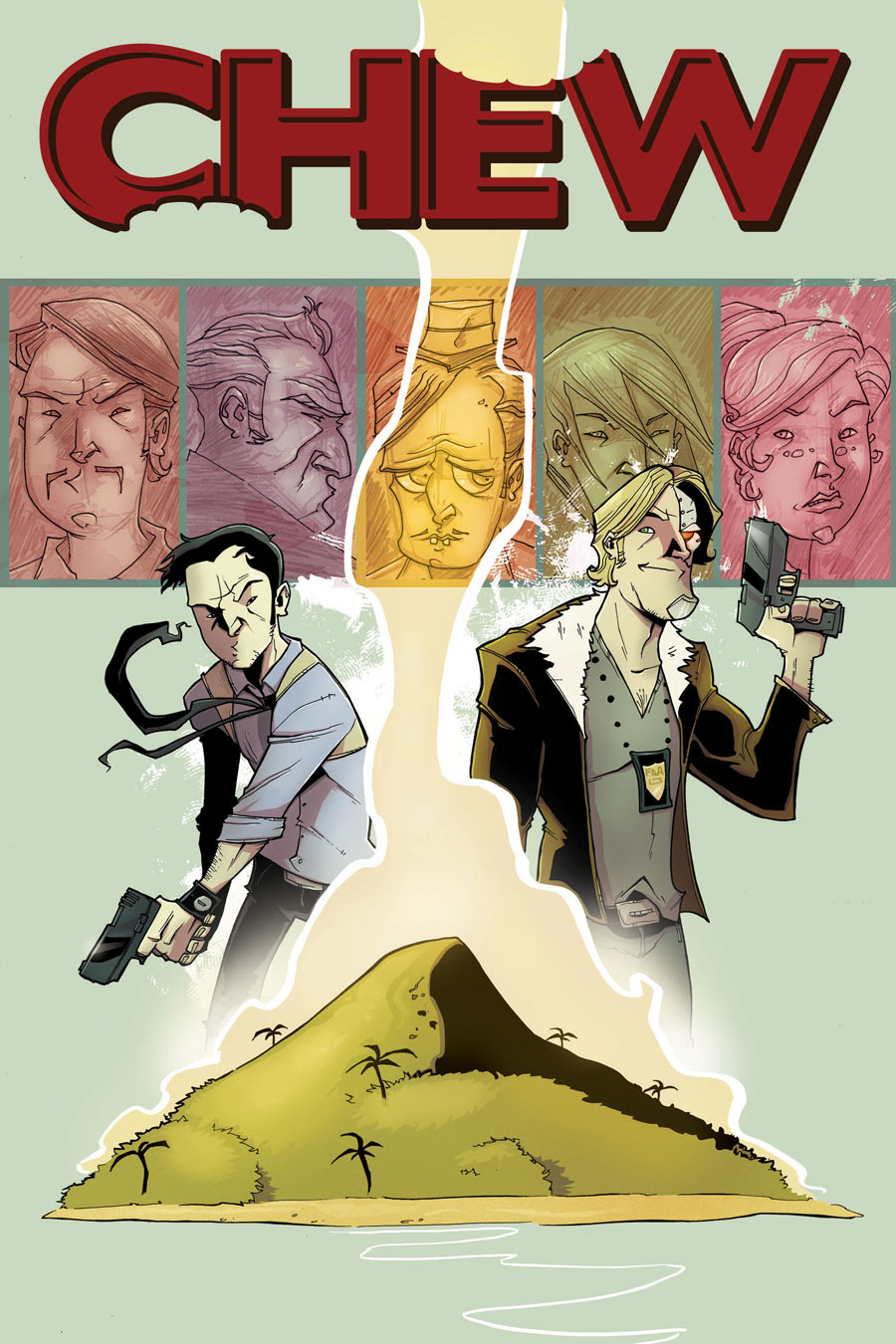
Chew is the story of Tony Chu, a humorless detective who has the unfortunate ability to gain psychic impressions from anything he eats (except beets). Recruited by the FDA – now the world’s most powerful law enforcement agency in the wake of an avian flu pandemic that took hundreds of millions of lives – for his singular talent, Tony finds himself taking bites of stranger and stranger substances as his casework, increasingly muddied by connections to shadowy criminal organizations and possibly extraterrestrial conspiracies, takes him from New York chicken speakeasies to Siberian research stations staffed by vampire ladies in ushankas to tropical dictator states. Add in a generously embarrassing family, an exhaustingly cheerful cyborg partner, and a hate-filled boss, and life just won’t let up on this by-the-rules cop.

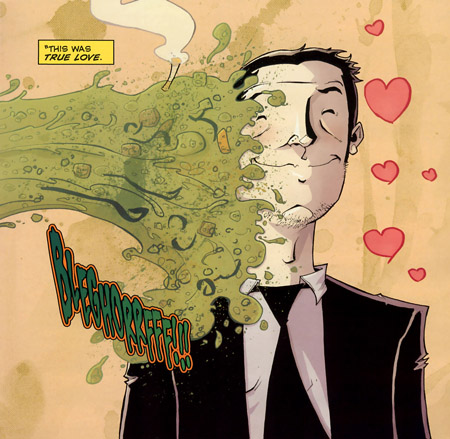
Man, this series. I had no idea what I was in for when Kakaner eagerly gifted me the first two volumes, but it proved to be a delicious combination of hyperkinetic art and zany-bordering-on-surreal world-building. Layman and Guillory are an inimitably weird team: to match Layman’s tireless inventiveness (one of the best parts of reading is trying to predict what absurd food-related superpower will next come into play), Guillory’s art is full of odd angles and wildly energetic gestures and the most! excellent! facial expressions, thanks to his characters’ crinkly, mobile features. His backgrounds, too, are stuffed to bursting with silly details (inexplicable graffiti, stray notes and photographs, etc. etc.), and as is only appropriate for an obsessively food-themed series, the distinctive color palette always reminds me of citrus popsicles:

(Even when Tony is getting a barf facial, apparently.)

The plot is obviously going somewhere, but frankly I’ve been so distracted and entertained and perplexed by the moment-to-moment madness of each volume that I haven’t been working all that hard to piece the bits together – though the gathering momentum was obvious by the end of volume 3, and left me hoping for some interesting developments IN SPACE.

I also have to single out Chew‘s creators for the fact that even though they make merry with pulp/genre stereotypes (well hello, melon-breasted Asian lady assassin, nice to roll my eyes at you again) and just-plain stereotypes (the female assassin is exaggerated to clearly satirical proportions; I’m far less comfortable with the fact that the only recurring black character in the series is, straighforwardly, a cowardly criminal), having gone for the Chew/Chu pun, Layman and Guillory obviously committed thereafter to representation of a varied cast of Asian characters. In other words, they didn’t let Tony’s ethnicity stay a one-off joke and then pat themselves on the back for being inclusive by way of one nonwhite protagonist. Which, frankly, I think plenty of other writers, especially in comics, would have done.

I give them heaping points, of course, for having a cool, competent male Asian protagonist in the first place; discounting of Asian men in pop culture as comical, emasculated etc. (if they’re not ninja/samurai) is a major pet peeve of mine. (I did a count once of the number of female Asian superheroes [ooo, so exotic!!] vs. male once, and the ratio was pretty dismal.) But from there, numerous members of Tony’s family, immediate and extended, have also gotten plenty of pagetime, including his cheerfully self-aggrandizing chef brother and adorable, NASA-employee twin sister.

Though character development takes second seat to conceptual and narrative whimsy in Chew, most of the characters are amply buoyed by the series’ manic energy and humor. It’s refreshing and gratifying to see a broad cast of Asian characters getting the same treatment, and adds immeasurably to my enjoyment of a series that already leaves me grinning at every turn.

Go to:

John Layman: bio and works reviewed 

I can’t get enough of…

…the superhero redesigns over at Project: Rooftop! Jemma Salume’s winning entry for the Canary on the Catwalk contest was my first (and possibly still greatest) love (if I could marry an illustration…) (IT’S JUST SO PERFECT), but there’s always something new to catch my eye, often accompanied by tantalizing snippets of imagined storylines.

I wish Denis Medri’s 1950’s Batman reboot were a real thing, for starters; it’s just the perfect blend of retro glam and grit, down to the muddied-up candy hues of the color palette. Betty Paige as Catwoman, hot-rod Batmobile, and leather jackets everywhere – sigh.

Project: Rooftop is also fun in that it highlights one of the most fascinating elements of the superhero genre: the relative freedom that different creators have to weld new themes, aesthetics, and cultural anxieties onto the preexisting chassis of a given character or series. I can’t think of any other contemporary media that enjoy both the long-term continuity and short-term adaptability of a comic-book hero who’s remolded and rebooted (and occasionally resurrected) over the course of countless issues, in the hands of dozens of artists and writers, each seeking to carve out new narrative space and (ideally) to reflect some aspect of contemporary culture. Hellblazer (which has been running continuously since 1988) has to be given particular props in the continuity department, since its timeline progresses and its characters age more or less in real time – in my mind, that level of verisimilitude can bolster the series’ effectiveness as a work of cultural criticism, though I haven’t really read far enough along yet to judge how well John Constantine ages as a character past the ’80’s.

Of course the eerie agelessness of most superheroes simply adds to their status as modern-day quasi-deities. I can’t remember who it was whom I first saw drawing a parallel between the teeming universes of Chinese folk traditions and superhero comics (possibly Barry Hughart? I can’t find the quote, at the moment), but it’s an apt comparison.

– E