Comics, summer 2016: Korgi, ApocalyptiGirl

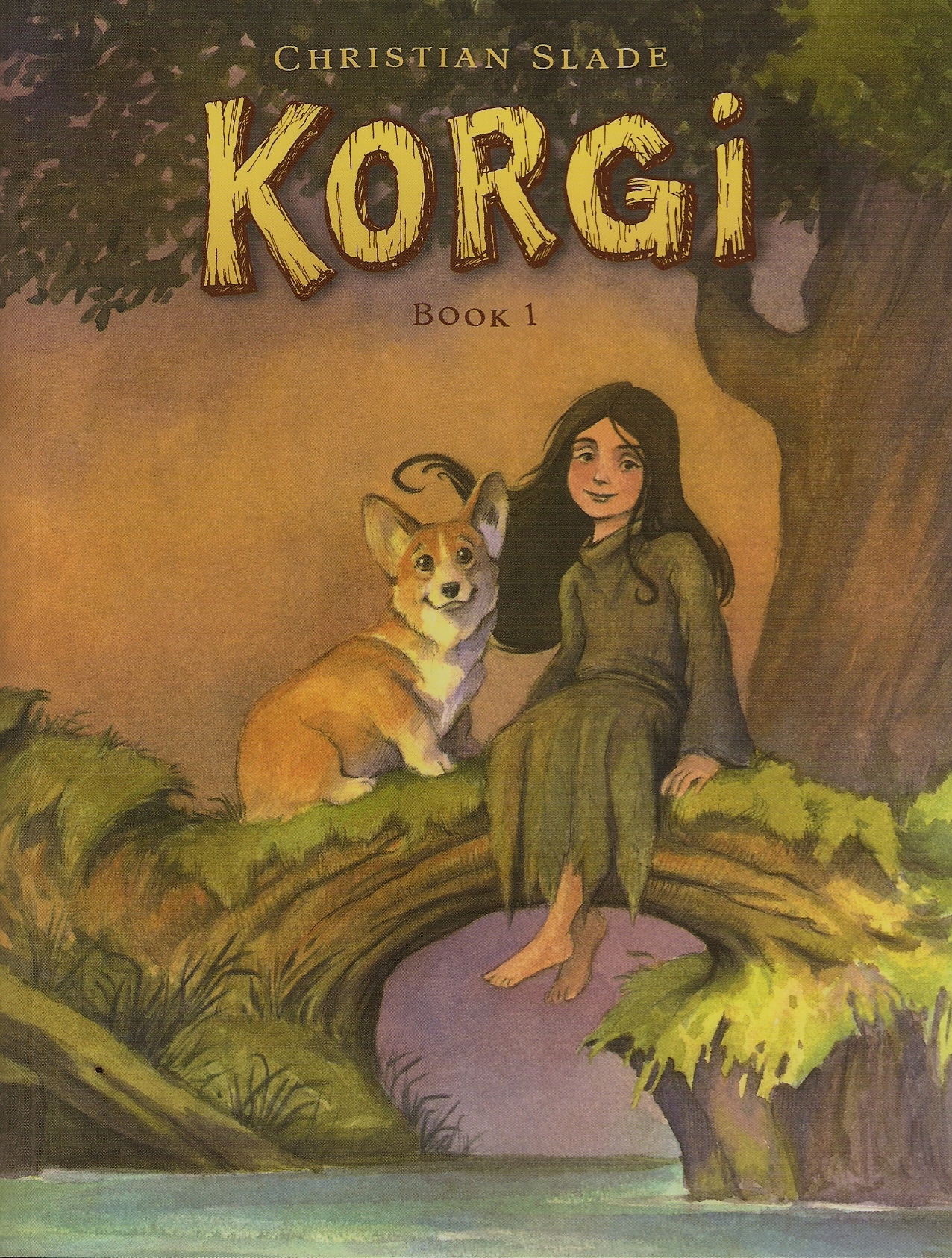
Korgi, by Christian Slade (2007): The woodland escapades and scrapes of a fairy-like young girl and her magical corgi companion – corgis were traditionally said to be fairy steeds. There are three volumes so far; I’ve read the first two.

Korgibook korgi3

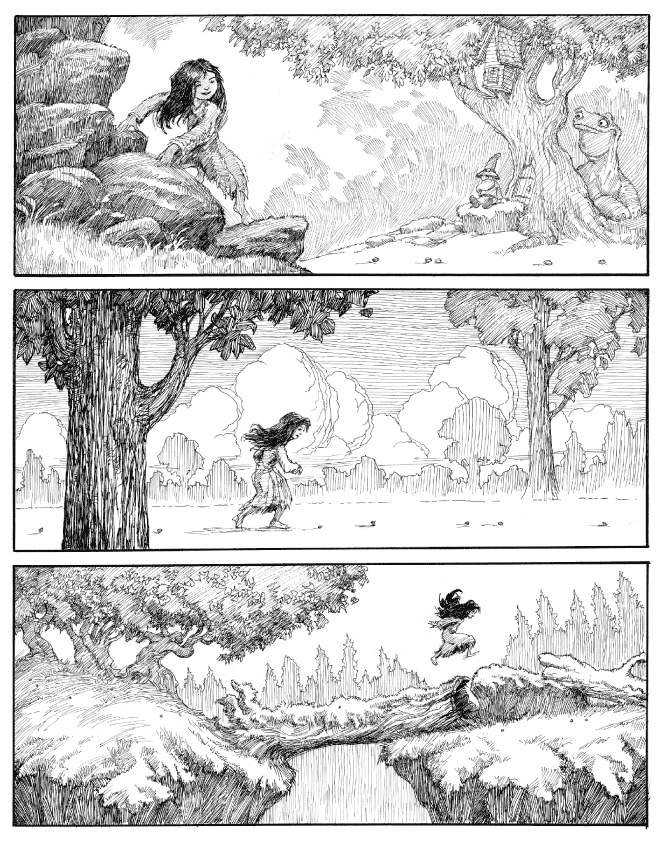
This would be a great gift for folks, children or otherwise, who are keen on fairies and/or dogs. Korgi is so cute and so peaceful – nearly as cute as Mouse Guard, and whimsical, dreamy, and celebratory of motion in a way that’s reminiscent of a lot of the first volume of Flight. Slade is not a very good draftsman (wandering facial features + an overall look that is slightly squishy and uncertain), but every panel is well-composed, again and again hitting that evocative sense of marveling at a woodland expanse. Also, his linework is notably enjoyable – scratchy, nervy, woodsy. His treetrunks are so nice.

Something that Slade does really right is letting loose when drawing the villainous critters – their gleeful bloat and gnarl works well to counterbalance the wide-eyed sweetness of the rest of the comic.

—–

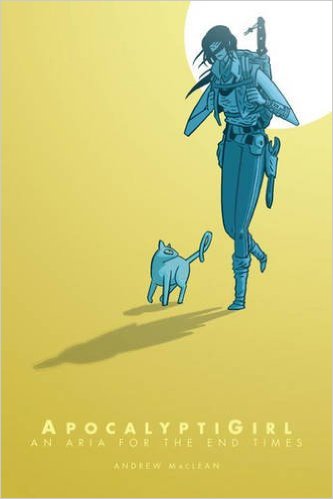
ApocalyptiGirl, by Andrew MacLean (2015): A beautiful, energetic, but morally questionable post-apocalyptic yarn of a young warrior woman and her cat surviving amid tribal warfare.

ApocalyptiGirl

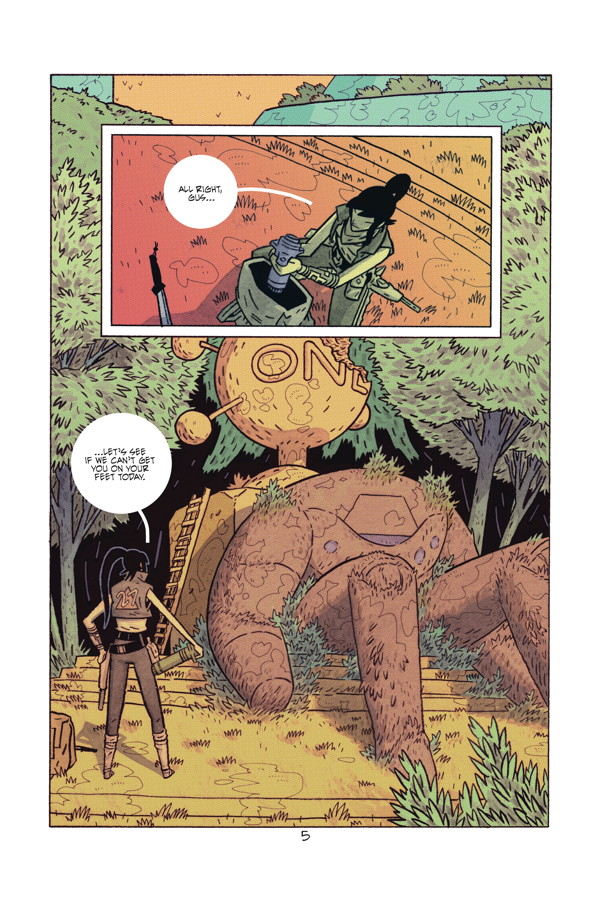
Read it for the crisp action sequences, expressive characters, and scruffy, nubbly, involving environments (rusting, grass-overgrown mechs; a home built in an abandoned subway train). The story’s mysteriousness is dampened by exposition that manages to be both heavy-handed and slightly garbled, and by the pat ending, which seems to lazily undercut all of heroine Aria’s past moral quandaries over the bloodshed she’s seen and enacted.

ApocalyptiGirl

Still, the ambience and visuals are striking and memorable; I’m very happy to own the comic to keep revisiting the art.

The Harp of Imach Thyssel, by Patricia C. Wrede (1985) E

Reviewer: Emera
Date read: 2.7.2016
Book from: Personal collection

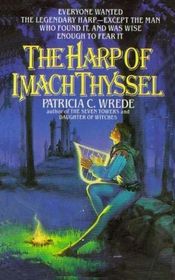
DID YOU KNOW that before Patricia Wrede hit it out the park with the Enchanted Forest Chronicles, she wrote a fair bit of generic epic fantasy? It’s true! Just look at this:

The Harp of Imach Thyssel

I found a copy at a used bookstore, and could not pass it up. Those glowing tights exerted an uncanny magnetism.

The Harp of Imach Thyssel is the third in a series of five books set in Lyra, all of which appear to have been recently revised and republished in the omnibus Shadows over Lyra (1997). Here’s the plot of Harp:

“Everyone wanted the legendary harp – except the man who found it, and was wise enough to fear its power.”

Execution was as you might expect based on the cover art. Since it’s Patricia Wrede, the dialogue can be witty, the writing is brisk, and some of the characters’ relationships are mildly intriguing, but otherwise, everything, everything about this book feels almost disturbingly superficial. None of the characters have motivations or desires more specific than “I fear/desire the Harp!” + “I love, in an incredibly nonspecific way, my family and hate my enemies.” There’s little to no sense of either political or mythological reality, even after the barrage of historical exposition in the last 20 pages or so. This is epic-fantasy MadLibs and a triumph of telling-not-showing.

I enjoyed this as a historical curiosity, and derived a bit of scandalous thrill from seeing an author who’s now exclusively acclaimed for mischievous but squeaky-clean YA, write something that involves death and sex (or at least overtly expressed sexual attraction). In the abstract, it’s fun to consider checking out the revised version of this, but given the time… I’d rather reread the Enchanted Forest Chronicles instead.

Go to:
Sorcery and Cecelia, by Patricia C. Wrede and Caroline Stevermer (1988)
The Grand Tour, by Patricia C. Wrede and Caroline Stevermer (2004)
Dealing with Dragons, by Patricia C. Wrede (1990)
Talking to Dragons, by Patricia C. Wrede (1985)
Thirteenth Child, by Patricia C. Wrede (1985)

K.M. & R.P. & MCMLXXL, by M. Dean

Reviewer: Emera
Date read: 7.27.2016
Read online for free.

Kennedy Michelakos has decided to quit smoking… She likes to ride horses. Her parents are Greek. We both really dig Tom Jones.

K.M. & R.P. & 1971 is a beautifully understated 16-page comic that deals in double layers of nostalgia: one for mildly dysfunctional high school friendships (sigh), and one for 70’s culture. (The tiny Jim Morrison poster might be my favorite bit of cultural clutter, but the rumpled Valley of the Dolls paperback is great too.)

The paneling is beautiful, and the color palette and nubbly linework are delicious. If the comic had a flavor, I think hazelnuts would be involved.

I’ve had the comic open for the past couple hours, just scrolling back and forth and enjoying the look and feel.

Related reading [quiet darkness and/or disaffected ’70’s girls]:
Egg Comic, by Z. Akhmetova
The Moth Diaries, by Rachel Klein (2002)
Fun Home, by Alison Bechdel (2006)

Archival dump: Magazine of Fantasy & Science Fiction, March 1983

More tidying of the drafts backlog. I read this issue back in 2011, holy crap; I’m not sure why I wrote about only these two stories. I did note that in the two old MF&SF issues that I own from the 1980’s, there wasn’t a single female writer, out of 17 total authors and several more columnists (also there were these spectacular ads).

—-

“From the Desk of Gilmer C. Merton,” Gene Wolfe: This was a terrible way to first read Wolfe. (I read The Wizard Knight duology, a very distinctive Arthurian retelling, shortly afterwards and liked it quite well.) The story is an extended and unfunny joke about sf&f publishing.

—-

“Down Among the Dead Men,” Gardner Dozois and Jack Dann: Vampiric Jew in a concentration camp. I say “vampiric Jew” rather than “Jewish vampire” because Dozois and Dann don’t seem to have put any effort into making this at all a particularly Jewish story, which seemed thoughtless and insensitive. The vampire character, and the narrator’s reactions to him, are clearly the products of western fictional conventions by way of Bram Stoker, which seems idiotic when you consider the wealth of fascinating, terrifying eastern European and specifically Jewish vampire folklore. The only Jewish thing the narrator does is participate in observance of Passover; otherwise we see him thinking about how he used to venerate another character as a “saint” and a makeshift weapon as a “holy relic.”

  • Encyclopedia Britannica: “The cult of saints in terms of veneration was not a part of the monotheistic religion of Israel.”
  • jewishvirtuallibrary.org: “Judaism, as a general rule, rejects physical manifestations of spirituality … perhaps the greatest sin the Israelites collectively committed was the construction of the Golden Calf … Today, Jews do not venerate any holy relics or man-made symbols.”

Encountering the vampire seems to have no spiritual repercussions for the narrator (which I have a hard time believing would happen even if he were a secular Jew – wouldn’t it make you start thinking hard thoughts if you were suffering at the hands of both mundane and supernatural embodiments of evil?); again his Jewishness is ignored, and the vampire trope is ultimately mined only to make fairly banal points about the contagiousness of violence and what people are willing to do to survive. All told, I had a hard time not seeing this as a by-the-book vampire story, with a distasteful veneer of seriousness and importance.

Go to:
BBCF: MF&SF, June 1983
Time Warp 1987: F&SF and a couple of soggy old men
More from the annals of F&SF

Archival comics dump: Daredevil, Hellboy

I’m trying to do something about the massive backlog of 60-98% complete post drafts. It’s scary in there! For example, both of these bits are from (gulp) 2012.

—-

Daredevil: The Man Without Fear (1993), by Frank Miller & John Romita Jr.

While Daredevil has long been my favorite single superhero, I wasn’t the right kind of fan to be the target audience for this. This is an origin-story miniseries that fills in gaps and juicy details (the rise of Kingpin, Matt’s childhood training, and his initial relationship with Elektra in college). I grew up with 4 or 5 single Daredevil issues around the house – much obsessed-over, but far from exhaustive enough for me to be able to appreciate the back-filling that Miller does. Since Miller compresses over a decade into 5 issues, the pace was also too breakneck for me to feel like I could really sink my teeth into the narrative, until Miller slows down enough to focus on a crucial kidnapping incident at the end of the series.

General thoughts: the style is strikingly noir, which is not surprising given that it’s Miller. Matt’s rage is always simmering in the background, and his rough upbringing in Hell’s Kitchen lays down the basic growth medium and texture for his character. Miller emphasizes in his intro that Daredevil could easily have been a supervillain. The emotional hook of the miniseries is that Matt’s righteous anger and physical prowess aren’t enough to make him a hero (there’s a really awful moment where he accidentally kills a prostitute while trying to attack one of his father’s killers); he must also learn self-mastery.

I warmed very slowly to Romita’s art, as it’s sort of blockily formless a lot of the time. However, there are occasionally really effective panels that made me okay with him by the end – in particular, the poetic silhouettes of Daredevil bounding across the Manhattan skyline, and one creepy close-up of Kingpin’s chilly eyes.

—-

Hellboy: Wake the Devil (Vol. 2) (1993), by Mike Mignola

Paranormal folkloric bingo! On top of the evil Nazis + Rasputin + cosmic/Revelations-flavored menace from last time, there are a Napoleonic-era vampire lord kickin’ it old school, Thessalian witches, Baba Yaga, an iron maiden broken in by Elizabeth Bathory, Lamia, Hecate, a homunculus… Honestly, it got overwhelming at times (I felt whiplashed), and occasionally I questioned the lumping of so many mythologies together, given that it really did start to feel like “lumped together” instead of “woven together.”

But the goofy dialogue lightens things up well, and Mignola’s art always sells it. There’s a spectacular cosmic setpiece of about 5 pages towards the end of the arc that actually had me reading with my mouth open. And then – emo Rasputin! Because even villains bent on universal chaos have to question themselves sadly sometimes, even if it’s just to ask if they’re being selfish enough.

Plotwise, this is really just expanding on the “evil Nazis/Rasputin plot for cosmic chaos” direction. Not too much more character development, sadly, although there’s plenty of character exposition.

– E


Elephantasm, by Tanith Lee (1983) E

Reviewer: Emera
Date read: 3.13.2016
Book from: Personal collection

Elephantasm is a violent, brooding, erotic fantasy of revenge against imperialism and patriarchy: Tanith Lee takes on Heart of Darkness, by way of colonial India. Elephants, monsoons, open wounds, whips, trauma survivors, immolation. Lush madness and harsh justice prevail against the privileged and callous. Lee’s usual interest in tough, quiet, street-bred, canny/uncanny heroines is in evidence.

More unusual is the sense of social and emotional reality around the secondary characters, especially the villains, who tend to be brutish to the point of caricature in Lee’s work. Here, she builds up thoughtful layers of pathos and longing around the Gormenghastly members of the Smolte household, as despicable as they are. This makes the book more interesting – earthier, more human – at the same time that it sharpens the implacable moral judgment that eventually arrives. Structurally, Lee also does some good work with the interleaved perspectives and flashbacks; Elephantasm had more of a sense of being a constructed novel than many of her works, which often register as simply a bewildering outpouring of strange events.

The obsession with the physical whiteness of the heroic characters is troubling, but unsurprising given Lee’s vampiric tastes in human beauty. It is meant to mirror the importance of ivory and bone in the plot, and Lee also consciously works against the ‘white savior’ narrative by positioning her heroine as a conduit, not an incarnation, of the Hindu gods. Nonetheless, it’s an off note, and undermines the book’s desired radical message.

One of the odder elements of the book is the character of Elizabeth Willow, the Smoltes’ deranged cat-daughter, who maybe crept in from a story of her own, or arrived (now that I think of it) as a weird domestic inverse of The Jungle Book‘s Mowgli. I mention her a) because the proliferative violence of Tanith Lee’s imagination never fails to amuse me – that, having established a grotesque household of sexually obsessive parvenu malcontents, she just had to stuff in one more oddity; and b) because the predatory girl-child is one of my favorite figures (see also Merricat Blackwood), and I’m always happy to see her. I hope Elizabeth Willow had an interesting, if likely not long, life after the main events of the novel blew by.

Go to:
Tanith Lee: bio and works reviewed
The Book of the Damned, by Tanith Lee (1988): review by Emera
Madame Two Swords, by Tanith Lee (1988): review by Emera
Louisa the Poisoner, by Tanith Lee (1995): review by Emera

“There Are Two Pools You May Drink From,” by Kerry-Lee Powell (2013) E

“One by one I’ve started hunting down those hazy figures of my past, the children hiding in the bodies of adults, tucked away in pockets of the countryside like witnesses in a protection program.”

Kerry-Lee Powell’s “There Are Two Pools You May Drink From” (Boston Review) is an excellent read for an evening when you’re feeling quiet and tired and maybe a little bit sad for ill-defined reasons (she said from personal experience). The title is terrific, to begin with – lovely, ominous, with fairy-tale echoes – and the story plays out that sense of unsettling stillness and depth, keeps it pouring on and on.

I’m struck by the story’s intense sense of gaze – a level, magnetic gaze. The narrator seems all gaze, determinedly empty of particularities of self, extroverting with quiet, furious energy only her hunger for others’ experience, the “kind of hunger [that] never really leaves.”

But then again, there are those sudden emergences of an articulated “I,” beautifully placed to startle amid the stream of vivid remembrance. “I know you can never really go back. I have lied to people myself and watched them nod in agreement and say, yes, that’s just how it was.” “I have come all this way, I wanted to say, and across all these years for you to tell me whose face it was that loomed over yours while you cried or pretended to sleep. I wanted her to tell me so that I could then tell her about some of the things that had happened to me.” It was for these effects of consciousness that I really loved the story, more than for any of the suggestions of plot that gradually emerge. The plottier revelations – as lightly handled as they are – felt expected, a little tired, compared to everything that surrounds them. (Maybe I’m just tending toward some ridiculous vanishing point where I’ll finally lose interest in anything but atmosphere in fiction; more seriously, and specifically to the story, I do think that I’m impatient with or jaded by certain kinds of narrative convention around sexual trauma.)

Thinking more, I’m reminded suddenly of Faulkner’s “A Rose for Emily;” these two stories fit together well, with their ethic of small-town Gothic, and intense foregrounding of the act of witnessing.

– E

Egg Comic

“Here is Egg Comic in its entirety.”

Kakaner, someone made a comic for you! Z. Akhmetova’s Egg Comic is seven pages of woodsy textures and homey comforts, paired with thick unease and late-night misdeeds.

The big-eyed, big-nosed auntie character and the way that eeriness is played off of a warmly inhabited setting had me thinking of Miyazaki movies. Also, you will probably want an omelet after reading it.

– E

Winter into spring, some short fiction reads

Rikki Ducornet, “Wormwood” (1997)
Available in the Iowa Review and in Ducornet’s collection The Word ‘Desire’

Strange, jagged, haunted, heated – like an animal taking little bites out of a freshly killed rabbit. Two children whisper dark stories and dirty, childish love-words to each other as a grandfather lies dying and a terrifying sculpture presides. The last batch of short fiction that I read by Ducornet – her collection The One Marvelous Thing – tended to the precious, in my opinion. I much preferred “Wormwood” for its rawness, its closeness to nightmare or fever-dream.

Stephen King, “A Death” (2015)
Read for free online: The New Yorker

The jury took an hour and a half. “We voted to hang him on the first ballot,” Kelton Fisher said later, “but we wanted it to look decent.”

A spare Western tale of moral doubt and casual miscarriage of justice. I admired its extreme tautness of language, and darkly funny dialogue. I had to read it two or three times before I’d satisfied myself that I’d explored plot possibilities other than the most obvious one presented at the story’s end.

Chimamanda Ngozi Adichie’s “Apollo” (2015)
Read for free online: The New Yorker

and

Rikki Ducornet’s “Bazar” (1991)
Available in the Chicago Review and in Ducornet’s collection The Complete Butcher’s Tales

These two get filed together on account of both being stories of repressed homosexual desire – one narrated by a Nigerian man revisiting his childhood friendship with his parents’ houseboy, and the other set in the heat and clutter of a bazaar in French Algeria shortly before its war for independence in the 1950’s.

“Apollo” is quietly tragic; disappointed affection turns into a moment of severance, of irreversible cruelty; this brings us back round to contemplate things initially unsaid by the the adult narrator. The story is also very much about class, and about the wary orbit that children maintain around their parents, and about reevaluating things seen at a distance (parents included).

Speaking of orbiting: Adichie relates in the accompanying interview that the etymology for “Apollo,” a colloquial term for conjunctivitis, might have to do with the Apollo-11 mission, and the American Academy of Optometry confirms so here. In the body of the story itself, no etymology is mentioned, and so I loved the term’s potent mysteriousness – its bittersweet glow, its intimations of an idealized, youthful homoeroticism, and of health and healing. (On revisiting the story, I noticed that the houseboy who preceded Raphael has the similarly suggestive name of “Hyginus” – also Greek, and having to do with health.)

Ducornet’s “Bazar” is almost explosively cruel by comparison – further explosions being foreshadowed by the impending Algerian War – though interspersed also with extremely funny dialogue between the bazar-owner and his bossy, canny American-expat friend. As with “Wormwood,” there’s a nightmarish viciousness to it; Ducornet’s trademark baroque language tumbles, slithers, lurches, and plunges among the crowded topography of the bazar, and the pitfalls of its proprietor’s psychology.

“Beach Rubble,” by K. J. Bishop (2003) E

K. J. Bishop’s “Beach Rubble” was first published in Borderlands #1, and recently republished in her short story collection That Book Your Mad Ancestor Wrote (2012). I’ve been rereading the collection lately for the first time since it came out, and eventually hope to write about most, if not all, of its contents in one way or another. (I’ve previously written about “The Heart of a Mouse” here, I realize.)

“Beach Rubble” is a dreamy, melancholy story of a brief romance between a young man (Zack) and a woman who might be very old indeed (Melusine), set on a virtual-reality island. It shares with The Etched City and “The Love of Beauty” the figures of elusive, alchemical women, and a certain procedural similarity to the bazaar segment of “We the Enclosed,” in its searching-through of accumulated objects for personal meaning. As an expression of the latter, I quote below a particularly beautiful and resonant passage, which works both as an expression of straining to apprehend a loved one who never quite drew near enough, and as an embodiment of the way that many of Bishop’s characters use ornamentation and artifice to delineate their identities.

“I’ve been going through all the stuff in the Lost and Found, looking at the things she chose to keep, discovering something like the shape of a hollow where she had lain in thousands of other people’s minds.”

Throughout Bishop’s work, that luxuriation in surface and artifice rarely goes unaccompanied by a shadow of misgiving: “Art is lust!” accuses the Beast in “The Love of Beauty,” and “the artist is a pornographer!” We see too a few flinching encounters with the ultimate descendant of the love of objects: mass production and consumerism. I think again of the bazaar episode in “We the Enclosed,” of the warped economy in “Heart of a Mouse,” and the several encounters with the pale uncanniness of suburbia in “Enclosed,” “Vision Splendid,” “She Mirrors,” and probably others.

In “Beach Rubble,” the virtual-reality setting is a useful means by which Bishop deepens and makes stranger that discomfort. Here there are no real tigers (sorry, Gwynn and Beth; thinking also of Wallace Stevens’ “tigers in red weather”), only a multiply mediated rendering of one: a virtual rendition of a carved ivory tiger’s head, delivered by a digital art gallery service. Real tigers, back on real Earth, are extinct, it’s suggested too.

And the exotic setting is, of course, beautifully done –

“The room was decorated with old prints and dwarf palms in African pots. Big windows faced the sea, where dhows and a couple of sailing schooners were drifting around in a world of sun-ignited blue.”

– but that exoticism is obliged to be more self-conscious than anywhere else: “Dark-skinned drones simulated a bustling population.” And all of this idyll funded by a Swiss bank account…

Melusine is a potent choice of name for the female protagonist. It entails secret-keeping (which is this Melusine’s ultimate aesthetic, and which she passes on to Zack), and watery elements, and an actual tail. I like to think that this Melusine might have tried on the alias in an effort at solidarity or identification with the mermaids whom she claims to have stolen her husband. “On nights after that I sometimes glimpsed their long cold tails flashing in the water, but I never saw my husband again.”

The insistently present element of water formed an interesting locus for many of my thoughts about Bishop’s fiction, though the water in “Beach Rubble” is a repetitive and encircling ocean. I associate Bishop’s work more with rivers, tributaries, a sense of continual onward-flowing. Some kind of end, some kind of drastic change in state is approaching (the edge of the Teleute Shelf in “The Art of Dying,” with its mysteriously nonvisible waterfall?); things very soon will not be as they were before; but the river keeps flowing.

I think of Beth’s fishing float being carried away, and her metaphor of whirlpools meeting, parting, and traveling on; of the water that carries the Gleeful Horse to Molimus; of the way that Zack in “Beach Rubble” sends his bottle-enclosed secrets floating out like feelers into the surrounding world, breaching the hermeticism of Melusine’s island; of the way we see Gwynn and his various analogues stride out again and again into various evenings and towards various ends, without ever quite ending.

Another piece of fiction that came to mind while reading “Beach Rubble:” Kelly Link’s story about a superhero convention and a MMORPG Missed Connection, “Secret Identity.” (This was most recently collected in Get In Trouble, which I have yet to pick up.) For me it’s not so much the obvious connection via virtual-reality romance, as it is the light, colorful, playfully sad way that both authors handle the irreal shine of video-game lives and mechanics. I wish Bishop’s shark programs handled my spam:

“It was your smooth white sand and coconut palms kind of beach, with lulling, sparkling wavelets, and parrots and gulls for colour and noise. Efficient shark programs patrolled the water. I’d never seen a single porn bottle or other spam object on the sand.”

As a side note, apologies for the lack of activity around here lately. I’m coming close (ish) (maybe!) to the end of my PhD, so time is at a premium, and writing here has had to fall off my priority list.

Go to:
K. J. Bishop: bio and works reviewed
The Etched City, by K. J. Bishop (2003): review by Emera
“The Heart of a Mouse,” by K. J. Bishop (2010): review by Emera